Settlement Planning Issues for Personal Injury Victims

By Jason D. Lazarus

Introduction

Catastrophically injured individuals have unique needs when it comes time to settle their cases.  A one-size-fits-all approach does not work given the complexities that are faced today upon resolution of a personal injury lawsuit. Consideration of how healthcare will be obtained have become much more complicated with the Affordable Care Act (ACA). An analysis is needed, in many cases, of whether to keep public benefits, such as Medicaid, in place for healthcare or go into the exchanges. In some cases, future Medicare eligibility may be jeopardized if proper planning is not done. Moreover, the question of how best to manage the net proceeds presents an important question that cannot be overlooked. Should the settlement be structured?  Should a trust be utilized?  Are there public benefit preservation issues that will determine what type of trust needs to be created?

Frequently these questions are overlooked because the defendant comes to mediation with a “structured settlement broker” who offers the solution to all of these issues, a structured settlement annuity.  Structured settlement annuities are a great planning device and certainly have their place in the resolution of a personal injury settlement. The problem becomes when it is touted as the solution to every issue and it is mandated by an insurer through their own captive life insurance company. The purpose of this article is to educate attorneys about the many issues that should be considered before accepting a settlement plan and an argument about why it is imperative to have an experienced “settlement planner” work directly with the personal injury victim.

Why You Need a Plaintiff “Settlement Planner”

Before talking about the planning-related issues that have become so important in today’s settlement landscape, I wanted to engage in a discussion and argument related to the importance to having a plaintiff-based “settlement planner” working with your client.  First and foremost, it is vitally important to have a credentialed expert assisting with what will be the most important financial transaction of the injury victim’s life.  A settlement is meant to last the remainder of that person’s life.  Making sure all options are explored is critical.  Secondly, making sure that client is properly protected in any transaction involving the insurance company and a structured settlement is imperative.  Protecting yourself from liability in these transactions is exceedingly important as they are complex and highly specialized.  Having an experienced team to guide you through the issues and make sure you don’t have malpractice exposure is critical.

I say that not to bash the other side, but to illustrate that their allegiance and concerns lie with their clients, the defendant insurance companies.  Typically, there is an emphasis on structured settlements being the only possible solution to managing the client’s settlement proceeds.  This is not limited to “brokers” that work for defendants.  There are also plaintiff “brokers” who only offer annuities as a funding solution.  However, a plaintiff-based settlement planner will rarely take this viewpoint.  Instead, the settlement planner will offer options and solutions based upon the needs of the client.  It is a needs-based planning approach that takes into consideration all of the factors that come into play for that particular client’s future plans.  It looks at financial issues, future wants/needs, available healthcare options and management of the client’s future care well into the future.  It typically will involve trusts, structured settlement annuities, life insurance, Affordable Care Act health insurance programs and other financial products.  An analysis of preservation of needs-based government benefits programs is typically undertaken to help clients decide whether it is right for them to stay eligible for benefits such as Medicaid and SSI.  It is a totally different perspective from those that are “structure brokers” for the defense that exclusively offer annuity-based solutions.  A settlement planner’s goal is to guard against the personal injury plaintiff from being victimized a second time by poorly crafted solutions or, worse yet, a one-product-fits-all approach.

This is not to say that structured settlements do not have their virtues.  They are an excellent choice for funding future quantifiable needs.  A properly crafted structured settlement provides guaranteed income tax-free payment streams for the injury victim.  A structure is also income tax-free to the death beneficiaries should something happen to the original annuitant (the injury victim).  They also enjoy certain protections from creditors and judgments.  There are no ongoing fees and costs associated with managing a structured settlement.  The injury victim can transfer the risk of outliving the settlement dollars to a well-capitalized, highly-rated life insurance company.  The tax-free returns, while conservative, are competitive with other fixed income products available in the marketplace.  For the foregoing reasons, a tax-free structured settlement is frequently going to be part of the ultimate settlement plan for the injury victim.  Frequently they are the cornerstone of the plan.

What Separates a “Settlement Planner” from the Rest? 

Having the depth of knowledge to address all of the planning related issues at settlement is what separates a “settlement planner” from a “broker”.  Things like understanding how the ACA works and its intersection with Medicaid/Medicare; being able to navigate thru Medicare Secondary Payer compliance issues and preservation of needs based public benefits; addressing the use of Qualified Settlement Funds (QSFs) and having a firm command of the types of settlement trusts that can be deployed (from SNTs to pooled trusts to Settlement Asset Management Trusts to ACA-optimized trusts).  These are the cornerstone of the planner’s arsenal and are vital to proper planning in a catastrophic injury case.  Below, I will address these issues in greater detail.

When you represent a catastrophically injured client who receives a large monetary settlement or award, many questions arise. Should the client seek Social Security Disability benefits and become Medicare-eligible? Should he or she create a Medicare set-aside? What if the client receives needs-based benefits such as Medicaid and Supplemental Security Income? Is coverage under the Patient Protection and Affordable Care Act a better or even an available option? How should the recovery be managed from a financial perspective? Is a trust appropriate, or a structured settlement? There are no easy answers to these questions, but here are some guidelines for navigating the terrain and advising your client.

Public Benefits

You need to understand the basics of public benefit programs and their differences to protect your client’s eligibility for them and plan for their recovery. Two primary public benefit programs are available to the injured and disabled: Medicaid with the intertwined Supplemental Security Income (SSI), and Medicare with the related Social Security Disability Income (SSDI). Receipt of a personal injury recovery can jeopardize a client’s eligibility for both programs.

Medicaid and SSI.  SSI is a need-based cash assistance program administered by the Social Security Administration. To receive SSI, the person must be either 65 or older, or blind or disabled, plus he or she must be a U.S. citizen and meet the financial eligibility requirements. In many states, one dollar of SSI benefits automatically provides Medicaid coverage. It is imperative in most situations to preserve some level of SSI benefits if Medicaid will be needed in the future. Medicaid provides basic health care coverage for those who cannot afford it. The state and federally funded program is run differently in each state, so eligibility requirements and available services vary. Because Medicaid and SSI depend on income and assets, a special needs trust may be necessary to preserve eligibility.

Medicare and SSDI.  These are entitlement benefits and are not income or asset sensitive. Clients who meet Social Security’s definition of disability and have paid enough into the system can receive disability benefits regardless of their financial situation. SSDI is funded by payroll contributions to Federal Insurance Contributions Act (FICA) and self-employment taxes. Workers earn credits based on their work history. Medicare is a federal health insurance program, and benefits begin at age 65 or two years after becoming disabled. Medicaid can supplement Medicare coverage if the client is eligible for both programs. For example, Medicaid can pay for prescription drugs as well as Medicare copayments or deductibles. A special needs trust is not necessary to protect eligibility for Medicare benefits; however, the Medicare Secondary Payer Act may necessitate use of a Medicare set-aside.

Planning Techniques for Government Benefit Preservation

Protect Medicaid and SSI eligibility. The primary vehicle for protecting needs-based benefits is a special needs trust (SNT). Assets held in a special needs trust are not countable for purposes of Medicaid or SSI eligibility.  Federal law governs the creation of and requirements for such trusts.  First and foremost, a client must be disabled to create an SNT. There are two primary types of SNTs, each with its own requirements and restrictions. The (d)(4)(A) special needs trust is only for those who are under 65. This trust holds the personal injury victim’s recovery and is for the victim’s own benefit. Alternatively, a (d)(4)(C) trust, typically called a pooled trust,  may be established with the disabled victim’s funds without regard to age.  Both types of SNTs can be established by the injury victim, a parent, grandparent, guardian, or court order.

Protect future Medicare coverage.   For any client who is a current Medicare beneficiary or reasonably expects to become one within 30 months, the Medicare Secondary Payer Act is implicated. According to CMS’s interpretation of this law, Medicare is not supposed to pay for future injury-related medical expenses covered by a liability or workers’ compensation settlement or award. In certain cases, a Medicare set-aside may be advisable to preserve future eligibility for Medicare coverage. A portion of the settlement is put into a segregated account and can be used only for the client’s injury-related care that would otherwise be covered by Medicare. Once the set-aside funds are exhausted, the client gets full Medicare coverage without Medicare seeking further contribution, reimbursement or subrogation.  In certain circumstances, Medicare signs off on the amount to be set aside and agrees to be responsible for all future expenses once those funds are depleted.

Dual eligibility.  If a client is a Medicaid and Medicare recipient, extra planning is in order. A Medicare set-aside can affect eligibility for needs-based benefits such as Medicaid and SSI, if it is not set up inside a special needs trust. Therefore, to maintain the client’s full benefits, the set-aside must be put inside an appropriate trust. A hybrid trust that addresses both Medicaid and Medicare is a complicated planning tool but one that is essential when you have a client with dual eligibility.

Financial Planning

After protecting public benefits, you should also consider how to best manage a client’s financial recovery. Should part of it be a structured settlement? Does the client need ongoing management of financial affairs or help from a fiduciary such as a corporate trustee? There are no right or wrong answers to these questions. Here are some options to consider to help your client make an informed decision.

One is to take the whole personal injury recovery in a lump sum. This lump sum is not taxable, but any investment gains are.  This option does not provide any spendthrift protection and leaves the funds at risk for creditor claims, judgments, and waste.  Also, the injured client has the sole burden of managing the money to cover future needs such as lost wages or medical expenses. As discussed above, the client would lose any needs-based public benefits.

The second option is a structured settlement to provide fixed periodic payments. A structured settlement’s investment gains are never taxed, it offers spendthrift protection, and the money has enhanced protection against creditor claims and judgments. A structured settlement recipient can avoid disqualification from public assistance if he or she also implements an appropriate trust, as discussed above.

A third option, which should always be considered, is a settlement trust. These are typically managed by a professional trustee and can also contain provisions to help preserve needs-based benefits. Settlement trusts provide liquidity and flexibility that a structured settlement cannot offer, and at the same time protect the recovery. The investment options become limitless and the trust can always be paired with a traditional structured settlement. It also protects the structured settlement from being sold to a factoring company (i.e., J.G. Wentworth).  Having a professional trustee in place that has a fiduciary duty to the client provides security and a trusted resource for life and financial management issues. In certain cases, this solution makes a lot of sense because of its ability to adapt to changing circumstances. When a disabled injury victim has needs that are not easily quantifiable or predictable, the settlement trust can adjust to the client’s needs. When a settlement trust is paired with a structured settlement, the client can have guaranteed income for life and sufficient liquidity.

Conclusion – Identify Clients Who Need Planning

You must establish a method of screening your files to identify clients who are sufficiently disabled to warrant further planning and determine whether you should consult outside experts. The easiest way to remember the process is the acronym CAD:

  • C—consult with competent experts who can help deal with these complicated issues.
  • A—advise the client about the available planning vehicles or have an outside expert do so.
  • D—document your efforts to protect your client.

If the client declines any type of planning, document the advice and education provided and have the client sign an acknowledgement. If he or she elects a settlement plan, hire skilled experts to put the plan together so they can help you document your file properly to close it compliantly.

Disabled clients especially need counseling given the likelihood they will be receiving some type of public benefits. To prevent being exposed to a malpractice suit, you should understand the types of public benefits for a disabled client and techniques for preserving them.
Getting CMS Approval Faster

B. Josh Pettingill

The Centers for Medicare and Medicaid Services (CMS) approval of a Medicare Set-Aside is a voluntary process but getting CMS approval has become the standard practice when resolving catastrophic workers’ compensation cases with Medicare eligible, injured workers. There are countless ways that an approval can be delayed. If any of the following items are missing or not accurate within the submission, the case can be “developed” which in laymen’s terms means investigated and further delayed.[1]


However, the most common reasons we see firsthand as to why there are interruptions with CMS approval are the following:

  • Line items in the report were either not priced correctly, and/or omitted purposely or inadvertently by the employer/carrier’s MSP compliance expert;
  • The most recent medical records or payouts were not included with the submission;
  • The MSA was submitted as a “lump sum” allocation when it should have been submitted as an “annuity funded” allocation.

It is vital to have your own MSA expert review any proposed MSA allocations by the defendant and have the option to prepare an independent WCMSA analysis or medical cost projection. That way, you can be certain that the MSA is an accurate reflection of the future medical costs for purposes of negotiations, as well as ensure expedited CMS approval of the MSA. Furthermore, all MSAs should be submitted as an annuity funded MSA. If CMS approves a different amount, whether it be lower or higher, you have the correct parameters for funding the MSA.

[1] https://www.cms.gov/Medicare/Coordination-of-Benefits-and-Recovery/Workers-Compensation-Medicare-Set-Aside-Arrangements/Downloads/WCMSA-Reference-Guide-Version-2_8.pdf

Injury Victim Gets Part B Denial of Care by Medicare

Jason D. Lazarus, J.D., LL.M., CSSC, MSCC

In the past, trial lawyers never had to worry about whether Medicare would pay for their client’s future care post-settlement. There is cause for concern that this may not be the case in the future.  Consider this scenario – you represent a current Medicare beneficiary in a third-party liability case.  As part of the workup of the case, you determine the client will need future medical care related to the injuries suffered.  This could be determined by either deposing the treating physician or by the creation of a life care plan for litigation purposes.  Ultimately, you settle the case.  Since the client is a Medicare beneficiary, the defendant will report the settlement under the Mandatory Insurer Reporting law as it is greater than $750.00 in gross settlement proceeds.  The defendant puts some language into the release about a Medicare Set-Aside being the injury victim’s responsibility and that they can’t shift the burden.  Everyone signs the release and settlement dollars are paid.  The file is closed, then forgotten.  But what if that course of action triggers a denial of future care by Medicare?

For many years this was not even a concern for trial attorneys and their clients. However, the risk of this occurring is now a very real possibility.  In fact, last year, a personal injury victim got this type of notice of denial for injury-related care from Medicare.  The service provided was hospital outpatient clinic services under Part B of Medicare.  The bill was denied, based upon the notice, because Medicare said “you may have funds set aside from your settlement to pay for your future medical expenses and prescription drug treatment related to your injury (ies).”  The denial was related to a 2014 personal injury settlement wherein the Medicare beneficiary was paid money as damages for future injury-related care.  Medicare’s position that an injury victim can’t settle their case and shift the burden to the Medicare Trust Fund for injury-related care isn’t new.  Medicare has stated this premise over and over.  This is just the first time anyone has seen an actual denial.

So, the question going forward is whether this was an isolated denial or actually represents Medicare’s shift to active enforcement of the Medicare Secondary Payer Act’s central premise.  While it may provide some comfort to think this is an isolated incident, the reality is that Medicare Set-Asides are clearly a top priority and on the radar for CMS.  As noted before in previous posts, there is currently an OMB Rulemaking process going on related to the Medicare Secondary Payer Act and Medicare Set-Asides.  The insurance industry, the plaintiff bar, and industry stakeholders are all bending CMS’s ear regarding a future process.  It is expected that proposed regulations will be disseminated sometime in the fall of 2019.  The question in the interim is, what do you do to protect yourself from a malpractice claim and protect your client from a denial?

Unfortunately, there is no cookie-cutter answer.  It is a case-by-case analysis.  In some instances, there may be an argument that future medicals aren’t funded at all by the settlement.  In other cases, there might be an argument that a reduced amount of future medicals should be set aside to satisfy obligations under the MSP because the case settled for less than full value.  There are just too many possibilities to give a simple one size fits all answer.  However, what is clear, doing nothing has its risks.  For example, the client who received the denial of care likely will face a lengthy appeals process within Medicare that must be exhausted before ever getting to step foot into a Federal district court.  In that scenario, the client is going to have to decide between paying out of their own pocket for future care or waiting for the care until exhausting all appeals and prevailing over Medicare.

While the problem created for the client is a serious one if they are denied care, an equally scary proposition for the trial lawyer is their exposure for malpractice claims in this scenario.  Let’s assume that the injury victim who got this denial letter was not properly advised of the risks of failing to set aside money, would the trial lawyer potentially face a suit for legal malpractice?  The answer is most likely they would.  There could be all sorts of arguments made about whether they fell below the standard of care, but in the end, this is a known issue and one that is of the law.  Worse yet, a trial lawyer and his/her firm could have Medicare breathing down their necks.  While we haven’t see any instances of Medicare pursuing a law firm over failing to set up a Medicare Set-Aside, there are recent examples of law firms being pursued by the Department Of Justice (DOJ) related to other aspects of the MSP and failing to have a process internally to ensure compliance with the MSP.  As part of a recent 2019 settlement after the DOJ brought action against a Maryland personal injury law firm, the firm agreed to pay $250,000 to resolve MSP claims and also agreed “to (1) designate a person at the firm responsible for paying Medicare secondary payer debts; (2) train the designated employee to ensure that the firm pays these debts on a timely basis; and (3) review any outstanding debts with the designated employee at least every six months to ensure compliance.”  This was the second such settlement in a little over a year.

With these kinds of risks at stake, why do personal injury firms take their chances with the potential for denials of care, malpractice actions and worse yet government action?  The answer is pretty simple, there is a lack of clarity of information and education about responsibilities under the MSP by Medicare.  It falls upon industry stakeholders to try and make all the parties who are involved in personal injury lawsuits aware of these issues and how to effectively deal with them.  So then the question is how do you make sure you are totally Medicare compliant?

Realizing there isn’t a definitive answer related to set-asides, we do have some recommendations:

  • Put into place a method of screening your files to determine those that involve Medicare beneficiaries or those with a reasonable expectation of becoming a Medicare beneficiary within 30 months.
  • Contact Medicare and report appropriately the settlement to get a final demand.
  • Audit the final demand and avail yourself of the compromise/waiver process for conditional payments.
  • Consult with client and explain the possibility of loss of future benefits without a Medicare Set-Aside so that an informed decision can be made about available options to consider Medicare’s future interests.
  • Identify any potential Part C/MAO liens and resolve those as well.

Start early and do not let the defendant-insurer control the Medicare compliance process.  At the outset of your case you have to confirm disability eligibility with Social Security and get copies of all insurance as well as government assistance cards.  Make sure you understand who is potentially Medicare eligible such as those who are on SSDI, those turning 65, someone with end-stage renal disease (ESRD), Lou Gehrig’s disease (ALS) or a child disabled before age 22 with a parent drawing Social Security benefits.  Collaborate with the other side regarding what is being reported under Mandatory Insurer Reporting laws.  Be active in mandating the proper ICD codes to be included in the release to make sure reporting is accurate.

If a client is a Medicare beneficiary, then evaluate with the client the possibility of a set-aside.  Discuss with competent experts the proper steps for MSP compliance.  Properly word the release if a set aside is being used to make sure the client doesn’t get saddled with inappropriate language or lose itemized deductions.  Appropriate planning will avoid a bad outcome.

Medicare beneficiaries must understand the risk of losing their Medicare coverage should they decide to set aside nothing from their personal injury settlement for future Medicare-covered expenses related to the injury.  Properly educating the client is key to ensure an informed decision can be made relative to these issues.  Beyond education of the client, the most critical issue becomes how to properly document your file about what was done and why with regard to MSP compliance.  This part is where the experts come into play.  For most practitioners, it is nearly impossible to know all of the nuances and issues that arise with the Medicare Secondary Payer Act.  From identifying liens, resolving conditional payments, deciding to set money aside, the creation of the allocation to the release language and the funding/administration of a set-aside, there are issues that can be daunting for even the most well informed personal injury practitioner.  Without proper consultation and guidance, mistakes can lead to unhappy clients, or worse yet, a legal malpractice claim.


Representing Clients with Government Benefits

Jason D. Lazarus, J.D., LL.M., CSSC, MSCC

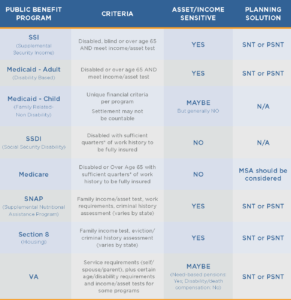
If you are confused by the myriad of government benefit programs that many clients receive as a result of being a personal injury victim, don’t worry as you are not alone.  Most times personal injury victims are not sure either about the benefits they receive and can confuse the different programs.  This is not surprising as the acronyms for the programs are similar and governed by the same or similar government agencies.  For example, a disabled client might get Supplemental Security Income (SSI) or Social Security Disability Insurance (SSDI).  While similar in terms of who qualifies and both provided by the Social Security Administration, how you qualify for each are vastly different.  Another example is Medicare and Medicaid.  Both involve the same agency, Centers for Medicare & Medicaid Services; however, Medicare is an entitlement that is administered entirely federally while Medicaid is income/asset sensitive and is administered mostly at the state level.  All of these benefits have unique issues and different planning solutions must be employed.

The goal of this post is to clarify the information and make it easy to understand.

The following chart is a good starting point to understanding public benefits:

To understand the table, you should know a few acronyms.

  • While the SS in SSDI and SSI stand for different things, you can use these first two letters as an easy way to remember that both are offered by the Social Security Administration.
  • VA stands for Veterans Administration.
  • SNT and PSNT stand for Special Needs Trust and Pooled Special Needs Trust, respectively.
  • MSA stands for Medicare Set-Aside.
  • There is no such thing as a Medicaid Set-Aside and there are many differences between how SNTs and MSAs operate.

Many times there is confusion about the proper planning solutions a client might need but by the time you are done reading this post, it should be much clearer.

Understanding Public Assistance Programs

There are two primary public benefit programs that are available to those who are injured and disabled.  The first is the Medicaid program and the intertwined Supplemental Security Income benefit (“SSI”).  The second is the Medicare program and the related Social Security Disability Income/Retirement benefit (“SSDI”).  Both programs can be adversely impacted by an injury victim’s receipt of a personal injury recovery.  Understanding the basics of these programs and their differences is imperative to protecting the client’s eligibility for these benefits.

Medicaid and Supplemental Security Income (hereinafter SSI) are income and asset sensitive public benefits that require special planning to preserve.  In many states, one dollar of SSI benefits automatically provides Medicaid coverage.  This is very important, as it is imperative in most situations to preserve some level of SSI benefits if Medicaid coverage is needed in the future.  SSI is a cash assistance program administered by the Social Security Administration.  It provides financial assistance to needy, aged, blind, or disabled individuals.  To receive SSI, the individual must be aged (sixty-five or older), blind or disabled, and be a U.S. citizen.  The recipient must also meet the financial eligibility requirements. Medicaid provides basic health care coverage for those who cannot afford it.  It is a state and federally funded program run differently in each state.  Eligibility requirements and services available vary by state.  Medicaid can be used to supplement Medicare coverage if the client is eligible for both programs (“dual eligible”).  For example, Medicaid can pay for prescription drugs as well as Medicare co-payments or deductibles.  Because Medicaid and SSI are income and asset sensitive, creation of a special needs trust and/or ABLE account may be necessary, which is discussed in greater detail below.

Some other benefits that are needs-based are Food Stamps, Supplemental Nutritional Assistance Program (SNAP), Section 8 (housing) and some Veterans Administration benefits (non-service connected).  Since these benefits are not necessarily protected by the use of traditional planning tools like an SNT, these are more complex to protect.  In many instances, it makes more sense to lose these benefits and allow an SNT to pay for these needs or use an ABLE account to pay for those types of expenses.  What complicates the payment of some of these types of benefits is the SSI restriction on paying for food & shelter.  That is where an ABLE account can come in handy since it is exempt from such rules (but there are limitations on who can create an ABLE account).   There are also some other financial-based planning techniques to try and preserve these benefits, but it does vary by program so consulting with an expert is imperative to help with the planning.

Medicare and Social Security Disability Income (hereinafter SSDI) benefits are an entitlement and are not income or asset sensitive.  Clients who meet Social Security’s definition of disability and have paid in enough quarters into the system can receive disability benefits without regard to their financial situation.  The SSDI benefit program is funded by the workforce’s contribution into FICA (social security) or self-employment taxes.  Workers earn credits based on their work history and a worker must have enough credits to get SSDI benefits should they become disabled.  Medicare is a federal health insurance program.  Medicare entitlement commences at age 65 or two years after becoming disabled under Social Security’s definition of disability.  Medicare coverage is available again without regard to the injury victim’s financial situation.  Accordingly, a special needs trust is not necessary to protect eligibility for these benefits.  However, the MSP may necessitate the use of a Medicare Set Aside discussed in greater detail below.

Planning Tools for Public Benefit Recipients

Medicaid/SSI

For those that receive needs-based public benefits such as SSI/Medicaid, there are planning devices that can be utilized to preserve eligibility for disabled injury victims. A special needs trust can be created to hold the recovery and preserve public benefit eligibility since assets held within a special needs trust are not a countable resource for purposes of Medicaid or SSI eligibility.  The creation of a special needs trusts is authorized by Federal law. Trusts commonly referred to as (d)(4)(a) special needs trusts, named after the Federal code section which authorizes their creation, are for those under the age of 65. Another type of trust is authorized under by Federal law with no age restriction and it is called a pooled trust, commonly referred to as a (d)(4)(c) trust.

The 1396p provisions in the United States Code governs the creation and requirements for such trusts.  First and foremost, a client must be disabled in order to create an SNT.  There are two primary types of trusts that may be created to hold a personal injury recovery each with its own requirements and restrictions.  First is the (d)(4)(A) special needs trust which can be established only for those who are disabled and are under age 65.  This trust is established with the personal injury victim’s recovery and is established for the victim’s own benefit.  It can be established by the injury victim themselves, a parent, grandparent, guardian or court order.  Second is a (d)(4)(C) trust typically called a pooled trust that may be established with the disabled victim’s funds without regard to age.  A pooled trust can be established by the injury victim and others just like a (d)(4)(A).  Both trusts operate identically and provide for the special needs of a client.  The primary restrictions on use of the money are that it must be for the sole benefit of the trust beneficiary, the trust cannot provide cash and it cannot be used for food or shelter (for those that receive SSI).  Other than that, it can provide for nearly anything that improves the trust beneficiary’s quality of life.

Oftentimes, an ABLE account can be used in conjunction with an SNT or instead of an SNT.  An ABLE account is a tax-advantaged savings account for disabled individuals.  An ABLE account can pay for any “qualified disability expense” which is quite broad and does not impose restrictions on food/shelter payments.   An ABLE account can only be established by someone who is disabled and whose onset of disability occurred prior to turning 26 years of age.  An ABLE account can only be funded up to a maximum amount of $15,000 annually and only the first $100,000 in funding is exempt from the SSI asset/resource test.  ABLE accounts remain a limited option and only makes sense in certain circumstances.

Medicare/SSDI

A client who is a current Medicare beneficiary or reasonably expected to become one within 30 months should concern every trial lawyer because of the implications of the Medicare Secondary Payer Act (“MSP”).  Since under the MSP Medicare is not supposed to pay for future medical expenses covered by a liability or Workers’ Compensation settlement, judgment or award, CMS recommends that injury victims set aside a sufficient amount to cover future medical expenses that are Medicare covered.  CMS’ recommended way to protect an injury victim’s future Medicare benefit eligibility is establishment of a Medicare Set-Aside (“MSA”) to pay for injury-related care until exhaustion.

In certain cases, a Medicare Set-Aside may be advisable in order to preserve future eligibility for Medicare coverage. A Medicare Set-Aside allows an injury victim to preserve Medicare benefits by setting aside a portion of the settlement money in a segregated account to pay for future Medicare covered healthcare. The funds in the set-aside can only be used for Medicare covered expenses for the client’s injury-related care. Once the set-aside account is exhausted, the client gets full Medicare coverage without Medicare ever looking to their remaining settlement dollars to provide for any Medicare covered health care. In certain circumstances, Medicare approves the amount to be set aside in writing and agrees to be responsible for all future expenses once the set-aside funds are depleted.

The problem is that MSAs are not required by a federal statute even in Workers’ Compensation cases where they are commonplace.  There are no regulations, at this time, related to MSAs either.  Instead, CMS has intricate “guidelines” and “FAQs” on their website for nearly every aspect of set-asides from submission to administration.  There are only limited guidelines for liability settlements involving Medicare beneficiaries.  While there is no legal requirement that an MSA be created, the failure to do so may result in Medicare refusing to pay for future medical expenses related to the injury until the entire settlement is exhausted.  There has been a slow progression towards a CMS “policy” of creating set-asides in liability settlements over the last seven years as a result of the Medicare Medicaid SCHIP Extension Act’s passage.  All of the uncertainty surrounding set-asides creates a difficult situation for Medicare beneficiary-injury victims and contingent liability for legal practitioners as well as other parties involved in litigation involving Medicare beneficiaries.  There do appear to be regulations on the horizon for set-asides based upon Medicare’s renewed focus on it for 2019.  For the time being, a set-aside analysis should be considered for settlements or judgments involving current Medicare beneficiaries.

Dual Eligibility – Medicare & Medicaid

Clients who receive both Medicaid and Medicare require extra planning to preserve all government benefits.  If it is determined that a Medicare Set-Aside is appropriate, it raises some issues with continued Medicaid eligibility.  A Medicare Set-Aside account is considered an available resource for purposes of needs-based benefits such as SSI/Medicaid.  If the Medicare Set-Aside account is not set up inside a Special Need Trust, the client will lose Medicaid/SSI eligibility.  Therefore, in order for someone with dual eligibility to maintain their Medicaid/SSI benefits the MSA must be put inside a Special Needs Trust.  In this instance, you would have a hybrid trust which addresses both Medicaid and Medicare.  It is a complicated planning tool but one that is essential when you have a client with dual eligibility.

Conclusion – Protect Your Client, Protect Your Firm

Disabled clients need counseling at settlement given the likelihood they will be receiving some type of government benefits.  To prevent being exposed to a malpractice cause of action, the personal injury practitioner should understand the types of public benefits that a disabled client may be eligible for and techniques that are available to preserve those benefits.  Having this knowledge will help the lawyer identify disabled clients they may want to refer for further consultation with other experts.

When a settlement involves the protection of public benefits or settlement assets, outside counsel is typically retained to assist with the trust devices commonly used to protect the client.  Lawyers who are well-versed in “settlement law” or “settlement planning” can be found and relied upon to assist with these difficult and complicated issues.  The legal fees for creation of the trusts to protect the settlement monies or public benefit eligibility are normally paid for out of the injury victim’s recovery.

Companies such as Synergy deal with these issues on a daily basis.  Having a consultant familiar with the planning issues and who has access to the right solutions is imperative.  This is where Synergy’s settlement consulting/planning team really shines and can be an invaluable member of your settlement team.  Having the knowledge of the public benefit programs along with issues such as Affordable Care Act coverage and options is a non-negotiable these days given the complex settlement landscape.

To learn more watch representing clients with government benefits watch our educational video below.

Handling Medical Liens in a Post-Montanile World, Tackle Head On

Teresa S. Kenyon

A fleeting memory of Montanile may have plaintiff attorneys encouraging injured parties to quickly spend their settlement funds thereby avoiding the lien asserted by their health plan. This would be a false narrative that could prove to be costly. No doubt about it, ERISA self-funded plan rights are often unyielding. But overall, they still need to be addressed head-on and brought to definite resolution. Fortunately for the injured party, if the health plan fails to take appropriate action then the Plan’s rights are not as ironclad as it may have thought. If all of the pieces of the puzzle are all there, Montanile can be a positive and the injured party can retain more of their settlement funds. Unfortunately, when some of those pieces of the puzzle are missing, handling and ultimately paying the lien is still required.

As you may recall, in Montanile v. Board of Trustees of the National Elevator Industry Health Benefit Plan, 136 S Ct 651 (2016), the Court found that if a plaintiff fully exhausts the settlement funds so that they are no longer in the possession and control of the plaintiff, then an ERISA plan could not make a claim against the plaintiff since the subject of their claim, the settlement fund, is fully dissipated. However, there are limitations and exceptions to this. To mirror the facts in Montanile that brought the success, two key pieces must be in the puzzle. First, the plaintiff attorney must be cooperative with the Plan and show a good faith effort to resolve the lien claim. Second, if the Plan is unresponsive in return, then the funds can arguably be spent on nontraceable items. Miss these two pieces and you’ll likely have a negative result.

There is no doubt that Montanile was a win for injured parties especially following the other ERISA related US Supreme Court decisions of McCutchen, Seraboff, and Knudson that have ultimately served to provide strength to self-funded plans seeking reimbursement against an injured party’s settlement funds. Understandably, it may be tempting in a post-Montanile world for plaintiff attorneys to just ignore the lien, take their fee and disburse the remaining funds to their client – doing so in the name of Montanile. However, that is not usually a recommended course of action. The best way to handle an asserted ERISA lien is to resolve the asserted ERISA lien; reach an agreement with the lien holder thereby fully and completely bringing the matter to a close. This avoids any potential ethical issues for attorneys in states that follow ABA Ethical Rule 1.15 which provides:

(e) When in the course of representation a lawyer is in possession of property in which two or more persons (one of whom may be the lawyer) claim interests, the property shall be kept separate by the lawyer until the dispute is resolved. The lawyer shall promptly distribute all portions of the property as to which the interests are not in dispute. ABA Rule 1.15.

and it ensures that the client is protected from any later action from the Plan including offset of future benefits or the time and expense of defending a reimbursement action brought by the Plan. Attorney due diligence is key. Avoiding the lien holder and hiding from the reimbursement demand is not suggested. In fact, it is not at all what Montanile or his attorney did.  A key piece in Montanile is that the plaintiff attorney demonstrated due diligence by informing the ERISA plan of the pursuit of a third-party claim, cooperating with the Plan by signing additional agreements (which isn’t recommended), and giving the Plan fourteen (14) days’ notice with an opportunity to object before disbursing the remaining settlement funds. These actions matter. Without these pieces of plaintiff counsel’s due diligence, the Court would have likely ruled differently.

Notifying the Plan is the first step to showing due diligence. As most plaintiff attorneys know, self-funded plans have expanded their policy language to encompass all defenses as case law evolves. The plan language has been repeatedly modified to ensure the Plan is in a robust posture for reimbursement. Most policy provisions state that a plan participant must notify the Plan that they are pursuing a third-party liability claim. If the Plan does not respond, then that piece of Montanile puzzle is present. On the other hand, if the Plan is never informed, then the plan participant cannot later argue that the Plan did not respond timely and that piece is forever missing.

Most ERISA Plan Administrators and their recovery vendors have responded to the Montanile case by clearly objecting to disbursement of settlement funds during negotiations. Plan Administrators now make faster decisions when negotiating lien claims. As negotiations stall, they are prepared to file legal action, provide the necessary testimony, and actively litigate their claim. Plans are being more proactive rather than waiting around for a windfall. The industry has a very different landscape from a decade ago, whereby Plans did not necessarily expect to see subrogation dollars. Now, the Plan’s outstanding subrogation interests are often represented as a line item on their accounts receivable. Thus, the more aggressive nature of pursuing their claims including asserting a claim directly against the tortfeasor and filing civil actions for reimbursement against injured parties. Plaintiff counsel’s mild cooperation with the Plan from the onset is likely to pacify most Plan Administrators and keep their assertive action and interference at bay.

Note that the Montanile Court made it clear that had the Plan taken more aggressive action, and sooner, that their recovery rights may have been preserved. The crux of the Montanile case is that when negotiations stalled, it was Montanile’s attorney who continued to be active by voicing his intent to distribute the settlement funds to Montanile unless the plan objected within 14 days. The Plan was radio silent. For six months. Ultimately, because of their inactivity, the funds had been dissipated by Montanile by the time the Plan brought its subrogation enforcement claim in the form of a reimbursement action. Although Montanile is a win for injured parties, an important puzzle piece is that plaintiff counsel must show due diligence to ensure that proper steps are taken. If the Plan fails to act, then piece one of Montanile can be relied on for plaintiff’s benefit.

Funds spent on non-traceable items

The second piece of the puzzle is examined more fully in another reimbursement action pursued by The Board of Trustees of the National Elevator Industry Health Benefit Plan. The Plan ensured that they did not fail to act timely this time and immediately took steps to ensure the reimbursement of the Plan when there was a third-party liability settlement. In Board of Trustees of National Elevator v. Goodspeed, 2019 WL 1934475 (E.D. Pa. May 1, 2019), the focus was on what the funds were dissipated on – whether they were traceable or not. Here, unfortunately for the Goodspeeds’ the Court found that their attempt to dissipate funds under a Montanile theory failed and that there was still an identifiable fund of which the Plan’s equitable lien could attach. The pertinent language from Montanile is:

“We hold that, when a participant dissipates the whole settlement on nontraceable items, the fiduciary cannot bring a suit to attach the participant’s general assets under §502(a)(3) because the suit is not one for ‘appropriate equitable relief’.” Justice Thomas in Montanile

In Goodspeed, the injured tort victim netted $304,463.22 after deducting attorney fees and costs. The Plan had notified the Goodspeeds’ attorney that they held a lien on the settlement proceeds prior to the case settling. Nonetheless, the attorney disbursed all $300,000plus to the Goodspeeds’ and did not reimburse the Plan’s asserted equitable lien of $82,088.36. The Goodspeeds’ deposited the check in their joint savings account in October 2017. Between October 2017 and May 2018, the couple spent or withdrew more than $304,463 from the account. Specifically, and traceably, they transferred $200,000 to a certificate of deposit with right of survivorship and purchased a van for $62,000. Presumably, the Goodspeeds’ believed that these actions would defeat the Plan’s reimbursement right because the funds were not only comingled with other general assets but also because the funds were dissipated. Regrettably, this belief was incorrect. The Court specifically found that there is an identifiable fund and allocation of the fund was now ready to be discussed.

The second key piece to Montanile is that the dissipation of funds must be attributed to nontraceable items.  It is not enough to fall into the Montanile bucket by just dissipating the funds. The use of the funds must be nontraceable which would include food, travel, remodeling a house, paying off bills, or other disposable items. Traceable items include identifiable things like vehicles and certificates of deposit as specifically outlined in Goodspeed.

Since Montanile, and as expected, other case decisions have been guided by it and attempted to fill in any gaps or otherwise expand its meaning. In Cognetta v Bonavita, 2018 WL 2744708 (E.D. N.Y) the Plan filed a declaratory action to establish a constructive trust for the benefit of the Plan before the settlement funds were even in existence. The Court allowed it. Other Plans could follow this course of action.  Plans are also intervening in the underlying case as a means of protecting their equitable lien and avoiding a Montanile defense. But this is a jungle that most plaintiff personal injury attorneys will not want to enter just to avoid paying an equitable lien claim. Unfortunately, another option for a scorned Plan Administrator is to offset future benefits if the injured party is still an active participant with the Plan. And finally, another risk is that the Plan names the tortfeasor in a subrogation action. Then the terms of the release obtained by the tortfeasor would be triggered whereby the tortfeasor would point to the indemnity clause placing the issue right back in the plaintiff attorney’s lap. Arguably, the Montanile dissipation argument would not be viable in that situation.

Conclusion

In the end, it comes with great risk to bury your head in the sand of Montanile and hope that the equitable lien just goes away. The better course of action is to tackle it head-on, thereby closing the case knowing that the lien issue is resolved completely and not still lingering. Synergy Settlement Services is your ERISA lien experts. We will tirelessly work to reduce the lien claim, bring the matter to a close and eliminate any risk and additional expense for you or your client. To watch our ERISA, Medicare advantage and Medicare refunds training course, visit our video learning center.

To learn more about handling medical liens in a post-montanile world watch our educational video below.

Settlement Language Can Make or Break a Workers Compensation Case

B Josh Pettingill

Appropriate settlement language can make a significant impact on the total amount of the workers’ compensation settlement, as well as dollars that the injured worker receives. This brief article will provide plaintiff/applicant attorneys with the requisite settlement language to maximize the workers’ compensation recovery, as well as protect their respective firms and clients.

Since the insurance carrier is cutting the check to resolve the workers’ compensation case, they may potentially have leverage to dictate the terms of the settlement. Some plaintiff/applicants’ attorneys may – agree to or overlook certain critical provisions of the settlement to expedite the resolution. Below are the key areas to focus on when drawing up a mediation, or settlement agreement to ensure a timely resolution, as well as maximize the recovery.

Medicare Set-Aside

Make sure to include an all-inclusive figure that encompasses Medicare-covered items, non-Medicare-covered items, and indemnity. Oftentimes, there are ways to get the MSA amount lowered due to the errors by the carrier’s MSA expert or through funding with a structured settlement. Any savings on the MSA can go directly in the injured workers’ pockets. Do not ever agree to terms that suggest some fixed amount PLUS the MSA. If that were to happen, then any savings on the MSA would go the carrier and not the claimant/applicant.

Structured Settlement

There must be language that allows the injured worker the option to place a portion of the settlement proceeds into a structured settlement. If not, some carriers may refuse to fund a structured settlement at a later time. This also allows for time for a qualified settlement consultant to meet with the injured worker to develop a proper settlement plan. Furthermore, you should include verbiage that states any structured settlement shall be brokered or co-brokered by Synergy Settlement Services, or XYZ Plaintiff Structured Settlement Company.

Funding the Agreement

Language should also be included about paying the settlement monies in a timely manner and funding any structured settlements expeditiously. These could be provisions for extra attorney fees, as well as penalties and interest for failure to do so. For example, this could be based either on a certain number of days after CMS approval or approval by the judge of compensation claims.

Continuation of Benefits

Attorneys for the injured worker should include language that medical and indemnity benefits will stay intact for a set time period or until the settlement checks have been issued. That way, the injured worker does not lose out on any benefits and there is no gap in coverage. This can be life-threatening to catastrophically injured workers if they are not able to receive ongoing medical care.

Conclusion

These are just a few of many issues that should be addressed in the settlement/mediation agreement. Other topics include reversionary clauses, CMS approval of the Medicare Set-Aside and what happens if CMS comes back with a larger suggested MSA amount than what was submitted. Settlement language can either make or break a settlement.  You need to have a qualified settlement consultant to assist with these complex issues. Synergy attends mediations at no cost to you or your client and offer a number of services to attorneys for workers’ compensation claims, liability claims, medical malpractice and more. Ask us today how we can help protect your law firm firm/your client, maximize the recovery of a workers’ compensation case and make your firm more efficient.

To learn more about Synergy’s Workers’ Compensation Medicare Set-Asides, visit our website.

Reversionary Clauses and the Impact on Injured Worker

B. Josh Pettingill

Reversionary clauses have become a common term of settlement in workers’ compensation cases involving a Medicare Set Aside (MSA). It is important for workers’ compensation attorneys to understand how these clauses can impact the injured worker, as well as the settlement.

What is a reversionary clause?

A reversionary clause means that when the injured worker passes away, any funds remaining in the WCMSA account would “revert” back to the carrier. The carrier essentially receives a rebate, or a refund on any unspent medical funds. The argument by the carrier for a reversionary clause is that they should only pay for medicals if the claimant is alive. Therefore, if the claimant passes away before the funds are exhausted, there is a “windfall” of money to the claimant’s beneficiaries or family.

Most plaintiff/applicant attorneys are not apt to agree to such a clause since it is money that the injured worker does not get to keep. There are multiple variations of a reversionary clause where it could be based either on a lump sum amount on the remaining funds in the account, the number of guaranteed annuity payments remaining on any structured settlement used to fund the MSA obligation, or a combination of both[1].

You must be careful when agreeing to use their professional MSA administration company for the MSA account.  One trick that carriers use is to offer to pay for lifetime professional administration “for the benefit” of the claimant. They do this for multiple reasons. They may have financial relationships with certain providers that incentivize them monetarily to push business towards a certain company. This also gives assurance that they will get paid back if there is a reversionary clause in place. The MSA administrator becomes a cash collector for them upon the injured worker’s passing. If professional administration is not in place, then it is exceedingly difficult to collect from a claimant’s estate even if this is a material term of the settlement.

Plaintiffs’ attorneys must be proactive to exclude or modify reversionary clauses

A reversionary clause should never be agreed to as a provision of a workers’ compensation settlement. Furthermore, if a settlement is reached, then the injured worker should be given the choice to select the company to professionally administer the WCMSA at the carrier’s expense.

There are rare occasions when a reversionary clause may be useful to reaching an agreement if there is a catastrophically injured person with a large WCMSA and reduced life expectancy. We have seen firsthand where a reversionary clause has helped bring the settling parties together because it allows the carrier to pay more dollars to get the case resolved in exchange for having some protection in the event the injured worker passed away prematurely. If the carrier insists on a reversionary clause, then you can always negotiate that only a certain percentage of any remaining funds or a certain number of annuity payments will revert to the carrier.

About Synergy’s Workers’ Compensation Settlement Experts

Synergy’s Workers’ Compensation Settlement Services team is headed up by Jason Lazarus who is a former workers’ compensation attorney and Josh Pettingill who frequently testifies as an economist on workers’ compensation matters. Both Jason and Josh are Medicare Set Aside Consultants Certified by the International Healthcare Commission, have served as MSP compliance expert witnesses and have authored numerous articles on Medicare Set Asides. Collectively, they have handled over 10,000 workers’ compensation cases and have taught over 500 hours of CLE education on settlement planning, Medicare Set Asides, public benefits protection and other complex issues impacting the value of workers’ compensation matters.

[1] High dollar WCMSAs are typically funded by way of a structured settlement that is only payable for as long as claimant is alive or for the claimant’s life expectancy. MSAs can typically be funded at a present value cost of 40%-60% less than the cost to fund the lump sum MSA amount.


Evidence Based MSAs (EBMSAs): Don’t Accept Blindly

B Josh Pettingill

Evidence Based MSAs (EBMSAs) have taken the workers’ compensation industry by storm the past several years. It is imperative for workers’ compensation attorneys to understand how EBMSAs can impact both the settlement value, as well as your clients’ benefits post-resolution. EBMSAs can be a cost savings mechanism in resolving a workers’ compensation claim. However, using an EBMSA to resolve a claim is not without risks.

EMBSAs are prepared based upon clinical guidelines and trends in medical research to project future Medicare covered expenses. This is a logical approach one would think. However, The Centers for Medicare and Medicaid Services (CMS) takes a different position as it relates to their approved methodology for preparing an MSA with a future cost projection.

Three Key Components of Evidence Based MSAs

There are numerous MSA practitioners and companies who offer EBMSAs for workers’ compensation cases. There are three key components to an EBMSA that should be noted:

  1. The EBMSA utilizes a pricing strategy that does match up to the CMS approved pricing guidelines when pricing a WCMSA[1].
  2. The EBMSA mandates professional administration for the claimant for a specified term[2].
  3. The EBMSA assumes the settlement parties will not seek CMS approval of the WCMSA.

Real World Pricing Strategy

There are two components of a Medicare set aside: prescription drugs and medical items/services[3]. The largest part of an MSA is usually prescription drugs. On average, prescription drugs make up 65% of the total MSA amount from a dollar standpoint. EBMSAs tend to be priced the CMS approved way as it relates to medical items and services. However, as it relates to prescription drugs, there is massive dichotomy in the approach for pricing. Specifically, CMS requires that any recommended drugs be allocated for the life of the claimant/applicant[4]. Whereas, EBMSA uses period certain durations (shorter timeframes) based on supporting medical evidence.

The Pros & Cons of an EBMSA

The cost of prescription drugs and their inclusion in an MSA can be one of the primary barriers to settlement of a workers’ compensation case. Since EBMSAs do not use full life expectancy to calculate future prescription drug costs, there can be a massive cost differential when compared with a non-evidence based MSA. One could argue that Medicare is being purposely being defrauded by a substantial amount by not using the appropriate pricing strategy for medications. However, an argument could also be made that pricing the MSA this way is more consistent with the “real world” approach; more importantly, the medical evidence supports this approach. It is not realistic to price medications for the lifetime of an injured worker. In fact, extended use of certain medications can contribute to a reduced life expectancy.

EBMSAs frequently have mandatory professional administration as a requirement to use them.  The argument for the EBMSA is that the MSA funds will always be spent appropriately with a professional administrator. But the caveat is that the claimant/applicant must agree to use that company’s professional administration service. Unfortunately, that particular company may not always be the best solution for the injured party’s needs.

EBMSAs are not submitted to CMS which clearly is a pro but it has risks associated with non-submission. CMS approval of a WCMSA is always voluntary but recommended in order to have final closure. In other words, CMS approval provides the guarantee that CMS cannot come back years down the road and argue not enough money was originally set aside to consider their future interests.  CMS approval is still the only way to have definitive peace of mind that your client is protected. One could even argue that there are malpractice risks for the claimant’s attorney if they rely solely on the carrier’s expert in determining the MSA amount using the evidence based method, while at the same time not getting CMS approval as part of the settlement process.

There are certainly benefits to an EBMSA such as reduced exposure to the employer/carrier which frees up other dollars to be used to resolve the claim. These companies claim that if CMS ever disagrees with the amount or denies something post-settlement that the claimant/applicant, as well their attorney, will be indemnified and held harmless. Also, the MSA company will either pay back Medicare if this were to happen or fight the claim that not enough funds were earmarked for the Medicare set aside.

Conclusion

As an attorney for injured workers, if you are presented with an EBMSA by the employer/carrier, you must consider the implications. We recommend obtaining an independent MSA analysis or medical cost projection to ensure that the EBMSA is an accurate reflection of the future medical costs. CMS has stated that the MSA is a claimant issue, not a carrier issue. If one chooses to accept the EBMSA, keep in mind that you are also relinquishing your ability to control the MSA process. As such, you are at the mercy of the employer/carrier’s expert for determining your client’s future needs.

An EBMSA is only one way to resolve a workers’ compensation claim. Synergy can help the injured worker and their attorney to not only save money but also maximize the recovery of the case. The last thing you want to happen is for CMS to return years later and disagree with the EBMSA amount because there was no CMS approval. Your client could find themselves in a situation whereby Medicare is denying coverage for accident related care. Such a situation could result in a legal malpractice case. Having a trusted partner to help take control of the MSA process, as well as guide you through the complex settlement issues, is imperative. To learn more about Synergy’s services for workers’ compensation settlements, visit our website by clicking HERE

[1] According to the WCMSA Reference Guide

[2] The duration depends on the product

[3] Durable equipment, medical services, items, etc.

[4] According to the WCMSA Reference Guide, “Reviewers (CMS) use the evidence in the records to determine if the proposal accounts for the reasonably probable future prescription drug needs. This includes the prescription drug history, the treatment notes, provider medication lists, and physician dispensing records.”

Liability Medicare Set-Aside (MSA) Case Studies: Eliminate, Reduce & Comply

B. Josh Pettingill

There is mounting evidence that the Centers for Medicare and Medicaid Services (CMS) will establish formal guidelines for liability MSAs in the imminent future.  Medicare Secondary Payor compliance related to future medical care is an issue that can’t be ignored but that doesn’t necessarily mean setting up a Medicare Set-Aside on every case involving a Medicare beneficiary.  The following post will highlight several real-world case studies in order to educate plaintiff attorneys on how to eliminate or reduce any Medicare Set-Aside issues for liability claims.

Key Takeaways

  • Medicare Secondary Payor Compliance is serious business and shouldn’t be ignored as evidenced by recent DOJ actions against personal injury law firms.
  • There is no black and white solution as it relates to MSP compliance and futures.
  • Plaintiff attorneys must control the MSA process if they want to avoid unwanted delays.
  • A treating physicians’ attestation indicating the care is completed is the only CMS approved way to avoid an MSA.
  • Plaintiff attorneys must be vigilant about the release language for their client’s protection of Medicare benefits.

Introduction

Most defendants have started to mandate, as part of the release language, that the plaintiff choose one of two below options for addressing Medicare’s future interests, without exception in return for payment of the settlement monies:

  1. Plaintiff agrees to get a letter from the treating doctor that, as of the date of settlement, all accident-related medical care has been provided/completed[1]. This is a viable solution to avoid any possible future denial of injury related Medicare covered services.
  2. Plaintiff agrees to do a Medicare Set-Aside and agrees not to bill Medicare for any future care related to the subject accident until the set-aside is exhausted.

To illustrate this point, below is an actual email (redacted) from a defense attorney to the plaintiff attorney that highlights such a tactic by the insurance carriers. This case involved a $15,000 global settlement on an auto accident. This email is a perfect example of what is becoming the norm for Medicare-eligible plaintiffs.

Dear Plaintiff’s Attorney,

I apologize for the delay in getting back to you.  I have conferred with my client on this issue, and due to your client’s Medicare eligibility, my client is obligated under the laws previously mentioned to protect Medicare, which includes the treating physician certification requirement or doing a Medicare set aside.  This is a legal obligation and therefore I am not authorized to remove these terms from the Release.  The treating certification can simply be in the form of a letter that tracks the language in the CMS Memo.

Thank you,

Defense Attorney

Application

One could argue that most liability cases that settle for $15,000 or less do not fund future medicals when all damages are considered; therefore, there is no need to consider a liability set-aside for any case that resolves under $15,000. In the case example involving the email from defense counsel, the client had reached maximum medical improvement (MMI) and had completed all the accident-related care. The settlement was delayed for months before the attorney contacted Synergy for assistance because the attorney did not want to jeopardize his client’s Medicare benefits. Ultimately, Synergy was able to provide template language to the attorney for the treating doctor to specify that the care was completed at the time of the settlement. If the circumstances had been different and this plaintiff had required future care in this example, then the parties could have done an analysis of the future medical expenses compared to the net recovery to calculate the MSA amount. An MSA does not always involve getting a full report done with a comprehensive medical review; it simply means setting aside monies based on all the facts of the case.  To avoid these types of delays post-settlement, one idea for attorneys to consider is to have consensus by the settlement parties on release language (including any/all Medicare language) prior to going to mediation. That way, there are no unwanted delays in receiving the settlement funds once the case had been resolved.

No Medicare Set-Aside

There are situations when a no-treatment attestation letter by a treating physician is not applicable whereby future medicals are not funded. This is a prime example: Synergy was retained on a policy limits case that resolved for a total of $500,000 whereby a husband and wife were hit by a drunk driver after leaving a restaurant. As a result of the accident, both became paraplegics. The past liens were greater than $1 million and the future damages exceeded $25 million. Even though the release language stated that it was a release for past, present and future damages, there were simply no monies leftover to fund any future medicals. In this scenario, Synergy was able to put together a “No MSA” letter for the plaintiff, indicating the same and that Medicare’s future interests were adequately considered. The file was documented to indicate why nothing was set-aside. The release language also memorialized that there were no settlement funds paid out for future medicals.

Conclusion

There is no black and white approach to addressing MSP compliance on liability settlements. Synergy has created a litmus test for attorneys to screen cases and to determine whether an MSA is an appropriate solution. To download that document, click here. Plaintiff’s counsel should insist on controlling the MSA process from start to finish as they are the ones who have legal malpractice risks and personal liability if, in fact, they fail to properly advise their client regarding the Set-Aside issue. Synergy frequently can justify why there is no need for an MSA or greatly reduce the MSA obligation. These savings are real dollars that go directly to the injury victim instead of Medicare.

Synergy provides no cost consultations to attorneys; please contact us if you have any questions that we can help you with at (877) 242-0022 or schedule a consultation here.

[1] On September 29, 2011, CMS issued a memorandum indicating there is no need for a liability Medicare Set-Aside and that its interests would be satisfied if the treating physician certified in writing that treatment for the alleged injury related to the liability insurance had been completed as of the date of settlement

To learn more about Liability Medicare Set-Asides MSAs Case Studies watch our educational video below.