Reforming Attorney Discipline

Testifying before the Maryland Court of Appeals, Judge Alan Wilner and Irwin Kramer debate the merits of proposals to reform the attorney disciplinary process.
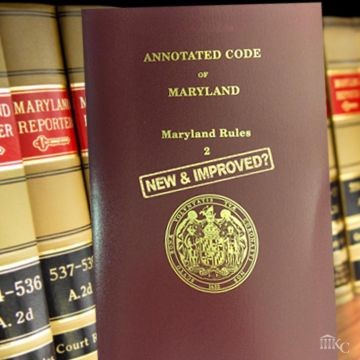
Issue: Should the Court reform the disciplinary process to enhance its fairness to the attorneys charged and to more proactively address the plight of lawyers in crisis?

Testimony: As Chairman of the Maryland Rules Committee, Judge Wilner presented recommendations which would revise certain procedural rules in more modest ways. An architect of the current system, this jurist argued that the system is not “broken,” and — citing statistics which show that most complaints are resolved without sanction — is exceedingly fair to attorneys accused of professional misconduct. By contrast, Irwin Kramer argued that the Court can do much more to provide a more level playing field and to better address the concerns of a profession with a higher incidence of addiction, mental illness and suicide than society at large.

Rejecting his proposals for more organized alternatives to discipline in appropriate cases, Judge Wilner defended the status quo. Observing that “the current rules have been in effect for 20 years,” Judge Wilner believed that “it says something that given the caseload, given all the attorneys that have been before Bar Counsel and this Court, only one lawyer, Mr. Kramer … filed a complaint about it.” Finding Mr. Kramer’s four-pronged proposal to be unnecessary and misguided, the jurist took particular issue with recommendations for remedial education and for a “community service” component that might address the needs of the underrepresented as part of the lawyer’s rehabilitation plan: “We don’t need a rule on community service any more than a rule on anger management or marriage counseling.”

With minor changes, the Court adopted Judge Wilner’s recommendations, which largely preserves the 20-year old system and leaves Bar Counsel in charge of the rehabilitation of those she prosecutes.

Meeting Date: June 14, 2021

Buying Out of a Grievance

Q. My client has threatened me with a lawsuit and an ethics complaint unless I refund her legal fees. Should I pay her to release these claims?

A. Although a refund may reduce the chances of a lawsuit or grievance, you must be very careful about negotiating a “settlement” with your disgruntled client.

Under Rule 1.8(h), you may not settle a potential malpractice claim unless this client is advised in writing to seek independent counsel and is given a reasonable opportunity to do so. Even then, you probably can’t do anything to deter the client from filing a grievance against you.

Few states have adopted rules which explicitly preclude the release of potential ethics complaints. But all states recognize the importance of maintaining the integrity of the profession through the reporting of unethical conduct. In attempting to eliminate such complaints, you will “engage in conduct that is prejudicial to the administration of justice” in violation of Rule 8.4(d). Not only is such an agreement unenforceable, it is universally regarded as unethical and may itself be a basis for sanctions.

Although you can enter into agreements which may absolve you of malpractice liability, you should never attempt to negotiate with your client directly. Without using a lawyer of your own, you expose yourself to future claims that you misled the client into an unwise settlement or acted improperly in the course of negotiations. Since the client has already threatened to sue you or to report you to the bar, the less direct contact you have with this person, the better.

Avoiding A Disruption To Practice

Bar Counsel wanted to suspend him. The Court wanted him to continue serving his community where “his pro bono legal service and his other volunteer efforts have been exceptional.”

Issue: What sanction should the Court impose upon an attorney who made mistakes in administering a small estate and failed to properly manage his attorney trust account?

Holding: While the Court ordinarily orders some form of suspension in cases like this, mitigating factors in this case warrant the lesser sanction of a reprimand where the lawyer did not act with a dishonest or selfish motive, expressed significant remorse for his errors, was fully cooperative, did not impede the investigation in any way, and had an exceptional history of contributions to the community through his pro bono legal service and other volunteer efforts.

Alleged Violations: Maryland Attorneys’ Rules of Professional Conduct 19-301.1, 19-301.3, 19-301.4(a)(2) and (3), 19-301.15(a) and (c), 19-308.4(a) and (d), and Maryland Rule 19-407(a)(3).

Argued: May 10, 2021

Decided: August 27, 2021

Read Opinion by Judge Biran

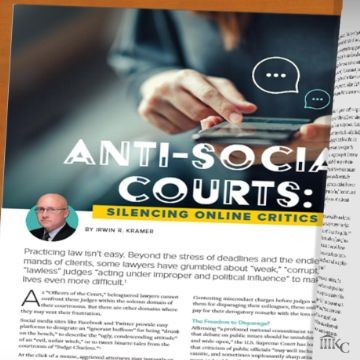
Anti-Social Courts

Q. I’ve had my fill of ignorant and arrogant judges who disgrace the ill-fitting robes they wear. As lawyers, isn’t it time we speak out and post about judicial incompetence so we may improve justice for all?

A. Unless you plan to retire, your efforts to reform the system through social media may not be a great career move.

Sites like Facebook and Twitter provide easy platforms to denigrate an “ignorant buffoon” for being “drunk on the bench,” to describe the “ugly, condescending attitude” of an “evil, unfair witch,” or to tweet bizarre tales from the courtroom of “Judge Clueless.”

At the click of a mouse, aggrieved attorneys may instantly expose the flaws of our judicial system and the shortcomings of those within it. It’s cathartic. Empowering. And free of charge.

But lawyers may face other types of charges for their impulsive posts.
Contesting misconduct charges before judges who may punish them for chastising their colleagues, attorneys may pay for their dissenting remarks with the loss of their careers. The exercise of First Amendment rights may be fraught with peril when judges move to silence their most knowledgeable online critics in disciplinary proceedings. In fact, the Rules of Professional Conduct themselves contain provisions that are arguably designed to chill the speech of those who dare to disparage the courts or who exhibit conduct “prejudicial to the administration of justice.”

To avoid an earlier retirement than planned, read this article before sharing your overdue diatribe… 

So you committed malpractice …

Q. I’m not inclined to make excuses. But things have been so hectic in my office that I let a nice accident case slip through the cracks and failed to file suit by the limitations deadline. My head is spinning. What should I do now?

A. When you make mistakes like this, you must rely on two policies: Your malpractice insurance … and honesty.

Get out your insurance policy and report the claim to your carrier right away. If you were smart enough to procure this coverage, this is what you’ve paid premiums for all these years. As important as the coverage itself may be, you now have an experienced malpractice claims professional on your side who can call upon the resources of attorneys with experience in this very situation.

Of course, honesty is the best policy. In this case, it will not prevent you from getting hit with a malpractice action. But full and honest disclosure to your client is the first step in putting this behind you and avoiding a claim for professional misconduct.

Once you have ascertained the salient facts, you must contact your client promptly to explain the situation, to take full responsibility for the error, and to advise the client of his or her need for independent counsel.

Whether you meet personally with the client, or speak over the telephone, you must confirm the substance of your conversation in writing. This will not only provide a helpful summary for your client, but it will also memorialize your honest and forthright disclosure of the circumstances surrounding the error. Given the sensitivity of this letter, you would be well advised to consult with counsel of your own before transmitting it to your client.

In all of your communications with the client, there are some important Do’s and Don’ts to follow:

DO:

1. Inform the client of your error and of the consequences resulting from your failure to file suit in a timely manner;

2. Advise your client to consult with independent counsel to determine whether to assert a legal malpractice claim against you;

3. Assure your client that you will cooperate fully in any investigation which may ensue.

DON’T:

1. Make excuses – don’t say anything to engender your client’s sympathy or dissuade the client from pursuing a claim;

2. Express an opinion on the outcome of a claim, or cast doubt on its viability;

3. Attempt to resolve the claim yourself – even if you seek a fair outcome, DIY negotiations may cause trouble that you cannot buy your way out of.


If you reported the error to your insurance carrier, you may also provide the name of the carrier and your adjuster’s contact information so that future communications may be directed there.

If you don’t have insurance, you should retain counsel of your own to handle future communications from the client or his counsel. Under no circumstances should you try to negotiate directly with the client.

Under the Rules of Professional Conduct, an attorney shall not settle a malpractice claim with an unrepresented client or former client unless that person is advised in writing of the desirability of seeking independent legal advice and is given a reasonable opportunity to do so. While you cannot force the client to retain other counsel, you should designate counsel of your own to field these delicate communications. If you try to negotiate a resolution yourself, you are open to claims that you misled the client or betrayed the client’s trust – claims that may place your license to practice law in jeopardy.


Right now, you have a potential malpractice claim on your hands. If you compound your mistake by failing to handle it with care, your isolated error may trigger misconduct charges that could cost you even more.

Suspending an “Extreme” Sanction

Finding Bar Counsel’s call for an indefinite suspension too “extreme,” the Court imposed a more modest moratorium on a lawyer with an unblemished record in close to 50 years of practice.

Issue: What sanction should the Court impose upon an attorney whose violations arose from his delegation of significant responsibilities in personal injury matters to an independent paralegal firm; his lack of supervision over that paralegal firm and his clients’ cases; his sharing of fees with that firm; and his failure to properly manage his attorney trust account?

Holding: Although the lawyer to maintain the proper records and reconciliations, failed to promptly remove earned attorney’s fees from his trust account, failed to properly supervise his paralegal staff, and split fees with a nonlawyer, the lack of dishonesty or self-interest in this case helped to persuade the Court to suspend him for six months and one day, on the condition that he engage a practice monitor for three months after reinstatement.

Alleged Violations: Maryland Attorneys’ Rules of Professional Conduct Rules (“MARPC”)1.4, 1.15, 5.3, 5.4, 5.5, and 8.4, along with Maryland Rules 19-407 and 19-408.

Argued: February 1, 2021

Decided: April 26, 2021

Read Opinion by Chief Judge Barbera

Online Review Rebuttals

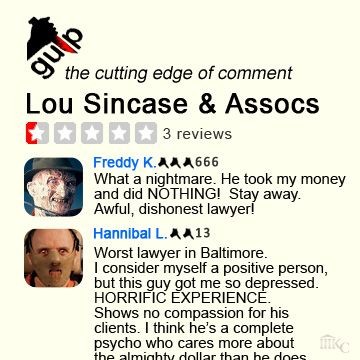
Q. My online reputation is everything to me. So how should I respond to a scathing review that called me an “awful” and “dishonest lawyer” who cares more about money than people?

A. Once you’re caught in the world wide web, it’s hard to get untangled.

Social media, and online review sites like Yelp and Avvo, help us reach more people than ever before. But they also give our critics a platform to question our competence and integrity.

Free speech can be costly. There’s no way to prevent a disgruntled client — or anyone — from posting negative, even scandalous reviews for all to see.

Some sites have a mechanism for flagging such reviews, especially if they’re posted by competitors seeking to sabotage your business or by those you never represented. Even then, it may be difficult to get them removed.

If that doesn’t work, you must decide whether to respond. If the attack comes amidst a plethora of positive reviews (or reduces your pristine 5-star rating to 4.5 stars), why would you dignify this aberration with a response that may elevate its prominence? With a quick internet search, you can usually determine whether the review has gained enough notoriety to do damage. If it hasn’t, don’t post a response that will.

If you think the post may hurt your business or require some form of response, reply with caution. When others attack your character, competence or professionalism, you should respond in a way that preserves all three: 

1. Watch Your Tone – it may be cathartic to slam your critics for posting false or unjustified reviews. But self-righteous rebuttals composed in anger will undermine your credibility with readers who haven’t made up their minds;

2. Don’t Sling Mud – stooping to the level of your antagonist isn’t professional. If you want to be seen as a professional who takes the high road and is not easily rattled, you must act accordingly;

3. Be Courteous – true professionals act cordially whether others deserve it or not. Leave the “nastygrams” to them. Your posts must be diplomatic in all respects;

4. Keep it Brief – the more you say, the more you legitimize the attack and the more “keywords” you give Google and other search engines to scan. So a point-by-point rebuttal unwittingly reinforces the original post and increases the chance that it will catch the eyes of prospective clients.

The Devil is in the details. If you share too much information about the client’s case, you will violate your duty to maintain client confidentiality. In most states, this duty goes well beyond privileged attorney-client communications and extends to any information you received in the course of your representation, even if it is publicly available. While you may use such information to respond to a bar complaint or to defend yourself in a malpractice action, the rules don’t let you do so to preserve your online reputation. In fact, the American Bar Association and numerous state bar ethics committees caution that a client’s “posting of criticism does not rise to the level of a controversy that would allow a lawyer to disclose confidential information in responding.” See ABA Formal Opinion 496.

Rather than breach this duty by posting a detailed rebuttal, play it safe with the following diplomatic response:

I wish you called me to discuss your concerns in person. Although I do not agree with your assessment, I cannot address the merits of your complaint on this site. As an attorney, the rules of ethics forbid me from disclosing the confidential and privileged information required to provide a fair and accurate response. I would be pleased to meet with you to discuss these issues, but I cannot compromise your privacy by doing so in a public forum. Please call me.

This shows your concern for the client’s welfare, your adherence to the rules of ethics and your professionalism. That, more than any detailed response, will speak volumes for the type of lawyer you really are.

Encryption Ethics

Q. After emailing several documents to opposing counsel, she slammed me for failing to encrypt the message and exposing records on her client’s medical history. Must I encrypt these emails?

A. There are no rules which expressly require an attorney to encrypt email messages. But you must still make reasonable efforts to protect the privacy of sensitive data and communications.

Where attorney-client communications are concerned, the Rules of Professional Conduct provide that an “attorney shall not reveal information relating to representation of a client.” In response to the increasing threat of data breaches among law firms, many states have begun to implement a rule requiring lawyer to “make reasonable efforts to prevent the inadvertent or unauthorized disclosure of, or unauthorized access to, information relating to the representation of a client.” Modifying its Model Rules to account for technological change, the American Bar Association has commented that “competent” lawyers “should keep abreast of … the benefits and risks associated with relevant technology.”

Though the ABA has yet to require that attorney-client communications be encrypted, its Cybersecurity Handbook “adopts a fact-specific approach to business security obligations that requires a ‘process’ to assess risks, identify and implement appropriate security measures.” Recognizing that ” particularly strong protective measures, like encryption, are warranted in some circumstances,” the ABA advises law firms to consider the sensitivity of the information, the danger of unauthorized disclosure, the cost of implementing security, and whether the safeguards will render communications “excessively difficult.”

Even in states that have not modified their ethics rules to account for technological challenges, the need to conduct such an assessment remains an important step in protecting the privacy of clients.

But what about information pertaining to adversaries and other third parties? To date, most of the literature focuses on attorney-client communications. But the rules recognize an attorney’s duty to respect the rights of third persons. Just as Rule 4.4(b) requires a lawyer to notify the sender of “electronically stored information … relating to the representation of the attorney’s client” that may have been “inadvertently sent,” the same degree of professionalism should apply to sensitive information on these individuals.

Like technology, our ethics rules continue to evolve. But as encryption and other safeguards get less expensive and cumbersome, your duty to implement these measures will undoubtedly increase.

Investigation Into the Conception Fire Shows Serious Safety Flaws; Boat Owners File Petition to Avoid Liability

A preliminary investigation by the U.S. Coast Guard and the Bureau of Alcohol, Tobacco, Firearms and Explosives reportedly shows that serious safety deficiencies may have caused or contributed to the Conception boat fire.

The fire, which killed 34 people, was the worst maritime disaster in California history. The passengers on the Conception had signed up for a multi-day scuba diving excursion and became trapped under the flames while sleeping below deck.

The investigation concluded that the Conception lacked a key safety measure: A “roaming night watchman.” The night watchman is typically required to walk the ship and alert passengers and crew if a fire or any other threat develops. The investigation also raised questions about whether the crew was properly trained and whether the passengers were given an adequate safety briefing, according to the Los Angeles Times.

While no criminal charges have been issued, officials from the U.S. Attorney’s Office have been on scene and have been coordinating with the investigation. According to The Times, a federal law known as “Seaman’s Manslaughter” was invoked to issue criminal charges against a Missouri duck boat captain involved in a high-profile sinking that cost 17 lives in 2018. The captain of that boat was charged with recklessly failing to assess the weather, steer the vehicle and advise passengers on proper procedures for abandoning ship.

The U.S. Coast Guard also oversaw the investigation that resulted in those charges. Another agency, the National Transportation Safety Board, is also investigating the Conception tragedy,

Jennifer Homendy, who is leading that investigation, told The Times that surviving crew members said the fire was burning too hot to save any passengers.

“What’s emerging from the interviews is a harrowing story of the last few minutes before the boat was engulfed in flames,” she said. “They felt that they had done what they could do in a very panicked situation.”

Boat Owner Files Petition to Limit Liability

As the investigation into the fire continues, the owners of the Conception are citing a 19th century maritime law to argue that they should not be held financially liable for the incident.

The attorneys for Glen and Dana Fritzler, owners of Truth Aquatics, filed a court petition on Sept. 5 asking a judge to rule out the possibility of having to pay the families of victims compensation for their losses.

The law in question, the Limitation of Liability Act of 1851, has been used repeatedly over the years to limit payouts to victims. The Titanic, the Deepwater Horizon and 2018’s duck boat tragedy are all examples of disaster where the law was invoked.

By filing the petition, the owners of the boat preclude state-level litigation against them, as all claims will not be routed to federal court. According to The Times, this maneuver represents a significant victory for the boat owners and their insurance company — despite timing that may seem quite callous to most observers.

Finding the Right Attorney

If you (or someone you love) has been injured through the negligence of another party, it’s imperative that you seek immediate legal action. By moving quickly, you can help ensure that you aren’t outmaneuvered by negligent parties and their insurance companies.

The post Investigation Into the Conception Fire Shows Serious Safety Flaws; Boat Owners File Petition to Avoid Liability appeared first on Personal Injury Attorney In Los Angeles | LA Personal Injury Lawyer.