Website audits are an important part of ensuring that your website provides a great user experience for every person who visits it.
Digging into the technical details of your site to find issues that harm its performance is a straightforward process. But if you haven’t done one before, it can be hard to know where to start.
We’ve put together this actionable guide to help you perform your first website audit so that you can dive right into optimizing it for visitors.
Why Do a Website Audit?
Technical issues will crop up no matter how meticulous you are with your website.
Whether it’s an old page you forgot to redirect to a new one or insecure pages without an SSL, it’s easy to overlook something. Running a website audit will help you find those problems. It will also help you develop an action plan to resolve them.
Regular auditing can benefit any website that you want to rank on Google or optimize for a higher conversion rate.
Running these types of audits can help you eliminate duplicate content, broken links, broken pages, and other problems that may harm your website’s performance. It’s a step in the right direction toward a better site experience. It can also have positive implications on your organic traffic from search engines.
If you’ve never run a site audit for your site before, it’s probably time to do so.
Site audits are also ideal at the start of any SEO-driven digital marketing campaign or website redesign. Regular website audits are useful for keeping technical problems under control on your website to ensure the best experience for visitors. They can be time-consuming if you do them by hand, but some tools allow you to run weekly or daily automated site audits.
Setting Up Ahrefs Site Audit
There are a lot of ways that you can do a website audit.
Most of these ways involve a tedious process of finding and cataloging issues and actions by hand. The easiest way to do it is by using an SEO audit tool that will automatically surface issues for you.
For example, you can configure Ahrefs’ Site Audit tool to crawl your entire website each week and bring any problems to your attention.
It’s also one of the easiest website audits for beginners to do.
To get started, go to Ahrefs and navigate to the Site Audit tool. If you don’t have an account, you can sign up here.
First, you’ll need to set up a project. Here’s how to complete the initial project setup process.
Once you’ve set up your projected and verified site ownership, you’ll need to configure the instructions for Ahrefs’ site crawler. This includes setting a schedule for the crawl and telling the tool where it should start crawling. This tool has a wide variety of crawling options, but a basic setup will surface plenty of data for you to act on.
Before you start the site crawl and auditing process, Ahrefs also lets you configure more details for your project.
You can choose target keywords you’d like to track your site’s rankings for and competitors you’d like to benchmark your site against. If you’re not sure what keywords to add, you can always do keyword research and add targets later. At the end of that process, Ahrefs will start crawling your website.
With the setup complete, it’s just a matter of time before your first site audit is ready.
Reviewing Issues Uncovered by Your Website Audit
Once your site crawl is complete, it’s ready for you to review and take action. Ahrefs’ website audits are well-organized, but all the different scores can be overwhelming if you’ve never seen one. Here’s what you need to know when you look at your site crawl data:
Older sites, larger sites, and sites that haven’t been maintained may have a lot of issues to deal with.
Drilling down into specific categories of issues can make reviewing them easier. Ahrefs breaks issues into three categories: errors, warnings, and notices. Errors are the most urgent, and notices are smaller, less pressing items.
Once you’ve reviewed your issues, you can start acting on them.
Resolving Issues Discovered During Your Site Audit
There are two common ways to resolve the issues you uncovered with a site audit. The method you choose just depends on what’s most comfortable for you.
The first way is by keeping your Ahrefs Site Audit open in one window or tab, navigating to each page on the list, and resolving issues in order.
The second way is by exporting the issues from Ahrefs.
This is a good idea if you’re not the person who does technical updates to your site. You can place this file in a spreadsheet and send it to the person who does resolve site issues. You can also use the spreadsheet to track the status of issues.
Whether you decide to resolve issues by working directly from Ahrefs or a spreadsheet, an audit sets you on the path to improving your website.
While you’re resolving technical issues, keep an eye out for other problems Ahrefs couldn’t surface.
You may want to look for pages with UX issues, such as annoying popups, non-functional chat widgets, or a poor mobile device experience. Accessibility issues are another important thing to watch for. You can also keep an eye out for thin or low-value content on your site. Resolving these issues can go a long way toward improving your site experience for visitors.
Next Steps
After doing a full site audit, you’ll have a ton of information at your disposal to improve your website.
A great thing about site audits is that many of the issues you find will be sitewide. That means you can fix the error on one page, and every other page with that error will be resolved too. The hard part is that fixing some of these issues takes some technical that many site owners don’t have.
If technical expertise is something you need help with, consider working with a site optimization specialist.
At Rankings.io, we help attorneys get the most out of their websites. If your law firm needs help with site audits, technical fixes, or search engine optimization, contact us today. With our experience, your site can start generating new cases for you like never before.
How to Do Keyword Research for SEO: Beginner’s Guide with Actionable Walkthrough
If you want to create web pages that rank on Google, keyword research is a requirement.
Finding, collecting, and analyzing keywords is a fundamental part of search engine optimization. Knowing which keywords your site should target is the first part of creating a content plan to capitalize on organic search. And understanding how to choose keywords is the first step toward growing organic traffic to your business’ website.
If you’ve never done keyword research before, this is the guide for you. We’ve created actionable, step-by-step walkthroughs to help you go from empty hands to ready-to-plan keywords in no time.
Create a List of Seed Keywords
Before you dive into a keyword research tool, there’s some prep work you’ll need to do.
You’ll need to create a list of seed keywords to start the research process. These are broad, high-level terms that longer keywords and key phrases build upon. You’ll use these in your keyword research tool, along with include and exclude filters to find hundreds or thousands of related terms.
For example, let’s say you’re doing keyword research for a lawyer wanting to attract more motor vehicle accident cases. Your seed keywords could be the following:
accident
accidents
crash
crashes
wreck
wrecks
When you enter these terms into your research tool, you’ll see how other terms can build upon them. For example, the seed crash could be the root of both car crash and stock market crash. One is ideal for our example website, and the other is definitely not.
That’s where the second piece of prep work comes in.
As you think of seeds, you can also note some initial modifiers. These terms will help you weed out irrelevant keywords and narrow the set down to ones that are related to your website’s primary topics.
For our personal injury lawyer example, you could note down some of the following modifiers:
lawyer
attorney
law
settle
As you work through keyword research, you may add a few more terms. But it’s a good idea to prepare a few in advance.
Certain sites have standard modifiers that they’ll use in most rounds of keyword research. SEOs for ecommerce sites, for instance, will use terms like top, best, vs, and versus to find transactional keywords.
Generate Keyword Ideas
Once you have your seed keywords ready, it’s time to move on to your keyword research tool.
For the rest of these steps, we’ll use Ahrefs for our examples. It’s an industry-standard SEO tool that’s easy to use and has a ton of keyword data.
To get started with keyword research using Ahrefs, go to their Keywords Explorer tool or sign up here.
The metrics in the walkthrough above will be important criteria for evaluating keywords later. But so far, we’ve only looked at the metrics for the seed keywords. To generate a massive amount of keyword ideas, use Ahrefs’ Matching Terms report.
With those six seeds, Ahrefs returns over 4 million long-tail keyword suggestions.
Some of those are going to be relevant to a personal injury lawyer but wreck it ralph doesn’t fit.
This is where we can turn to Ahrefs’ filtering tools to sculpt the keyword set into something more manageable. Filtering by monthly search volumes, keyword difficulty, and include and exclude keyword phrases can help you find relevant keywords more easily than sifting through millions of junk terms.
Ahrefs only allows you to use 99 include and exclude filter terms at a time, so you’ll need to think carefully about the ones you use.
Fortunately, you can use wildcards to set broader filters. For example, instead of entering lawyer and lawyers into the include filter, you can just enter lawyer*. This tells Ahrefs to include both the singular and the plural version of the word.
In the example above, we also used a filter to eliminate certain junk characters. This helps to get rid of useless or low-volume keywords. You can copy those terms from the list below:
With the initial set of potential keywords you’ve generated, you’re ready to start shortlisting keywords.
When you select topics to add to your target keyword list, there are three operations to perform:
Analyze each keyword for search intent
Analyze the relevance of each keyword
Assess the ranking difficulty for each potential keyword
The next three steps in the keyword research process cover each of these operations.
Analyze the Search Results for Search Intent
Each time someone searches for a keyword, they have an underlying motivation. Over time, Google tries to identify this need and serve up results that match the searcher’s reason for using that keyword—their search intent.
SEOs usually sort search intents into four different categories:
Navigational: When people search for a specific website
Informational: When people search for an answer to their question or details on a given topic
Transactional: When people search for a product or service to purchase
Commercial: When people search for information on products before buying
Some search intents may not match the type of content for your website. For instance, terms with commercial intent might not fit a lawyer’s marketing plan. Or attorney advertising rules may bar them from making content directly comparing other lawyers.
Trying to target a term that has a defined intent with a page that does not match the intent often results in a page that fails to rank.
You can prequalify your keywords for intent before shortlisting them to avoid this problem.
You can also keep your eye out for terms with local intent. If your business depends on local customers, such as our example of a personal injury lawyer, these terms might make your shortlist.
Analyze Keywords for Topical Relevance and Business Value
The previous step helps you shortlist keywords based on whether it has an intent that you can service. In this step, you’ll go a layer deeper and ask yourself if the keyword is relevant to your business or to topics you want to cover.
For example, aviation accident attorney has a fairly high search volume, and the search intent matches something a lawyer might want. But if the law firm doesn’t handle those cases, then the keyword isn’t a relevant one to target.
Assessing for search intent, topicality, and business value are all important, but there’s still one other factor to consider before adding a keyword to your shortlist.
Assess Keywords for Ranking Difficulty
The next question to ask when shortlisting is whether or not your site can rank for the keyword given the competition.
Ahrefs uses a metric called Keyword Difficulty (KD) to show you the relative difficulty of ranking for the term. It’s based on the number of backlinks the pages ranking at the top of the results hold for a given keyword. The higher the difficulty, the harder it may be to rank.
Just because a keyword has a high difficulty score does not mean you should discount it.
For example, a car accident attorney should still have a car accident lawsuit service page despite difficulty score. People may not always find it through search, but they’ll expect it on your website.
Once you’ve assessed a keyword’s intent, relevance, and difficulty, you’re all set to add that term to your shortlist.
Finding Competitor Keywords
A supplementary way to find keywords that may be relevant to you is by looking at your competitors’ rankings.
To do that, you can use Ahrefs’ content gap tool.
Adding keywords that your competitor’s domains rank for can be a quick way to add relevant terms to your shortlist.
You can take the keywords you exported from the Content Gap report and run them through Keywords Explorer. Then you can qualify each keyword using the steps above to add them to your list.
Exporting Keywords and Planning Content
Now that you’ve created your shortlist, you’re ready to export it and begin planning content for your website.
With the qualified list of keywords you generated, you’re ready to develop your plan for new pages and blog posts on your website.
One important thing to consider when planning is whether the keywords you want to target should result in one page or two. For example, a page about car accident attorneys can rank for car accident lawyer and car accident attorney.
Creating two pages wastes your effort and can result in keyword cannibalization. This happens when Google can’t decide which of two similar pages it should rank.
You can take the keywords you’ve exported and use Ahrefs’s SERP similarity tool to tell if two different keywords are a part of the same topic or if they need to be separate pages.
Determining if a set of keywords should be one page or two can be a time-consuming process. But it’s worth it to avoid wasting time trying to resolve cannibalization issues down the road.
Keyword research is a hugely important part of an SEO-driven marketing plan.
Taking the time to learn how to do it can help put your website on the path to growth. If you don’t have the time to get into the weeds, consider working with a professional SEO agency. At Rankings.io, we help lawyers get the best results from their marketing efforts. Contact us today to see how we can help.
ChatGPT for Lawyers: Embracing AI to Enhance Your Legal Practice
The legal profession has often been slow to embrace new technology, but ChatGPT is an innovation that lawyers can’t afford to ignore.
ChatGPT offers new possibilities for modernizing law firms and raises questions about the future roles of attorneys. While some may view ChatGPT as a threat, forward-thinking lawyers see it as an opportunity to transform their work.
Embracing this cutting-edge technology may hold the key to a more productive, profitable, and client-centric law firm.
What is ChatGPT?
If you’ve followed the news since late 2022, you’ve probably heard of ChatGPT.
ChatGPT is a large language model developed by OpenAI. It uses machine learning algorithms to analyze text and generate responses to natural language prompts. The model can understand and process human language and then respond to it.
To be less technical, it’s an advanced AI chatbot.
You give it a prompt, such as a question, and it responds with an answer that seems human. But that description doesn’t do full justice to the tool. The possibilities that ChatGPT represents for businesses, including law firms, are numerous.
Since its release in November of 2022, ChatGPT has become a cultural phenomenon.
It’s been a major topic in the media, and in February of 2023, it became the fastest-growing consumer application in history, with over 100 million monthly users. It took Facebook almost 5 years to hit the same number.
People have used ChatGPT to code entire websites, create fully-functional applications, explain concept concepts, and automate tedious business tasks. And that only scratches the surface of what it can do.
Although the tool is still in its infancy, it’s natural for lawyers to question the future of their roles. As ChatGPT continues to develop, it can serve as a valuable resource to enhance their practice and enable them to stay ahead in a competitive market.
Will this Technology Replace Me?
ChatGPT is less likely to replace the need for lawyers than it is to help lawyers become more productive. AI chatbots will transform the way work is done, including work in law firms. Just like the personal computer brought changes, ChatGPT will also cause shifts.
The key is learning how to use it correctly.
Learning to use this tool as an early adopter can give lawyers a leg up over their competition. Integrating ChatGPT in your law firm has both productivity and profitability implications. It also has the potential to improve the lives of the people you serve.
It can do simple things like speeding up the time to respond to client emails. It can do more complex tasks, like helping you put together the first draft of a PI demand letter. With its help, you can analyze and summarize legal research that would otherwise take hours.
Because you can get more done with the help of AI, you can free up more time to help clients. You’ll also have more time to spend on high-value tasks than on lower-value administrative work.
By serving more people more efficiently, you may improve client satisfaction. This could lead to an increase in referrals and help grow your law firm even more.
Use Cases for ChatGPT in a Law Firm
ChatGPT is poised to revolutionize the legal field with its ability to enhance processes within law firms. Here are just a few ways it can streamline workflows, boost efficiency, and offer valuable insights for attorneys.
Legal Document Drafting
Since it is a natural language text generator, ChatGPT excels at creating long-form documents. What’s more, it’s great at developing documents that follow a highly-structured format. This means that ChatGPT has the potential to streamline your process of drafting formal legal documents.
You can use ChatGPT to help you develop your first drafts for things like demand letters, non-disclosure agreements, and even contracts.
For example, here’s a video from Simon Gibson showcasing how he got the tool to write an NDA.
If you watch the full video, you can also find his process for creating a contract, a demand letter, and other documents.
While he deals with UK and Australian law in this video, you can apply these principles to US law. All it takes is a well-crafted prompt to push the AI in the right direction, and you’ll have a first draft. From there, you can modify the draft yourself or work with the AI to refine it.
Note that you should treat the documents ChatGPT returns to you as a first draft.
The language model can make mistakes and give you a document that is not 100% correct. An expert should review and edit the AI draft before it leaves your office. But doing that is often faster than staring at a blank page and typing a draft from scratch.
Analyzing and Summarizing Documents
ChatGPT doesn’t just generate text. It can understand the data you give it and extract the key points. This makes it an excellent candidate for summarizing lengthy documents like briefs, discovery files, deposition transcripts, and more.
Getting a summary from ChatGPT isn’t hard. You just need to prompt the AI with something like “Summarize this document:” and then paste your document into the chat.
You can also ask it to provide a specific type of summary.
For instance, you could ask it to respond with the summary in a set amount of bullet points so that it’s easy to digest. Or you could tell it to write a summary that is no longer than a certain number of words.
You can also ask ChatGPT to analyze a document.
For instance, you could ask it to find logical fallacies in a brief that you wrote. Or you could ask it to look for and fix grammar mistakes. Or you could give it a complex email and ask it to break it down into action items.
The biggest limiting factor with summaries and analysis using ChatGPT is the token limit.
The token limit is the maximum number of words or characters that ChatGPT can process in a single input. If your document exceeds the token limit, ChatGPT can only summarize up to that limit.
On the free ChatGPT plan, the limit is 4096 tokens. GPT4, which is only available on the paid ChatGPT Plus plan, has a token limit of 8192.
Each token corresponds to approximately 4 text characters. If you’re ever concerned with token length, OpenAI has a free tokenizer tool to measure how many tokens long a given piece of text is.
Assisting with Legal Research
ChatGPT may also be helpful for lawyers while they are researching.
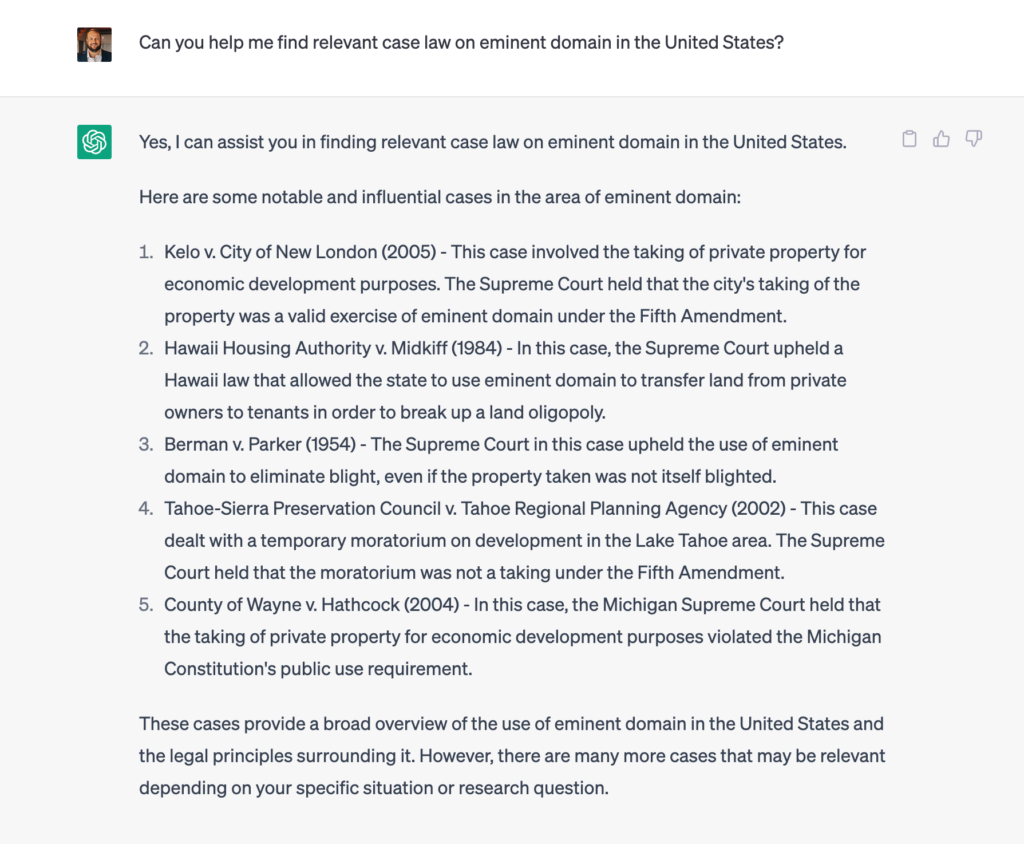
Since OpenAI trained ChatGPT on a large body of public data, it can find things like case law, court opinions, and precedents. The tool may also be helpful with cross-referencing and analyzing this legal research.
There’s one big limitation to using ChatGPT for legal research for now.
The tool does not have access to the internet right now. It can’t find recent case data or anything after 2021. OpenAI is working on a browser plugin allowing people on paid plans to ask ChatGPT to search the web.
Because of this, it may not be able to find all the legal research you may need.
Transcribing Voice Notes, Videos, and More
Transcribing notes from an audio or video file may not seem like a big deal, but this may be the most impactful use case we’ve looked at so far.
Imagine pulling out your phone and recording yourself talking through an ongoing legal matter. Then a few minutes later having a complete transcript of the recording along with a bullet list summary, action items, and follow-up questions.
In the video below, productivity expert Thomas Frank walks viewers through the process of creating a transcription system. This video is a little long, but it’s worth bookmarking.
The best part is that you don’t have to limit yourself to your own voice notes.
With a little modification, you can use any audio file. That means rich transcripts of things like depositions, firm meetings, and even podcasts you’re listening to for personal development are all within reach.
Responding to Emails
Dealing with email can be a huge drain on a lawyer’s time. ChatGPT can help with that.
Using some of the processes mentioned above, you can paste an email into ChatGPT. Then you can ask it to summarize it for you. From there, you can prompt the tool to help you draft a response to that email.
Once you’ve created a prompt that works for you, you may see your time spent responding to emails shrink.
That’s only one way to use ChatGPT to help with your email, though. You can also use third-party tools to make the process even easier. In the video below, attorney Enrico Shaefer walks his viewers through his process for responding to emails with ChatGPT.
This is just a selection of the possibilities for lawyers with ChatGPT. As this tool develops and evolves, more functionality will emerge.
For now, you can take these ideas and pair them with some key considerations to get the best results.
Getting the Best Results from ChatGPT
Before jumping headfirst into using ChatGPT, there are some limitations you should know.
ChatGPT is not perfect. The data that it gives you will not always be 100% accurate. When you use it, take what it tells you with a grain of salt and fact-check it. AI language models have a tendency to “hallucinate” or make things up.
That’s one of the reasons why human guidance is key to using AI tools.
When you create your prompts, you can limit the possible outcomes by not asking open-ended questions. You can also give it more context on the task you are asking it to perform. That way, the tool will give you results that are closer to your expectations. Over time, you’ll refine your prompts so that you’ll consistently get outputs that you like.
Transform Your Law Firm with ChatGPT
ChatGPT offers a unique opportunity for lawyers to modernize their practices and outpace competitors. By incorporating ChatGPT into everyday tasks, attorneys can boost productivity, profitability, and client satisfaction.
While ChatGPT has limitations, early adopters who embrace its potential can significantly enhance their legal practice.
Social Media for Lawyers: The No-Nonsense Crash Course
Social media presents personal injury attorneys with a wealth of opportunities to expand their practice and connect with clients.
Getting started with social is a challenge, but a well-executed strategy can unlock the door to long-term success. By following actionable steps and using powerful tactics, attorneys can harness social media to transform their practice.
Important Things To Know
When you approach social media with a clear understanding of its purpose and a well-defined target audience, you’re on the path to success.
By recognizing who you want to reach and your goals, you’ll be better prepared to make the most of your online presence and reach your ideal clients.
Understanding the Purpose of Social Media for Lawyers
Marketing on social media is about your audience, not you.
Use it to showcase your expertise to your potential clients so you can build trust with them. The easiest way to do this is by sharing valuable content related to what you do that they would care about. Create content that will get people to interact with your content so they remember you when they need your help in the future.
Don’t forget that.
Social media platforms offer a cost-effective way for lawyers to advertise their services and stay connected with industry peers for networking and collaboration opportunities.
Identify Your Target Audience & Platform
One common mistake lawyers make in their social media strategy is trying to be everything to everyone across all platforms.
This approach often leads to inconsistency and diluted messaging because most lawyers just try to copy and paste their content across every platform. Failing to realize that you need to create the type of content people want to consume, and those vary from platform to platform.
This is no one likes static carousel-style posts on TikTok. It’s TikTok. People want video.
Without a full team of marketers to back you, consistently posting the right type of content across every platform is just too time-consuming.
To avoid this, focus on the one platform where your target audience is most active and where you can consistently create the type of content they want to consume.
Start by asking yourself what demographics you’re targeting and what pain points you can address. The answers will guide you in choosing the right platform and tailoring your content to your target audience.
For example, LinkedIn is an excellent choice for reaching professionals with large networks and influence. By sharing your expertise on this platform, you can attract referrals and even potential talent for your firm.
Remember, LinkedIn users value content that aids their professional development, making it a better choice for some types of lawyers.
On the other hand, Instagram and TikTok can help you reach a broader audience with fewer content constraints. Keep in mind that TikTok is a video-first platform, so if you’re not comfortable creating videos, it might not be the best choice for you.
Different social media platforms attract different kinds of users. Find out what the top performers like you are doing that resonates with their audience (they don’t have to be direct competitors).
Where do they post content?
What medium(s) do they use (text, image, video, etc.)?
How often do they post content?
What does their top-performing content all have in common?
Knowing this can help guide your own decisions and provide a foundation for your own unique and effective approach to content.
Don’t be afraid to try different types of content until you figure out what works. Just don’t try it across a bunch of different platforms.
Many lawyers struggle to find the right level of formality when they start posting on social media.
Lawyers spend a lot of time writing formal legal documents that require a certain tone of voice. Once you’re in that groove, it’s hard to break out of it. But that’s not how writing for people on social media works.
Mismatching your tone with what your audience expects affects how they view you.
Content that is too formal may come across as distant and unapproachable. An informal tone can be unprofessional and may make you look like an amateur. Strike the wrong tone and people tune out.
To find the sweet spot, personal injury attorneys need to use a conversational tone that still maintains professionalism.
Steer clear of legal jargon, opting for relatable language instead. Unless you are defining a piece of legal jargon to educate your audience, you’re better off using a simpler term. Incorporating personal stories from time to time can also help you connect with your audience.
Your target audience’s preferences also play a part in determining how formal you should be.
You can find the right balance by experimenting with your posting style. Pay attention to reactions to your posts and social media engagement metrics. When you start getting attention from the type of people you want as clients, you’re getting closer to an effective communication style for your audience.
Posting Content Inconsistently
The next mistake is not sticking with a consistent posting schedule. Posting only when you remember or have time to is a waste of your efforts. You’ll have a less engaged audience since only a few people will remember who you are when you do happen to post.
Your message needs time to sink in with your audience.
Maintaining a consistent posting schedule can lead to more potential clients and improved visibility. The more frequently they’re exposed to your content, the more familiar they’ll be with who you are and what you do.
Sticking to one social platform at first can help since you’ll only have to worry about posting there.
To further avoid falling into inconsistency, use social scheduling tools. Many social platforms have native scheduling features that allow you to add posts in bulk to post on specific dates. If that’s not enough, third-party tools like Hootsuite or Buffer may be more useful.
By scheduling your posts, you’ll have a regular flow of content even when you’re too busy to post manually.
Focusing on Selling, Not Educating
One of the biggest mistakes personal injury attorneys make on social media is concentrating on self-promotion and selling their services.
People turn to social media to connect with friends, be entertained, or learn. They don’t join social networks to be sold to. Attorneys who focus their content on their own services, achievements, and lawyer awards set themselves up for disappointment.
Lawyers who create educational or entertaining content their audience cares about will see greater success.
To improve your social media presence, should shift your focus to educating your ideal client. Create content that addresses common concerns, explains legal processes, and offers insights into the world of personal injury law. By taking this approach, attorneys can position themselves as experts in their field while creating the type of content people want to see.
Here’s a great example from Mike Rafi, a personal injury lawyer who’s active on TikTok:
In this video, he’s educating his audience on what a PI lawyer is supposed to do for their clients. At the same time, he’s walking the viewer through his process of representing someone. This allows him to walk his audience through his services without talking about them directly.
Steps to Launch Your Social Media Presence
With those common pitfalls in mind, you’re ready to start building your social media presence.
Following the steps below, you’ll be on your way to implementing a targeted social media strategy.
Step 1: Determine Your Social Media Goals
Defining clear social media goals is crucial for personal injury attorneys.
Setting goals allows you to focus your marketing efforts. They give you objective metrics for assessing performance. They also help you fine-tune your tactics in response to performance so you can achieve your desired outcome.
To start, outline the primary objectives for your social media marketing campaign.
For example, your goal might be generating awareness and demand with potential clients. Or it may be developing a referral network with other lawyers.
Regardless of your goal, it should follow the SMART framework. Goals that stand up to these criteria are more likely to be well-defined and actionable.
Once you have established your goals, you’ll need key performance indicators (KPIs) to track and measure your progress.
KPIs for social media can include metrics like engagement rates, follower growth, website traffic, and lead conversions. Reviewing your KPIs during your campaign allows you to make adjustments to your tactics. Doing so helps you stay on track to achieve the goals you set.
Step 2: Create a Content Strategy
A well-defined content strategy allows personal injury attorneys to consistently deliver relevant, engaging, and valuable content to their audience.
To get started, sit down over the course of a weekend and put together 40 posts that all revolve around 4-5 strong opinions you have about your field that you think your audience should know.
Once you do that, you have 40 days of content. And you can reuse them in the future by saying the same thing again but in a different way.
For example, you can change the hook (the first part of your post that catches their attention and makes them stop scrolling), the format, or the nuance of your angle. If you want to include graphics, just use Canva.
Next, develop a content calendar to plan and schedule your social media posts.
Make sure your content strategy aligns with your social media goals and includes a mix of content types. This includes formats like text posts (without linking to your blog posts), infographics, videos, and podcasts, to cater to your audience’s preferences.
Finally, maintain a balance between promotional and educational content.
Aim for a ratio of 1:10 in favor of the educational content to build a stable following. Remember, people don’t use social media to be sold to. Bombarding them with promotional content will overwhelm them and turn them away.
By offering the kind of content they care about, you can better connect with your audience and improve the chances of them remembering you when they need help.
Step 3: Join an Accountability Cohort of Other Professionals
Joining an accountability cohort can help you stay consistent with your publishing cadence.
As our good friends over at Ship30 say, “Writing alone is hard. Writing with a community is easy.” Don’t be surprised when you make some unexpected lifelong friendships as a byproduct, either. Time and time again, we’ve heard cohort members of Ship30 say, “I came for the writing, but I stayed for the community.”
To find a community, seek out online groups, forums, or professional organizations.
Look for groups where personal injury attorneys gather to discuss social media marketing strategies, challenges, and successes. You can find groups like this on platforms like LinkedIn, Facebook, or dedicated legal forums.
Once you join an accountability cohort, stay active in discussions, share your own experiences, and provide constructive feedback to others.
Joining a cohort doesn’t just build meaningful relationships with fellow professionals. It also fosters an environment of mutual growth and learning. For best results, set up regular check-ins with your cohort to discuss progress, share insights, and maintain motivation for achieving your social media goals.
Simple Upgrades to Accelerate Growth
While you establish your social media presence, you’ll continuously refine your strategy. To accelerate your growth, you might consider some of these options.
Use Live Events to Fuel Your Content Engine
Personal injury attorneys can use live events, such as webinars, workshops, and Q&A sessions, as content sources for their social media channels.
Using content from events creates a steady stream of material to share with your audience. Turning live events into short video posts or as seeds for future content can save you time and resources. It also provides opportunities for real-time interaction with potential clients.
This can help attorneys demonstrate their expertise while learning more about their audience’s wants and needs.
To implement this strategy, start by identifying topics relevant to your audience and organize live events around those themes.
After the event, reframe the ideas you talked about into various formats. Live events can fuel content types like video clips, infographics, and text posts. Consider using event highlights to further engage your audience and as a source for new content ideas.
Don’t Fear Getting Controversial
Tackling controversial topics can help personal injury attorneys stand out from their competitors.
By presenting well-reasoned arguments and fostering open discussions, attorneys can demonstrate their thought leadership and create a strong online presence. By stepping out of the norm, you can spark meaningful conversations and encourage audience engagement.
Asking thought-provoking questions can stimulate dialogue and encourage your audience to share their opinions.
Possible controversial topics for personal injury attorneys could include:
The impact of tort reform on personal injury cases
The role of social media in personal injury cases
The ethics of aggressive advertising in the legal industry
The pros and cons of settling out of court versus going to trial
By carefully presenting your stance on controversial issues, you can create content that encourages audience interaction. At the same time, you’ll be able to showcase your expertise and approach to the law.
Partner with Other Influential People
Collaborating with well-known people in the legal industry or related fields can help personal injury attorneys grow their own social media audiences.
When you collaborate with others, you can expand your reach, enhance your credibility, and gain access to their audiences. The increased brand awareness from these partnerships can lead to new followers, new clients, and an increase in referrals.
To establish a collaboration, identify influential people who share your target audience and have complementary expertise.
Once you’ve found some potential partners, reach out to them with a collaboration proposal, such as for a legal podcast interview or to co-host a live event with you. If the partnership aligns with both of your social media goals, you have a new avenue to create fresh content for your audience.
You don’t have to limit yourself to only contacting other lawyers. Possible collaborators might include:
Doctors
Physical therapists
Chiropractors
Mental health professionals
Insurance experts
For example, you could collaborate with a medical expert on a joint webinar discussing the impact of personal injuries on mental health. Or you could write a guest post on a popular legal website to share insights on emerging trends in personal injury law. Another idea could be collaborating with a former insurance adjuster to help your audience understand the tactics used by insurance companies after a car accident.
Best Practices Moving Forward
The simple upgrades aren’t the only thing that can elevate your marketing efforts. There are a few best practices that can help you establish and build a lasting presence on social media.
Use Social Media to Build Relationships with Potential Clients
Social media can be an effective tool for law firm marketing, but simply posting content and letting it sit isn’t enough.
You’ll see better results when you engage with your potential clients. Respond to their comments and questions on content you posted. In addition to sharing content that addresses their interests, consider asking them about the topics they would like you to talk about.
Interacting with your audience can build rapport and trust with them.
For example, if you post a TikTok video breaking down a legal concept, you may have people ask you follow-up questions. That’s a golden opportunity to help another person out and build a positive reputation with every person who comes across your response.
Stay Up-to-Date on Legal and Social Trends
Social media — and lawyers’ relationship to it — is in a constant state of change. If you want to succeed in marketing yourself on social media, you’ll need to keep track of your audience’s habits and needs. You’ll also want to stay current with the rules for advertising your law firm.
Sometimes, a new social app emerges, and people flock to it.
People moving to a new platform can be an opportunity for lawyers. It may open up new types of content that wouldn’t have worked on older services. Your audience could be more receptive to your messaging on the new platform.
It’s not just emerging apps to look out for, either.
Social media algorithms change often, and so do people’s tastes. If you find that some types of content no longer perform, it may be time to adjust your tactics.
By keeping an eye open for changes, you can decide whether you need to shift with people’s habits.
Lawyers also need to consider their ethical responsibilities on social media. While attorney advertising rules don’t change as often as social media platforms, it does happen sometimes.
Make sure that the marketing material that you put out into the world complies with your bar association’s rules. Some states have very strict rules on what they consider advertising. Knowing what those rules are ensures that your marketing efforts are both effective and ethical.
Track Your Performance and Adjust Your Tactics
Getting started with social media marketing takes some experimentation. Over time, you’ll figure out what’s working and what isn’t. Tracking your performance will allow you to get a handle on this faster than a trial-and-error approach.
If you set your KPIs at the outset, this is where they’ll come into play.
By tracking metrics like engagement rates and follower growth, you can start to assess how effective your posts are. Social media apps have built-in analytics features you can use for these data-driven insights. If that’s not enough, you can use third-party tools like Sprout Social or (on LinkedIn) Shield App.
But insights from analytics software aren’t the only tool at your disposal.
Any new clients that come to you can give you valuable insights, too. For instance, you can add a field to your contact form asking anyone who submits it how and where they found you. If you start to see a trend in people citing social media as a source, you’ll have a better idea of your actual performance.
Going over the data will show you patterns, trends, and areas of success or weakness.
Based on your findings, you can adjust your tactics. You might end up experimenting with posting frequency, adjust audience targeting, or even cut out certain types of content. By keeping up with the data and making adjustments, your marketing efforts will become more effective over time.
Elevate Your Personal Injury Practice through Social Media Mastery
Embracing social media is essential for personal injury attorneys looking to connect with their audience and grow their practice.
By finding your target audience, being consistent, and focusing on educating rather than selling, you can build an audience of potential clients. By understanding common mistakes, you can avoid the pitfalls many attorneys fall into. Using the simple upgrades above, you can level up your practice’s outcomes.
Success in social media marketing comes from persistence, continuous learning, and adaptation. With dedication and the right approach, your personal injury practice can create a steady stream of new clients.
Solo Law Firm Marketing Tips: How Solo Lawyers Can Win Big
Running a solo law firm means you might need to wear many hats.
Marketing your firm is essential for bringing in new clients. Even if you’re feeling like a one-man or one-woman band, there are many marketing options available to you that can leverage your strengths.
Learn the best tips for attracting new clients below.
Create a Winning Marketing Strategy
Effective marketing as a solo attorney begins with developing a strategy that establishes how you will win potential clients.
The ABA 2020 Tech Report shows that nearly one-third of solo lawyers report that no one is responsible for marketing in their law firm. That’s a big opportunity for solo lawyers to take advantage of. Putting together a winning strategy can put you ahead of your competition.
Your strategy is the various choices that determine how you’ll win new clients, where you’ll find them, and how you’ll set yourself apart in that market. Your plan refers to the activities you’ll do, although those activities don’t necessarily guarantee the results you’ll get.
Understanding these differences is an important step in creating your attorney marketing plan.
Your marketing plan is a strategic document that explains how you’ll get ideal clients to find and hire you. In your marketing plan, you will:
Plan for measurements and KPIs so you can course correct as needed
A winning marketing strategy and an optimized website are two core components of marketing for any law firm. Choosing from the other tips on this list will depend upon the strategic choices that you make.
Build a Search Engine Optimized Website to Capture Leads
No matter what marketing strategy you decide on, your potential clients need a way to reach you.
Having a high-performing, clearly organized solo law firm website gives potential clients one central hub to contact you for legal services. Even if you don’t plan on publishing blog posts, your website is a crucial component of law firm marketing.
Optimizing your site for search engines is also critical.
Doing so makes sure that Google and other search platforms can find, understand, and index your website. With the right technical SEO setup and strong content aligned with what your potential clients are searching for, it’s easier for your ideal clientele to find and connect with you.
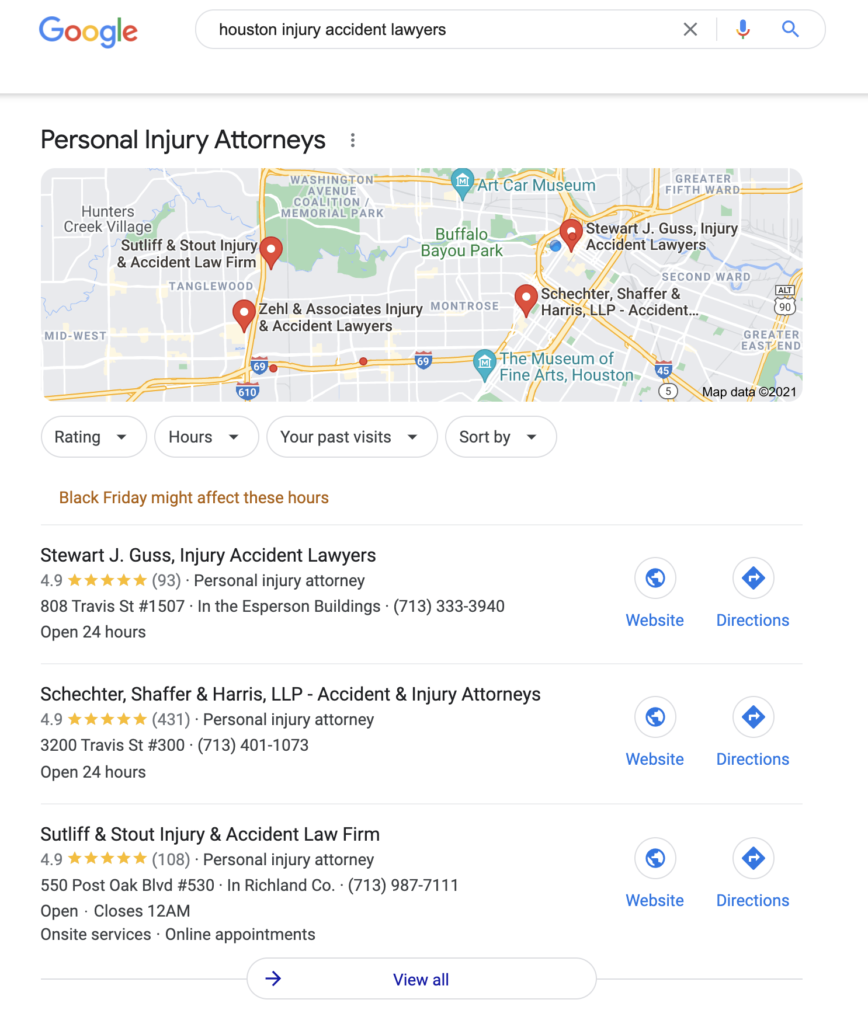
If you deal with local clients, setting up a Google Business Profile and directory listings is another important component.
Claim Your Google Business Profile and Build Citations
Citations pointing to your website are a critical part of local SEO.
These citations showcase key details about your firm, like your office location and contact information. These are crucial signals that help Google determine whether they should place your site in certain local searches.
A robust Google My Business Profile is among the most important citations for solo lawyers serving local clients.
Start by claiming your Google Business Profile, which requires verification. From there, you can add hours, location, your phone number and website, and photos. Your profile is an important place to capture reviews from clients, too.
After that, you can claim other important citations.
Now that we’ve gone over the things all solo lawyers should do, you have several options that you can mix and match based on your marketing plan and goals. If you’re just launching your law firm, we recommend picking one channel to master at a time and grow from there.
Create Blog Content that Addresses Potential Clients Needs
Creating search engine optimized blog content that addresses prospective clients’ most important questions can bring in new leads organically. Content optimized for both search engines and ideal clients takes time to ramp up, but it’s one of the most sustainable marketing methods overall.
Much of the content you’ll create is evergreen in nature, meaning that it can perform well all throughout the year. Upfront investments in SEO for lawyers can pay off for years.
Law firm blogging is a strong choice for long-term benefits, but it does require technical SEO skills and internet writing skills.
Most solo lawyers already have enough on their to-do list and don’t have the time or interest to devote to mastering SEO content. That’s why many hand it off to a trusted law firm marketing expert in most cases.
You can use your personality and unique value proposition to connect directly with clients through engaging and informational posts.
Creating entertaining and educational content on social media can help you build up a trustworthy personal brand that exposes what you do to your audience so that when they need help, they come to you.
Social media works best when you’re consistent with it, but it’s not as sustainable as SEO since your content on social media is short-lived.
Solo law firm owners can highlight both their personal and business brands on social media, which means you can form an authentic connection with your potential clients on these platforms.
As a solo lawyer, you’re likely to be front and center in most of the posts on social media, which means you can humanize yourself more easily than most other lawyers. Making yourself relatable while highlighting your expertise can build trust quickly on social media.
If you decide that social is the channel for you, there are a ton of options. Solo lawyers see plenty of success on platforms like Instagram, TikTok, Twitter, and Linkedin.
Use Paid Ads to Attract Potential Clients
Organic social media and SEO can bring in new clients, but sometimes you need more of a push to get your law firm out there to start generating revenue.
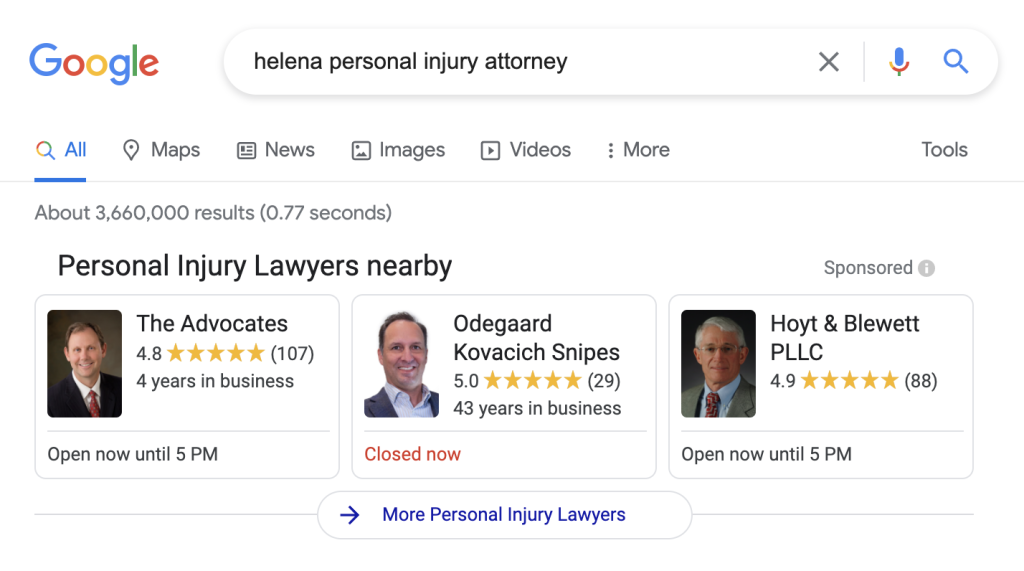
Many new solo firms consider using paid ads to draw in high-quality clients. Google PPC ads, Google Local Service Ads, or social media PPC can get quick results if you know how to target the right audiences, but they are expensive in the long run.
Over time, you’ll need to consider adding in more sustainable methods like SEO if you want to avoid getting stuck on the paid ads hamster wheel.
For personal injury lawyers looking to market, it’s very easy to get priced out of this market because of the high demand and cost of running paid ads. Personal injury PPC is notoriously one of the most expensive industry segments for Google ads.
Create Entertaining Videos for YouTube or TikTok
YouTube and TikTok marketing are great avenues for solo attorneys who aren’t afraid to get on camera.
Video marketing on these platforms can help you build out your profile as an expert. You can cover common questions and current trends to establish your authority in your practice area.
Both TikTok and YouTube educate and entertain your target market to generate demand. When those clients need help with a legal issue, your firm will be top of mind.
Check out Legal Eagle on YouTube for a good example of how to combine your personal and professional law firm brand on social media. His videos are explanatory and interesting at the same, all while setting him up as an expert in his practice areas.
If TikTok is more your speed, check out lawyer Mike Mandel. With over 7 million followers, he dominates the platform with catchy, relevant, and humorous videos.
Partner with Another Professional for Podcasts or Live Events
Expand your reach easily by tapping into someone else’s existing audience.
This is a two-for-one marketing opportunity since you may forge a relationship with a new referral partner while introducing yourself to their audience in a compelling way.
Creating a legal podcast with a partner is another way to share your thoughts and then repurpose the ideas for multiple platforms. You could also host a show where you feature multiple guests relevant to your audience’s interests and questions.
For example, a personal injury lawyer could speak with a chiropractor, an orthopedic doctor, a body repair shop owner, or former car insurance claims agent.
Determine Your Next Solo Law Firm Marketing Step
If you don’t yet have a marketing document, take this opportunity to walk through your options and outline your formal law firm marketing plan.
From there, you can start mastering one channel and building on your efforts as you grow.
Marketing doesn’t have to be overwhelming, even for solo lawyers, when you outsource to the right partner. Rankings.io has a stellar track record in providing results and excellent service to law firms looking to go to the next level. Contact us today to see how we can help your solo law firm succeed in your marketing efforts.
7 Tips for Marketing a Small Law Firm and Getting Actual Results
Small law firm owners who want to market themselves effectively need to focus on their ideal customers and narrow down their marketing channels.
Balancing your budget and deciding on the highest-value activities to start with can be challenging, but marketing your small law firm can be broken down into seven basic steps.
Here are the best tips for setting up your marketing to bring in new clients.
1. Understand Your Target Audience
Effective law firm marketing begins by understanding your audience’s wants and needs.
Where possible, use research to determine this. Think about demographic factors your target clients have in common, their fears and questions about their legal issues or hiring a lawyer, and where they spend time.
If you think your potential client is “everyone,” “all business owners in Chicago,” or something equally broad, you need to consider niching.
Narrowing down your target audience and offer helps you stand out from other law firms and clarifies your value proposition when those clients find you. You’ll also be ready to scale more easily with a focused service offering and client type.
This is the first part of developing an law firm marketing plan, and steps two and three below are also components of your bigger law firm marketing strategy. Your plan is your roadmap to success and the foundation of your online marketing efforts, so you should always start with these first three steps.
2. Select the Channel that Will Work Best for You
Small law firms often have smaller budgets, meaning they need to narrow their efforts down to one channel that will provide them the best results.
Starting with one channel allows you to optimize for the best success there. Once you have a system down, you can expand to other options.
To choose the best channel, you must have clarity on what qualifies as a channel. A marketing channel is a way that you deliver your law firm marketing messages to prospective clients. Since there are many channels to choose from, look for these three things when choosing the one you’ll focus on first.
These are spaces where:
Your target clients spend time and consume content
You can afford to create and publish material
You have time to consistently create and publish high-quality content
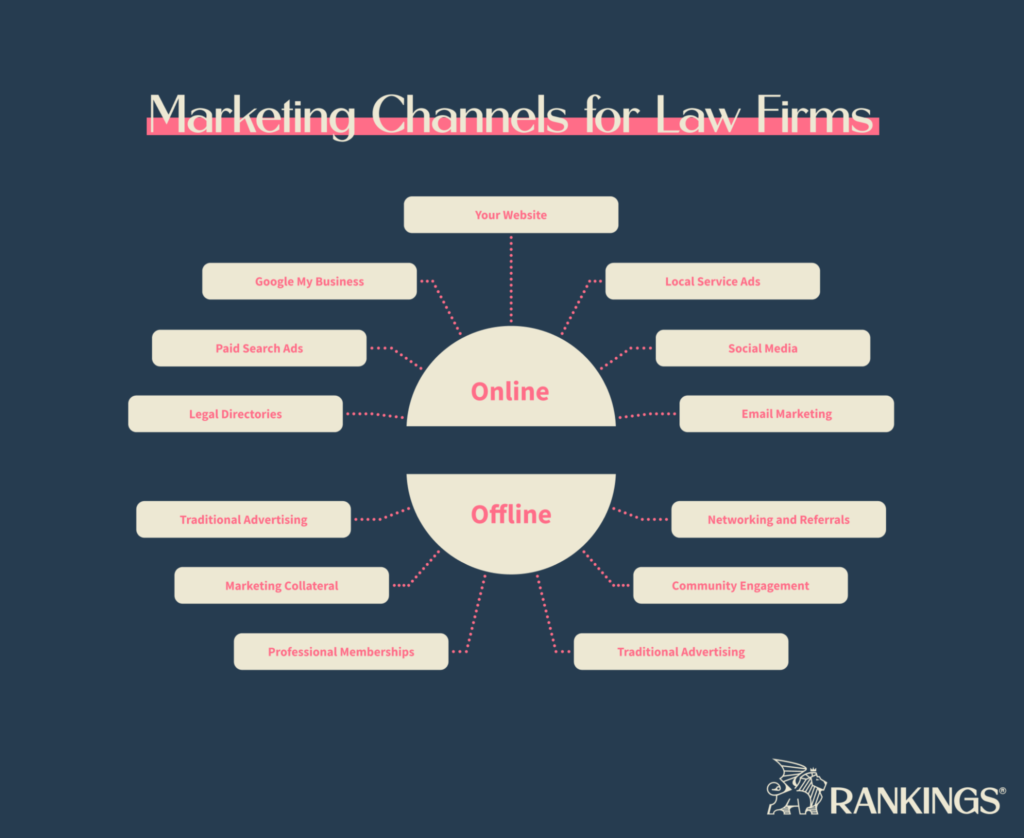
There are three major channels to explore for solo and small firm lawyers looking to take their first steps into marketing. These are social media, paid search advertising, and search engine optimization through blogging. Each has its own pros and cons.
To succeed in these channels, your target audience should be regular users of these platforms. Social media is usually the best channel to start with for new law firm owners because of the ease of creating content. In fact, most law firms think that social media marketing is the best choice for their firm.
If you don’t have the budget to invest in ads or play the long game with blogging, you probably do have the time to create a video for TikTok every day or a few times a week. In order to succeed with social media, follow these guidelines with each platform in mind:
Create the type of content your audience will most likely see (Reels on Instagram, etc.)
Create engaging and entertaining content
Publish content that captures their attention within just a few seconds
Paid search advertising is another option for law firms. While this can deliver results, it’s a money-in and money-out scenario.
Most new law firm owners don’t have extra cash for ad spend or the time and skills needed to create custom landing pages for each of the ads. If you are interested in paid advertising, small law firms have a few options:
Finally, law firms may consider using law firm SEO to build their blog posts and website content.
This requires SEO skills and time to write them yourself or budget to pay a team to handle it. Law firm blogging is a good channel to pursue as it gives you a great opportunity to expand your reach over time. It’s the most sustainable and has high return on investment since you’re driving quality traffic to your site with content you only have to pay for once.
Most law firms start with social media and then build their blog shortly after to start capitalizing on SEO.
3. Determine Your Marketing Budget
Determining how much you can or will spend on your marketing has an influence on your channel and tactics.
Once you know what channel to use first, you need to decide what you’ll allocate in your budget to thrive on that channel. Your law firm marketing budget may help you decide which channels to use, too.
For example, your budget may preclude you from working on paid ads first. You might realize the substantial time investment you’d need to handle SEO on your own and choose to work with a qualified law firm marketing partner for that aspect instead.
Some law firms use a scaling marketing budget when they first start out, investing a smaller amount at first to master one channel and then growing that over time.
For example, once your law firm blog content is gaining steam, you might decide to allocate some spend to paid ads, too.
4. Build a Modern Law Firm Website
Having a law firm website is an important part of marketing your legal services because it gives your potential clients a way to find and contact you.
Your website should tell potential clients who you are and what you can do for them in a quick and compelling way.
Even if your primary marketing channel is social media, you still need a website. Just because you aren’t focused on SEO content or on paid ads does not mean people will not try to find your website to schedule a consultation.
Your website is the home base for your business.
It’s the only place where you control the entirety of the content since you own the domain, design, and copy on the pages. Your website is the place you’ll drive traffic to from SEO, paid ads, or social media, so it’s a vital component of your law firm marketing.
A good law firm website for a solo or small firm should:
Have an excellent user experience
Have a clear and consistent marketing message
Showcase your practice areas with SEO-optimized content
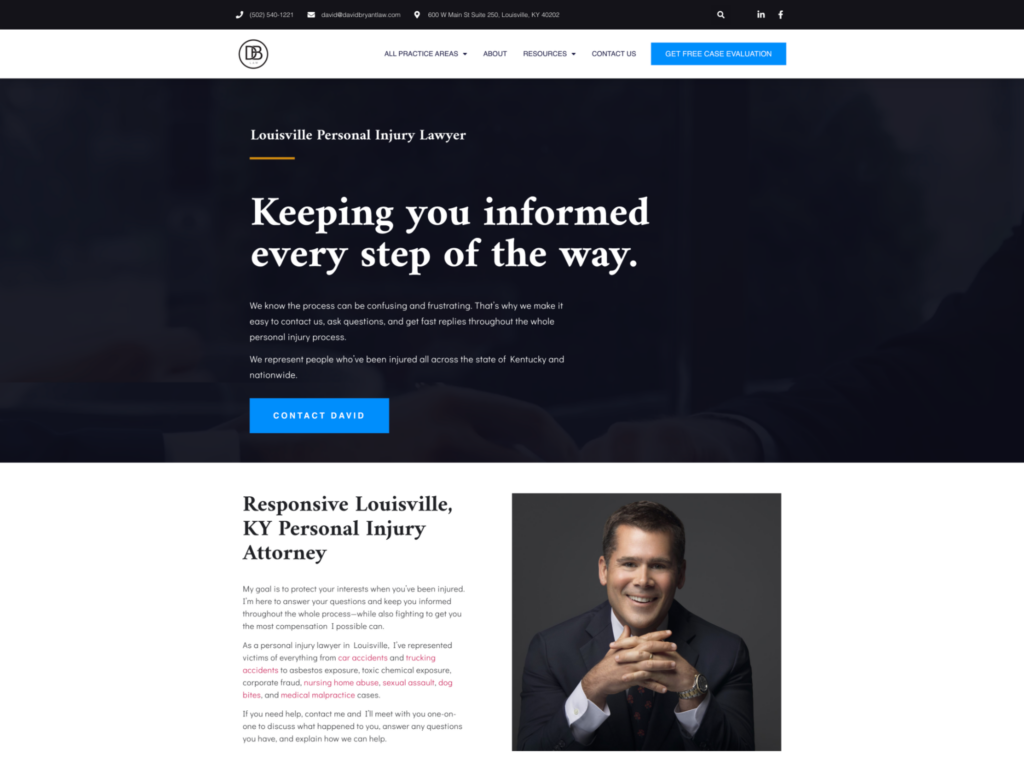
Here’s an example from solo personal injury lawyer David Bryant Law. Here’s why it works:
The colors are crisp, clear, and work well together
His offering (Louisville Personal Injury Lawyer) is obvious and easy to read
He offers contact options in multiple formats right on the homepage
It’s simple for potential clients to click on what they need
The value proposition (communication, guidance, support throughout the case) is strong
A happy, upbeat photo of attorney David Bryant paints him as personable and friendly
Besides creating a great website, you also need to consider some other aspects of SEO that support your online presence and your website. These include:
Together, these all help share key information about your firm, especially your location and contact details.
5. Create Content that People Care About in That Channel
It would be easy to just create one piece of content and blast it across numerous channels, but that’s not how social media works in 2023.
There’s no point in creating content your audience doesn’t care about, so test different kinds of content and tones to see what your audience likes. At the end of the day, only invest in content that you want your audience to see.
Edutainment is king among social media content options. This is content that both explains something while also presenting it in an engaging way.
Keep self-promotion to a minimum and think instead about what’s most interesting to your followers and ideal clients on social media. Giving people the content they want in that channel is essential for connecting with your audience.
Big and small law firms may approach this process differently.
Here’s an example of Greenberg Traurig LLP putting excellent content on their LinkedIn. As a large law firm, positioning themselves as industry experts who speak at global events highlights their firm with content most likely to resonate with LinkedIn followers.
On the other hand, this engaging video on TikTok discussing copyright issues by Legal Eagle is short, sweet, and entertaining. It’s perfect for that platform. Adjust your message, tone, and delivery to the channel you choose.
6. Put Your Clients First in Both Marketing and Service
Putting your clients first in marketing and in your services attracts more new leads and can bring in more referrals.
In your marketing, this means giving people interesting content that they care about, which provides you a chance to:
Repeat your message
Expose them to your brand
Build trust and confidence with potential clients
Increase the likelihood they will come to you when they need help
When you talk about your legal services, make your client the hero. You’re guiding them through a difficult legal situation but ultimately positioning them as the hero of the whole story.
The client-first mentality doesn’t just apply to your marketing, either. It’s equally important for you to match what you promised in your messaging to the delivery of client service.
Client-first law firms are more likely to get positive feedback from current and former clients. Feedback from satisfied clients paves the way for referrals from word of mouth and positive reviews that reinforce your online presence.
7. Measure Your Results and Optimize Your Marketing
It’s not enough to decide on what you want to publish and put it out there. You need to track that information over time to see how it performs.
Measuring your results helps you track what is and is not working so that you can ditch the bad and continuously improve. You can take data from performance and decide what to do more of and what to tweak to hit your marketing goals.
This ensures that you’re spending your time, energy, and marketing budget on the right things.
Master Your Marketing with an Outside Partner
Marketing your legal practice is crucial if you want to bring in new clients, but it’s so easy for solo and small firm lawyers to feel overwhelmed.
Trying to market on a budget requires strategic expertise. Turn to Rankings.io for customized help with leading strategies that work in the legal space. Start getting leads today with marketing services designed to grow your law firm.
A Detailed Guide to New Jersey’s Attorney Advertising Rules
Advertising and marketing your law firm helps get your name out there for ideal clients.
But to advertise in New Jersey, lawyers’ activities must comply with rules that many other businesses never need to think about. In addition to national attorney advertising rules developed and governed by the American Bar Association, New Jersey lawyers must also follow state-specific compliance rules.
Understanding New Jersey’s rules for attorney advertising provides lawyers in that state with a firm framework for advertising ethically and clears the way for doing so effectively.
Overview of New Jersey’s Attorney Advertising Rules
These rules are an appendix to the New Jersey Rules of Court and are published by the New Jersey Bar. All issues related to attorney ethics and legal practice fall under the governance of the New Jersey Supreme Court.
New Jersey also has a Committee on Attorney Advertising. This body of lawyers and non-lawyers has full authority to look into ethics grievances and advisory opinions on matters for advertisements and related communications under the state’s rules.
Rules 7.1 through 7.5 cover the lion’s share of the requirements for advertising. Some related details may be found in other rules. The rules related to attorney advertising are in place to protect the public as well as to maintain professionalism across the practice of law in New Jersey.
Per Rule 7.1, attorney advertising is considered any communication of information about the lawyer’s services through public media.
That includes legal directories, television, radio, newspapers, telephony directories, written mailed communication, or internet and electronic media, including websites.
Rule 7.1: Communications Concerning a Lawyer’s Service
Rule 7.1 covers New Jersey’s definition of communication and general regulations for attorney communications.
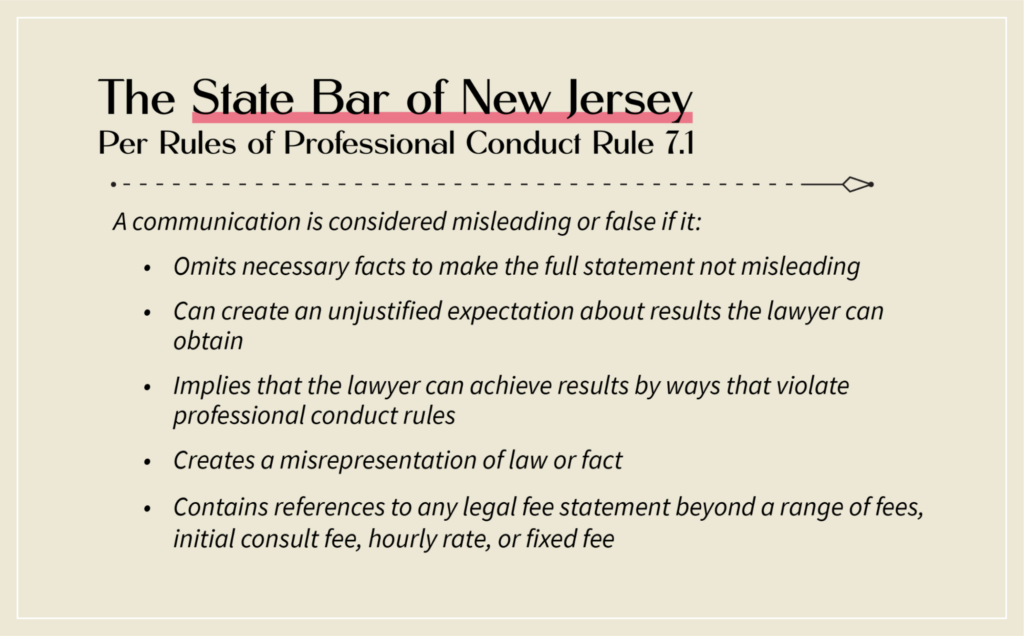
Most importantly, Rule 7.1 addresses any misleading or false statements in any form of advertising. A communication is considered misleading or false if it:
Omits necessary facts to make the full statement not misleading
Can create an unjustified expectation about results the lawyer can obtain
Implies that the lawyer can achieve results by ways that violate professional conduct rules
Creates a misrepresentation of law or fact
Contains references to any legal fee statement beyond a range of fees, initial consult fee, hourly rate, or fixed fee
Further, a statement is misleading if it compares a lawyer’s service offerings with other lawyers without a disclaimer or is missing a basis for substantiating the claims.
The following disclaimer must be included with any ad comparing one lawyer’s services with another: “No aspect of this advertisement has been approved by the Supreme Court of New Jersey.”
Lawyers are forbidden from using any ads or communications previously disapproved or similar to those disapproved by the Committee on Attorney Advertising.
Rule 7.2: Advertising
Rule 7.1 covers New Jersey’s general rules on advertising.
These state that a lawyer can communicate details about their services through many means, but also outline filing requirements for any ad and rules around compensation for referrals/testimonials.
Lawyers in New Jersey must keep copies of their ads for three years after it was used. Information on a law firm’s website must be captured and stored on an electronic or paper backup a minimum of once a month, and this must be stored for at least three years.
New Jersey attorneys cannot give anything of value for recommending the attorney’s services with the following exceptions:
A lawyer can pay reasonable ad costs
A lawyer can pay general charges for a non-profit lawyer referral service
A lawyer can pay for ads and written details related to selling the full legal practice
Rule 7.3: Personal Contact with Prospective Clients
Rule 7.3 covers New Jersey’s rules on contact with prospective clients, solicitations, and referrals.
A lawyer is allowed to initiate contact with a potential client for the purposes of obtaining employment so long as that lawyer does not violate the stipulations outlined below.
Contact with Potential Clients Through Written Means
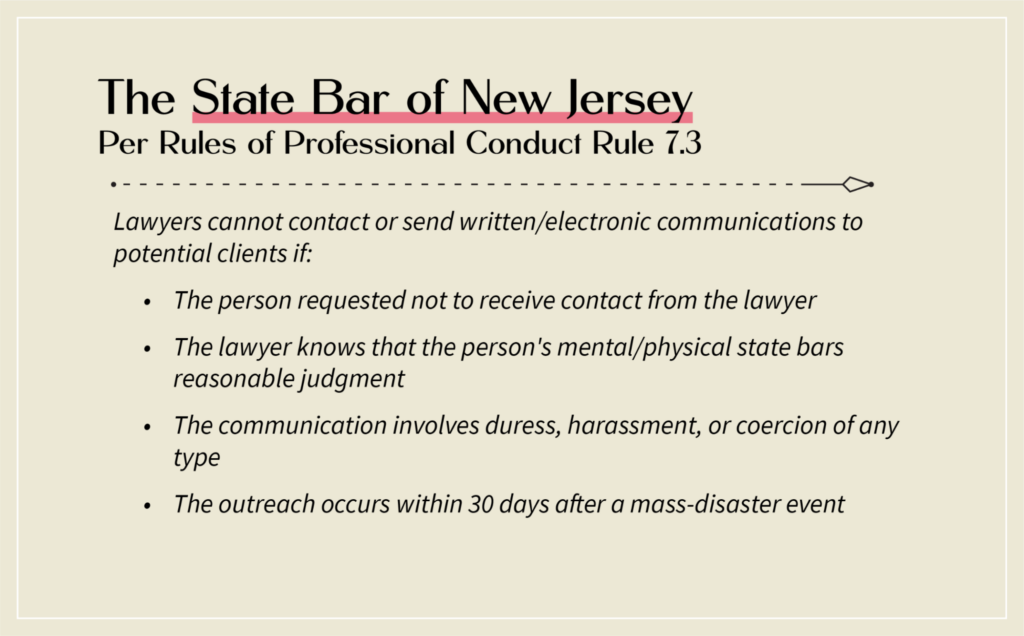
Lawyers cannot contact or send written or electronic communications to potential clients if:
The person requested not to receive contact from the lawyer
The lawyer knows that the person’s mental/physical state bars reasonable judgment
The communication involves duress, harassment, or coercion of any type
The outreach occurs within 30 days after a mass disaster event
When outreach relates to an event that is not a classified mass disaster, the lawyer must take additional steps with their communication. These steps include that:
Only a letter can be sent by regular mail
The letter must use the word “ADVERTISEMENT” in all capitals
The envelope can only include the lawyer’s name, address, and “ADVERTISEMENT”
A statement that the recipient can ignore the letter if they already have a lawyer
Additionally, two notices must be included at the bottom of the last page of text on these letters.
These are:
“Before making your choice of attorney, you should give this matter careful thought. The selection of an attorney is an important decision.”
“If this letter is inaccurate or misleading, report same to the Committee on Attorney Advertising, Hughes Justice Complex, P.O. Box 970, Trenton, New Jersey 08625-0970.”
The name and address of the attorney responsible for the content of the letter shall be included in these notices.
Compensation for Recommending the Lawyer
Lawyers cannot knowingly help any organization that pays for legal services to others to promote their own legal services if the promotional activity involved relates to false/misleading statements, unwarranted promises of benefits, duress, compulsion, threats, intimidation, or harassing conduct.
Lawyers cannot provide anything of value to an organization or person for recommending or securing the lawyer’s employment by a client.
A lawyer can pay for reasonable fees/dues charged by a legitimate lawyer referral service approved or sponsored by a bar association.
Lawyers can cooperate with organizations like legal aid offices, military legal assistance offices, lawyer referral services approved by a bar association, and certain organizations that pay for or furnish legal services to their members.
Those organizations must:
Not retain any profit from recommending legal services
Provide any financial benefit for recommending the organization
Exist for reasons beyond the sole purpose is procuring legal work for a lawyer
File with the Supreme Court annually about their legal service plan
Recognize the client/beneficiary as the lawyer’s client
Allow the client to select other counsel for handling the legal matter if the client chooses
Rule 7.4: Communication of Fields of Practice and Certification
Rule 7.4 covers what attorneys can and cannot claim about service areas and certifications or specializations.
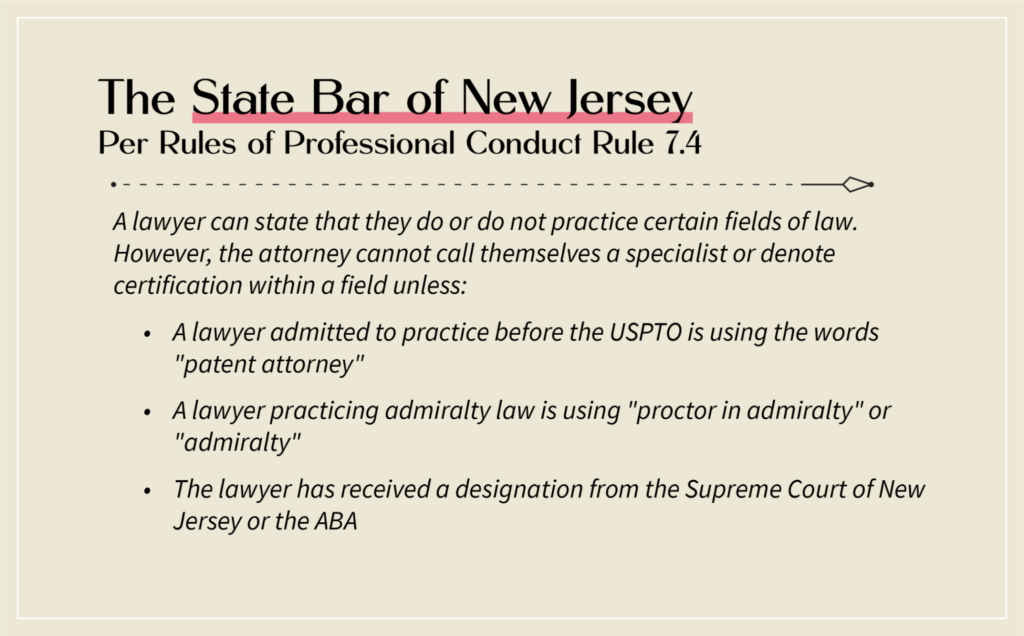
Specific language around certifications and specializations cannot be used by any lawyer in New Jersey unless certain terms are met. A lawyer can state that they do or do not practice certain fields of law.
Attorneys cannot call themselves a specialist or denote certification within a field unless:
A lawyer admitted to practice before the USPTO is using the words “patent attorney”
A lawyer practicing admiralty law is using “proctor in admiralty” or “admiralty”
The lawyer has received a designation from the Supreme Court of New Jersey or the ABA
Rule 7.5: Law Firm Names and Letterheads
Rule 7.5 covers what names attorneys can refer to their firms by, such as trade names or business names.
Lawyers cannot use false or misleading law firm names or designations. A law firm with multiple offices can use the same firm name in New Jersey. When doing so, the firm must indicate the limitations on any lawyers in the firm unable to practice in NJ.
The law firm’s name cannot contain the name of any individual not currently associated with the firm as a lawyer other than names of people who have left through retirement or have passed away after working for the firm as a lawyer.
Firms cannot imply they practice in a partnership unless they can show that the firm’s partners share liability and responsibility for the firm’s legal services. Persons designated in the firm name must be members, partners, or shareholders in the firm.
Law firms in NJ can use language like “and associates” only when that accurately describes the firm’s services.
To use language like “legal services,” you must share the fact that the firm is not associated with a charitable or public organization. Firms are not allowed to use the name “legal aid” in their firm name.
Trade names are allowed so long as the name is not comparative, suggestive of possible case results, or misleading. If the trade name does not include a current or previous firm lawyer’s name on it, communication about the firm name must include the name and contact information for at least one firm lawyer.
How Do These Rules Apply to Law Firm Websites?
Lawyer websites are permissible in New Jersey. Your site must follow all rules relating to advertising communication. Your firm must also store your backups of website materials per rule 7.2.
Many lawyers choose to cover their bases by using a disclaimer on their website stating their website content is not considered a guarantee of case outcomes or a representation of legal services between the reader and the law firm.
Applying New Jersey’s Advertising Rules to Your Practice
There are a few best practices attorneys can follow to ensure compliance with New York’s advertising rules.
Start by completing a thorough review of the advertising rules in relation to your current ads and website. Then set aside time to regularly review and update ad materials and train your staff on ad rules and regulations.
If an outside partner, such as a law firm marketing agency, manages your website, they should also understand and comply with New Jersey’s Rules of Professional Conduct.
Growing Your Firm with Advertising
Implementing digital marketing and advertising options like investing in law firm SEO, social media marketing, and more can be a great thing for a New Jersey law firm.
But to achieve your goals, your law firm marketing strategy must comply with New Jersey’s Rules of Professional Conduct.
Applying the rules helps you clear the way for effective and ethical advertising. Having an outside marketing partner who understands them can save you time and get you better results than trying to do it yourself. Contact Rankings.io to learn more about our full suite of digital marketing support for law firms.
These rules exist to protect the public and maintain professionalism in the practice of law in New York. This document covers a wide variety of topics exhaustively, including a detailed chapter on attorney advertising.
Importantly, Rule 7.1 lays out the state bar’s definition of advertising.
Advertising, under Rule 7.1 (a), is public or private communication made on behalf of or by a law firm or lawyer about that person/firm’s services, with the primary goal of getting someone to retain the firm. This rule excludes communications to current clients or other lawyers as ads.
New York’s rules on attorney advertising cover important topics in successive subsections like:
General rules about ads
Rules on payments for referrals
Rules on solicitation and employment recommendations
Rules on identifying your practice or specialty
Rules on professional notices and branding.
Each other rule further defines what New York lawyers can and cannot do in their communications with potential clients.
Rule 7.1: Advertising
Rule 7.1 covers New York’s general regulations for attorney advertising. This includes several core requirements for ads and law firm websites.
For the purposes of this and other attorney advertising rules, consider your entire law firm website an advertisement that must comply with the following rules:
There may be no statements or claims that are deceptive, false, or misleading
Inclusion of the principal law office address, firm name, and telephone number of the firm
A statement that this communication is a form of “attorney advertising”
For the last rule, there are some exceptions and some specifications.
All ads except those on the radio, television, billboards, directories, newspapers, magazines, or other periodicals must include the phrase on the first page. Any electronic mail ads must include “attorney advertising” in the subject line. Most law firms cover this on their website in the footer across all pages to keep things simple.
You must include a minimum of one lawyer’s name or the law firm’s name, location, and telephone number on all forms of advertisement. This is usually the name of the lawyer responsible for reviewing and signing off on the ad.
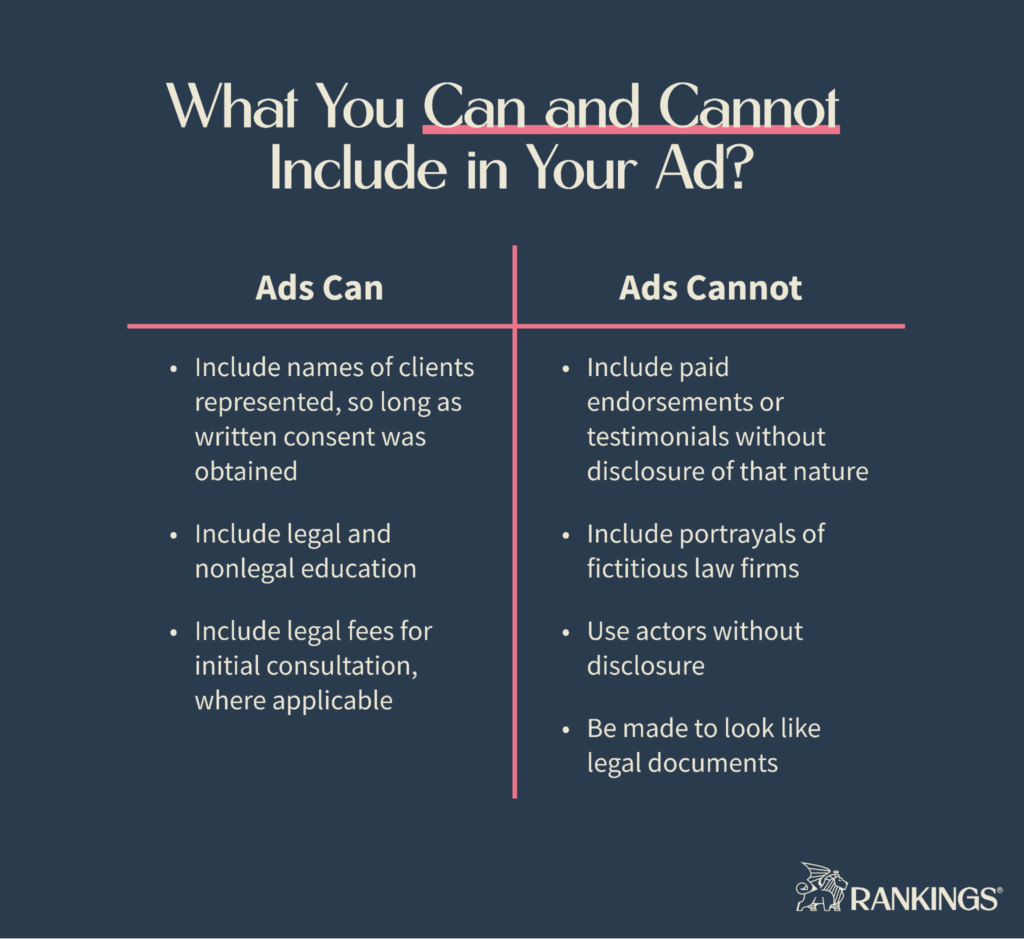
Ads can include information like:
Names of clients represented, so long as written consent was obtained
Legal and nonlegal education
Legal fees for initial consultation, where applicable
Ads cannot:
Include paid endorsements or testimonials without disclosure of that nature
Include portrayals of fictitious law firms
Use actors to portray lawyers, firm members, or judges without disclosure
Be made to look like legal documents
Lawyers must keep all ads on file for no less than three years after their initial use. This excludes computer-based communications, which you must keep for at least one year.
Rule 7.2: Payment for Referrals
Rule 7.2 covers payment for referrals and recommendations in attorney advertising.
A lawyer cannot give anything of value or compensate someone for obtaining employment by a client or recommending the firm to a client unless the lawyer is paying reasonable fees or dues for a legal assistance organization or as a referral fee to another lawyer.
Additionally, lawyers can refer clients to a nonlegal professional or professional service on a systematic basis. This is true so long as the referral does not include any reward, tangible consideration, or monetary award for the same.
Lawyers can cooperate with certain legal assistance offices. This includes things like a legal aid organization, public defender’s office, non-profits, bar association-approved or sponsored organizations, and military legal assistance offices.
Rule 7.3: Solicitation and Recommendation of Professional Employment
Rule 7.3 governs solicitation and communication in attorney advertising. These rules relate to when a lawyer can and cannot attempt to solicit clients.
The bar defines solicitation as any advertisement initiated by or on behalf of a law firm or lawyer that is directed at a specific group of recipients (or those person’s family members/legal representatives) with the primary purpose of getting that group member to retain the law firm.
A lawyer cannot engage in solicitation in person or through telephone contact or any computer-based application unless the recipient is a relative, close friend, existing client, or former client.
A lawyer cannot engage in solicitation through any form of communication if:
The recipient has asked for communication to cease
The solicitation involves duress, coercion, or harassment
The lawyer knows or should know that the recipient cannot exercise reasonable judgment
The lawyer expects but doesn’t disclose that services will be handled by another attorney
Ads intended for specific groups must be filed with the attorney disciplinary committee of the judicial department or district where the law firm maintains its primary office. If there is no such office, the filing must be made in the jurisdiction in which the solicitation will be sent.
That filing must include:
A copy of the ad/solicitation
A transcript of any audio part of any radio or television solicitation
An English translation if the ad is in any other language
There are a few other specific rules associated with solicitations that only apply based on the type of ad sent.
For example, law firms cannot send written solicitations by a method that requires the person to travel to any location beyond where they typically get personal or business mail or through a method that requires a signature.
Lawyers cannot send solicitations about a specific event (such as major accidents leading to personal injury or death) before the 30th day after the date of the incident. This holds true unless a filing is required within 30 days, which would change this block to no earlier than the 15th day after the incident.
If you provide any retainer agreement example with an ad, it must be marked in red ink with the words “SAMPLE” in the largest font used on that entire solicitation. The words “DO NOT SIGN” must fill the client signature line on any document like this.
If a solicitation is in writing or sent via a computer and directed to someone specifically, it must disclose how the lawyer learned the identity of the recipient and the possible legal issue.
Rule 7.4: Identification of Practice and Specialty
Rule 7.4 addresses communication of fields of practice and specialization in attorney advertising. This refers to how a lawyer claims and shares their practice areas.
A lawyer can identify one or multiple areas of law in which the individual or firm practices, so long as the firm does not state that they are a specialist or specialize in a particular area unless they have been so recognized.
A lawyer can only use terms such as “specialist” or “certified” in a few situations.
The first is any circumstance in which the ABA or a certification body recognized by the ABA designates the lawyer as a “specialist” or “certified.”
The ad must include the statement, “this certification is not granted by any governmental authority.”
Another situation where a lawyer may use these terms is when an authority with jurisdiction under the laws of another state certifies them as a specialist in a specific area of law.
In these cases, the lawyer must state, “this certification is not granted by any governmental authority within the State of New York.”
Finally, a lawyer can use certain statements in ads that are legible and readable by an average individual in a font size at least two sizes larger than the text used to name the certification.
If they speak the certification aloud in their ad, the lawyer must state it clearly and audibly at a level that is intelligible to the average person. It must also be at a cadence no faster than the statement of certification.
Rule 7.5: Professional Notices, Letterheads, and Signs
Rule 7.5 regulates law firm names and trade names in a variety of ad, solicitation, and communication venues.
Under this rule, a lawyer can use professional cards, letterheads, websites, and professional notices so long as they do not violate any court rule or statute. You can use colloquial trade names such as “New York City Estate Planning Lawyers” or a domain name such as nycestateplanning.com.
A lawyer in private practice cannot practice under a deceptive, false, or misleading trade name or domain name.
Further, terms such as “legal aid,” “legal service office,” “legal assistance office,” “defender office,” and similar phrases can only be used by an actual legal assistance organization.
A law firm cannot use the term “non-profit” or “not for private” unless the law firm meets formal requirements as a non-profit.
A law firm or lawyer in private practice cannot include the name of any nonlawyer in their firm name. Professional corporations can be designated by the initials “PC,” and limited liability companies or partnerships can use designations like “LLC” or “LLP.”
Finally, a law firm can only use terms like “special counsel” or “of counsel” on their letterhead or professional cards if there is a continuing relationship with another law firm or lawyer beyond as a partner or associate.
How Do New York’s Advertising Rules Apply to Attorney Websites?
Attorneys in New York are free to have websites, but these websites are governed by the Rules of Professional Conduct.
As noted above, the rules consider websites a form of advertising. All materials you post on your website must abide by the established rules.
In Rule 7.1, the bar defines computer-accessed communications as anything made by or on behalf of the attorney or firm distributed through mediums like your website.
Law firms cannot use domain or trade names that include words like “legal aid” or “legal services” unless they are a formally recognized organization aligned with those terms.
Both trade and domain names cannot be misleading or false.
For example, domain names like “getyoursettlement.com” or “winningworkerscomplawyers.com” are not allowed as they imply the law firm is guaranteeing results.
You can use more generic domain names so long as these are not false, misleading, or deceptive.
For example, a lawyer in Schenectady who focuses on motorcycle accidents could use a domain name like “schenectadymotorcyclelawyers.com.”
As with all other ads, websites must comply with Rules 7.1-7.5 for the following:
Ensuring accuracy, avoiding false or misleading statements
Understanding what qualifies as online solicitation and use of required disclaimers
Communicating fields of practice and specialization on websites
Displaying firm names, jurisdictions, and office locations on websites
Applying ethical considerations for website design, content, and accessibility
As mentioned above, your website must also have a disclaimer with the statement “attorney advertising.” Many NY lawyers place this statement in their website’s footer.
Having a well-designed and accessible website goes further than just applying the Rules of Professional Conduct. It’s a best practice for drawing in qualified leads through your website.
Best Practices for Complying with Advertising Rules
It’s your responsibility to ensure that every ad meets the compliance rules created by the bar and to continue to keep things on file for your records as required. There are a few best practices attorneys can follow to ensure compliance with New York’s advertising rules.
Here are some things you can implement across the firm for maximum effectiveness:
Regularly review and update advertising materials
Train staff on advertising rules and regulations
Keep abreast of changes to advertising rules and regulations
Work with a professional law firm marketer
If you decide to outsource your law firm marketing, make sure your vendor understands your firm’s ethical obligations. The right law firm marketing agency will know and understand the bar association rules and will collaborate with you to ensure everything they do stays in compliance.
Ensuring Ethical Advertising in New York
Verifying compliance is an ongoing task. It’s something any lead attorney or involved staff member should know, too.
Familiarizing yourself with the rules keeps your business on solid ethical ground. It helps protect the public from being misinformed and maintains a standard of professionalism in New York.
Most of all, it allows you to advertise effectively without the worry of being out of line.
Working with the right marketing partner can ensure your ads comply with New York’s lawyer advertising rules. It can also save you time while increasing your chances of positive results.
When you create a clear policy for posting and interacting online, you put yourself in a position to maintain ethical standards and client confidentiality while still spreading your message.
Whether you manage your own social media or outsource your law firm’s social media marketing, here’s what lawyers need to know about social media policies.
Does Your Law Firm Need a Social Media Policy?
Every law firm can benefit from a structured social media policy.
Social media offers a number of opportunities to lawyers. Many lawyers use social media to connect with prospective clients. By sharing how they can help potential clients, they build a marketing channel that helps grow their law firms.
At the same time, social media can open you up to some ethical complications. While social media is an excellent marketing tool, there are potential risks.
All businesses face risks on social media. For example, businesses need policies to prevent unprofessional conduct. They need to know how they’ll react to negative reviews or comments.
But law firms must also consider other issues.
What you post may brush up against local or state bar association compliance rules. Or it can conflict with privacy issues for clients.
With a law firm social media policy in place, you mitigate those risks. You also develop ways to deal with any problems that arise.
This gives you the power to start building your online presence and market your law firm effectively on social media channels.
To get the most out of a law firm social media policy, it’s important to consider the key aspects that go into it.
Key Components of an Effective Social Media Policy
A social media policy lays out what kind of content goes on your law firm’s social media channels. It also covers issues that extend into employees’ personal usage of social media, too.
Your law firm’s social media policy should include rules and statements about:
Maintaining client confidentiality and respecting attorney-client privilege
Compliance with industry standards and rules
Regulating employee social media usage while respecting their personal freedoms
Before creating your own policy, read through local, state, and national bar association rules on attorney advertising. Look for rules on ethical advertising and the danger of misleading statements. These will help you define the baseline of your internal policy.
With these key aspects in mind, you can tailor a bespoke policy to your law firm’s specific needs.
Step 1: Define the Policy’s Purpose, Scope, and Stakeholders
Open your law firm’s social media policy document by creating the foundation. Name the purpose and scope of the policy in relation to the use of the law firm’s social media posts and channels.
You’ll also want to identify the key stakeholders and decision-makers. This includes thinking about who signs off on official posts made on the law firm’s accounts.
In this opening section, mention what rules you must follow in line with your bar association. Conclude by naming the objectives and goals of your policy.
Step 2. Develop Guidelines for Content Creation, Sharing, and Engagement
A good social media policy has clear guidelines for posting and engaging with content on social media.
Whether you use a staff member or an outsourced social media marketing agency for posting, these set specific rules of conduct.
This includes naming:
Best practices for developing content
What kinds of content can you will share (text posts, images, videos, etc.)
Plans for monitoring and addressing negative comments online
Goals to encourage engagement and interaction with followers
If you use more than one platform, you may want to craft specific guidelines for each one.
Crafting all these rules can be a challenge. Once it’s done, though, it lays the baseline rules for content creation. Setting the rules means anyone who posts for your firm doesn’t need to worry about whether something is out of bounds.
Step 3. Set Rules for Employee Behavior and Usage
A strong law firm social media policy includes guidelines for employee social media usage and behavior.
Employees don’t just represent themselves on social media. Others may see them as an ambassador of your law firm’s mission, vision, values, and ethics. Make sure to define appropriate online conduct and how to handle concerns.
For example, if an employee is unsure of whether to post something, who should they ask? If an employee violates social media expectations, what are the consequences?
Include tips for managing personal and professional accounts on social media.
Employees have the right to manage their own social media accounts with their own opinions. Your policy must take their rights into account while defining what’s acceptable.
If the employee openly states on their social media profiles that they work for your firm or they regularly post pictures at your office, personal posts may be construed as falling under the firm’s policy.
Step 4. Implement the Policy and Train Employees
After you’ve created your policy, you’re ready to roll it out to your team.
If you’re developing a new policy, set a time with your staff to go over it. You may also add a step to your new hire onboarding to walk them through the policy.
Employees may not realize the blurred line between their personal and professional posts as part of your law firm team.
An employee, for example, might not realize what does and doesn’t cross the line with client confidentiality. A post about a case they’re dealing with could reveal personal information about the client or the legal issue.
Your social media policy can clear up misconceptions like that. You can clearly define what information can and cannot be shared about clients, cases, or pending legal issues.
Step 5. Regularly Review and Update the Policy
A social media policy is not something you create once and store on the law firm hard drive.
Instead, it’s a living document that evolves over time. Your policy could need adjustment in response to changes in social media platforms, laws, and regulations.
Your policy may also need updates when new social media platforms emerge. If there’s a new tool or channel to reach your audience, your policy should accommodate the different qualities of that platform.
For example, when TikTok started gaining traction, it became a viable platform for lawyers. But TikTok is different from things like Facebook or Twitter. To get the most out of it, lawyers needed to update their policies to account for its uniqueness.
Legal and Ethical Considerations for Social Media Policies
There are some common pitfalls that lawyers can fall in without a social media policy.
The first pitfall is making a policy without considering advertising regulations for lawyers. While social media is a great place to talk about your firm, certain bar association rules still apply.
A good policy has guidelines that help you avoid running afoul of ethical guidelines. For example, your policy may include guidance on misleading statements, comments that seem like promises, or claiming specializations.
It may also include guidance on certain disclaimers, such as those clarifying that your posts are not legal advice.
The second pitfall is not balancing free speech rights with professional conduct.
Your staff has the right to maintain their own personal accounts. But people may perceive employees’ social media posts as reflecting your law firm’s official stance on things.
A good policy defines what professional conduct online looks like. At the same time, it takes into account people’s personal freedoms.
Set the Tone for Social Media with a Comprehensive Policy
Creating a comprehensive social media policy takes some work.
But it’s an important one for protecting your law firm’s reputation. With your policy, you can maintain client confidentiality and stay within ethical guidelines. You’ll also encourage responsible and effective use of social media by employees.
A comprehensive policy also clears the way for effective law firm marketing on social platforms.
Whether you’re handling social media in-house or you want to partner with a social media marketing agency for lawyers, having a complete policy is one of a few important components of reaching your potential clients online.