The Beginners Guide to Online Marketing for Lawyers

Online marketing is a great way for lawyers to reach potential clients. Even if you have offline marketing plans in place, an online presence for your law firm is key to capturing new clients.

But failing to have a clear online marketing strategy blocks you from being able to scale your law firm. For most lawyers, it’s best done with the help of an experienced marketing partner.

Does Online Marketing Work for Lawyers?

Online marketing is a great option for lawyers. Nearly 85% of people searching for a lawyer use online research to help inform their decision. You’re leaving money on the table if you’re not active with digital marketing.

Traditional marketing still has its place. It may still be an important component of your marketing strategy. That doesn’t mean online marketing isn’t right for you.

Online marketing allows you to better target prospective clients and reach a wider audience. Additionally, having no online presence makes clients question your credibility.

To get the most out of your digital marketing, you need to know where to reach people online. This requires you to look at online channels. Knowing which ones are right for you is the first step in starting to market your firm online.

Understanding Online Marketing Channels

There are plenty of different ways lawyers can market themselves online. The avenues you use to reach your target audience are referred to as your “marketing channels.”

A marketing channel is distinct from your law firm marketing strategy. It’s also different from the tactics you use to reach your audience.

A channel is a platform through which you share your message. Common examples include your law firm website or a social media platform.

The actions you take in these channels comprise your tactics for that channel. There are many tactics to reach new clients through different channels. These include search engine optimization, social media marketing, pay-per-click ads, and pay-per-lead ads.

Organic Search and Search Engine Optimization

When someone types a key phrase into Google, its algorithm returns a list of results. These results are based on what the search engine thinks the searcher is looking for at that time.

Search engine optimization for lawyers involves getting your website ranking for relevant key search terms. It takes a comprehensive law firm SEO plan to ensure you rank for important keywords.

Your website is the basis of all your SEO efforts. The primary goal is to get qualified traffic from the search engine to your website. Once they visit your site, you may educate or even convert that reader into a client, depending on where they fall in the marketing funnel.

SEO plays out in three ways for law firm marketing. First, by creating content designed to capture traffic. Second, by developing a presence on legal directories and Google Business. And Third, through optimizations to your website.

It’s essential that your law firm show up for relevant local keywords. Think of terms like Tampa motorcycle accident lawyer or Chicago collaborative divorce.

But local keywords aren’t the only things you can target with SEO.

You gain search engine rankings by choosing keywords for other types of content. For example, website service pages and blog posts.

When you perform keyword research, you’ll be able to discover topics you want to rank for. Then you can begin to execute your legal content marketing plan. When done right, you should see your website gain more traction from search engine traffic.

SEO also comes into play through legal directory citations and your Google Business Profile. Together, all of these factors help tell Google who you are, who you help, and where you’re located.

The biggest benefit of SEO is that you can build on your efforts over time. You drive compounding traffic to your website by accumulating quality content.

On the downside, SEO takes time to generate results. It can be harder for newer lawyers in the SEO game to get clients at the beginning. Hiring an expert to help with your SEO implementation is one of the best ways to get results faster.

Social Media Marketing

Social media is another channel through which you might find your ideal clients.

Choosing the right mix of social media platforms is critical. And there are a lot of them to choose from. Lawyers find success on everything from Facebook to Twitter to TikTok.

You need to be on platforms where you know your audience is most likely to see it. This means you do not need to be active on every platform with a customized social media plan in the beginning.

Instead, it’s easier to start with one. You can scale out to other options once you’ve mastered the best place to find your target clients.

The other important factor with social media is having a clear plan. Lawyers are more successful when they know what they’ll post, how often, and when.

One harsh reality of social media marketing is that many people are unlikely to hire you from one social media share. That doesn’t mean it’s not a good channel, though.

Instead, you can use social media to create demand and improve brand awareness for future conversions. This involves educating people about you, your firm, and your services.

While social media is an excellent way to connect with your ideal clients, it can be overwhelming for attorneys who already have a full plate. Staying consistent with social media is a must. It’s the only way to increase the chances of potential clients seeing your content.

If you struggle to keep up with something like social media, you may choose to outsource it for the best results.

Pay Per Click Advertising

Another way to get quick results for new business in your law firm is to use ads such as pay per click.

Google’s organic search results display what the search engine believes to be the best content on the web for someone’s query. Above the organic search results, however, are Google ads.

This makes Google PPC an attractive proposition for lawyers. Your ad will appear at the top of the page on the most used search engine in the world.

For the best results on Google PPC, you’ll want to bid on high-intent search terms. These are terms that indicate a prospective customer is very close to hiring an attorney.

The problem with Google PPC is that it can be expensive for some lawyers. For instance, personal injury PPC has some of the highest advertising prices of any industry.

You can also leverage pay-per-click options on social media. This involves running ads on places like Facebook and LinkedIn.

With pay-per-click, you set a bid for what you are willing to spend for certain terms or per day. Then you use text ads (on Google) or text and image or video ads (on social media) to get attention from an audience.

On Google, you can target using local demographic keywords. On social media, you can narrow your audience down a little further. You can run ads to people who have specific interests or fall into particular age categories.

Pay Per Lead Advertising
Positives of PPL

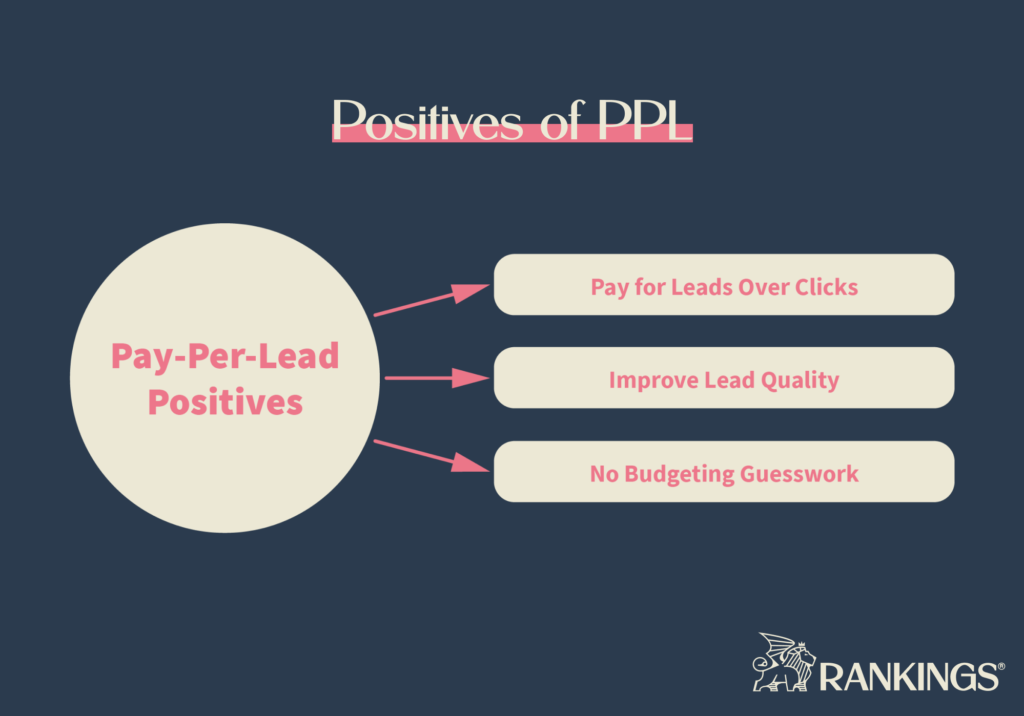
Pay per lead ads for lawyers function in a similar way to pay per click. The difference with PPL is that you pay to receive a lead from a Google local service ad or some other company.

Google local service ads can work well if your primary focus is on local clients. You only pay Google for people who contact your firm, and you can dispute erroneous leads.

The same is not always true of other lead services. Other pay-per-lead services may not offer exclusive leads. This means you still pay to get that lead’s detail but may be sharing those details with other lawyers.

It’s important to determine if PPL costs are viable for you in your marketing plan. It might be a way to generate some business when you start out, but it can get costly if this is your only way to bring in new clients.

Tips for Successful Online Marketing as a Lawyer

One of the best ways to increase your chances of success with online marketing is by avoiding the most common pitfalls. Many lawyers see limited results by not understanding how online marketing works.

Using our tips, you’ll be on the way to a successful campaign.

1. Don’t Start Without a Plan

You need a strategy, goals, and a plan to get results with your law firm marketing efforts.

Too many lawyers have no plan at all, simply jumping from one activity to the next. This leads to habitually trying the newest thing and giving up on it before getting traction. You’ll end up spreading yourself too thin.

By looking at what you want to achieve, it’s much easier to narrow down what you need to do to make your vision happen. Defining a law firm marketing strategy and an attorney marketing plan sets you up for success.

2. Know Who Your Target Audience is and Where to Find Them
To reach potential clients, you need to know who they are. “All adults” or “anyone thinking about getting a divorce” is not a target client identifier.

Narrowing down and clearly defining your audience helps with two important factors.

It tells you who they really are. You’ll come to understand what they care about and what kind of messaging resonates with them.

And it tells you where they spend time online. This determines where you will distribute your messages to them.

Understanding these factors helps you avoid a common pitfall. You won’t end up spending time in channels where your audience isn’t active or are unlikely to connect with a lawyer.

3. Keep Your Clients First in Your Marketing

Too many attorneys put the focus on themselves in marketing and not enough on the client and their needs.

One of the most impactful things you can do is place your client’s needs first in all of your messaging.

You can do this by creating marketing content that speaks to your client’s needs first. That doesn’t preclude you from sharing what you do. It just means you put the focus on how you help others.

Taking a client-first approach won’t just help you bring in new clients through online channels. If you can fulfill your promise of an excellent client experience, you can cash in on word of mouth, too.

4. Build a Great Law Firm Website

Regardless of the channels you choose, your website is the central hub for your marketing. This is also the place where you have the most control over how your law firm looks. You get to decide the branding, style, and content across your entire website.

One common pitfall for lawyers is hosting an outdated, inaccessible, or unattractive website. It’s easily avoidable, and it just turns potential clients away to go look for someone else.

Instead, focus on a website that:

  • Was built by a professional
  • Loads quickly
  • Is easy to navigate
  • Helps solve client problems

To expand upon the last tip, your website exists primarily to help your clients. You can make sure it meets this goal by putting informative content across your whole site.

5. Choose the Channels that Work For You

The good news is that you don’t need to spend all of your efforts working on multiple channels at once.

Instead, you can choose the marketing channels that mesh with your goals and are places where your clients spend time.

As you grow, you may choose to alter these channels over time.

For example, you might lean heavily on pay per click at the beginning. Later, you might swap PPC out for SEO efforts once you’ve built up your online presence.

A mistake made by many is to give up too soon. Give each marketing channel and tactic enough time for you to really get a sense of whether it will work for you.

Look back at your goals and key performance indicators to stay on track, only deciding to eliminate a channel when it’s clear it’s not working.

6. Work with a Marketing Partner Who Understands You

There are a lot of moving pieces in online legal marketing. It’s no surprise that many successful attorneys rely on the help of a law firm marketing expert.

Trying to manage marketing all on your own can set you up for failure. You might get overwhelmed or in the weeds. As a lawyer, your time is best spent in your zone of genius, not dealing with the details of marketing.

Finding the right expert is the best way to leverage someone else’s experience. You will benefit from saving time and gaining the confidence that you’ll be getting things right.

Find the Right Marketing Partner Now

Now that you know what pitfalls to avoid, you can cut out a lot of the trial and error in online marketing as a lawyer.

Whether you’re looking for help with social media or SEO services for lawyers, finding the right legal marketing partner helps you get things right from the get-go.

An expert can help you create and customize your plans that fit your law firm perfectly. They can help you build your practice without the extra stress of taking it all on yourself.

Rankings.io is well-known for executing winning law firm marketing strategies. We’ve helped some of the most successful law firms bring in new clients consistently. If that sounds like the perfect plan for you, contact us today to get started.

The post The Beginners Guide to Online Marketing for Lawyers appeared first on Rankings.

100 Instagram Bio Ideas for Lawyers (And How to Craft a Unique Bio)

Instagram is the fourth most used social media platform in the world. The average person on the platform spends 30 minutes a day there.

While the feed scrolls by quickly, you can capture the attention of your ideal client on the platform. Generating engaging and interesting content might prompt a prospective client to learn more about you in your bio.

If you can get someone to click over to your bio to learn more, you want to make a solid impression there. Your bio should make it clear what you do and the kind of content you’ll share.

This could be the thing that tips someone over the edge to follow you or to connect with you personally.

Your bio is about you, but it’s also about giving your audience a window into the value you provide on the platform.

Crafting your own bio on Instagram is best for connecting with your audience. You can use the lists in this article for inspiration as you make your own.

Why You Should Go with an Original Bio

There is no shortage of lawyers on Instagram using copy-and-paste bios. Recycled quotes from other people may be convenient, but they won’t help you stand out.

A recycled quote or joke doesn’t tell your audience anything about you or what you have to offer as an attorney.

Your Instagram bio is another chance to stand out from the crowd. You can use your bio real estate to tell your potential clients who you are, who you serve, and how you help them.

Client-Experience Focused Instagram Bio Ideas for Lawyers

When you can give people a window into what it’s like to work with you, you’re in a better position to attract ideal clients who are looking for your skillset and unique value proposition.

Modify these bio prompts to your practice area to ensure readers know exactly who you are.

  • Expertise Meets Experience
  • Putting Clients First
  • Empowering Your Legal Rights
  • Legal Assistance You Can Count On
  • Your Advocates in the Legal System
  • Comprehensive Legal Services for Your Needs
  • Effective Legal Solutions for Your Business
  • Skilled Representation for Your Case
  • Compassionate and Diligent Attorneys
  • A Legal Firm That Cares
  • Your Reliable Legal Partner
  • Your Strongest Legal Ally
  • Your Dedicated Legal Advocates
  • Your Partner for Personal and Business Needs
  • Advocating for Your Fair Treatment
  • Legal Solutions That Work for You
  • Your Trustworthy Legal Team
  • Fighting for Your Best Interests
  • Innovative Legal Solutions for Your Business
  • Your Legal Advocates for Life
  • Results-Driven and Client-Focused
  • A Firm That Fights for You
  • Personalized Legal Advice
  • Fighting for Justice
  • Legal Solutions for Life’s Challenges
  • Dedicated to Your Case
  • Personalized Legal Services
  • Protecting Your Interests
  • Committed to Your Success

Here, McBean Immigration Law highlights the aspirations of their clients: to live the best life they can in the United States.

Without getting too narrow, this lawyer hits right at what’s most valuable at the end of a challenging legal journey. The bio also indicates this lawyer is a thought leader by pointing out their subscriber level on YouTube, which is full of helpful information for people with immigration-related questions.

Instagram Bio Ideas Focused on Your Competitive Edge as a Lawyer

To stand out from the competition, your law firm may look at legal problems in an innovative way. This gets to the heart of some of the top concerns people have about working with a lawyer.

For clients who want an advocate in their corner taking their needs and questions seriously, this category of Instagram bios tells a bit more about how you look at legal problems to find solutions.

  • Experienced and Skilled Attorneys
  • Your Voice in the Legal System
  • Smart, Strategic, and Aggressive Representation
  • Compassionate and Tenacious Attorneys
  • A Law Firm You Can Trust
  • Innovating Legal Solutions
  • Your Shield in the Legal Arena
  • Your Legal Partner
  • Compassionate Advocacy
  • Experienced Legal Counsel for You
  • Your Voice in the Legal Arena
  • Holding X Opponents Accountable (Insurance Companies, etc.)
  • Mediation-Focused Lawyers Who Help You Win Out of Court
  • Strategic Legal Counsel for Your Case
  • Award-Winning Trial Advocates
  • Professional Legal Services That Deliver Results
  • Innovative Legal Strategies That Win
  • Legal Solutions That Meet Your Needs
  • Advocating for Your Best Interests
  • Your Strategic Legal Advisors
  • Empowering You with Legal Expertise
  • Skilled Advocacy for Your Case
  • Legal Support for Personal and Business Needs
  • Professional Legal Services That Work
  • Legal Representation Putting Settlement First
  • Creative and Strategic Legal Solutions
  • Innovative Legal Strategies for You
  • Trusted Advisors in the Legal Arena
  • Innovative and Creative Legal Strategies
  • Delivering Better Outcomes for Clients
  • Skilled and Experienced Attorneys
  • Protecting Your Future
  • Legal Assistance for All
  • Dedicated to Protecting Your Rights
  • Finding Solutions for Complex Legal Issues
  • Your Strongest Legal Advocate
  • Legal Solutions for Your Business
  • Protecting Your Interests with Expertise
  • Efficient and Effective Legal Services
  • Skilled Legal Representation for Your Case
  • Trusted Legal Counsel for America’s X Clients

Thought-Provoking Instagram Bio Ideas for Lawyers

While it’s a best practice to touch on your most prominent practice area, you might also decide to dig deeper. You might want your bio to reflect on the bigger mission for your firm, something you care about in your community, or a unique aspect of your practice.

Here are some examples of other Instagram bio concepts that go a little deeper than talking only about what kinds of cases you accept.

  • Empowering You with Legal Knowledge You Need to Win
  • Advocating for Your Rights and Freedom
  • Dedicated to Exploring All Avenues for Resolution
  • Restoring Justice for X Clients
  • Giving a Voice to Y Clients
  • Challenging a Broken System/Process
  • Taking Injustice Head On for Z Clients
  • Finding/Providing Clarity in the Legal Process
  • Dedicated to Justice for All
  • Fighting for What Matters: Your Constitutional Rights
  • Protecting Your Rights and Future
  • National Team of X Lawyers with a Reputation for Y
  • Your Legal Guardian
  • Problem-Solving Lawyers
  • Your Advocates in the Legal System
  • Legal Solutions for Real Life
  • Your Legal Shield Against Injustice
  • Finding Solutions to Your Legal Problems
  • Your Trusted Partner in the Legal System
  • Bringing Resolution to Complex Legal Issues
  • Legal Support for Life’s Challenges
  • Bringing Justice to Your Doorstep
  • Your Ally in the Courtroom
  • The Law on Your Side

How to Create Your Own Unique Lawyer Instagram Bio

Creating an original, compelling lawyer bio doesn’t take much more effort than using a premade one, but you can get much more out of it.

There are four simple steps to writing a compelling lawyer bio on Instagram:

  • Make your services clear
  • Use relevant hashtags
  • Make it easy to read
  • Use the right link in your bio.

Following the steps below sets you on the path to making a great lawyer Instagram bio.

1. Make What You Do Clear

Since you only have a brief opportunity to make an impression with your Instagram bio, make it count. You might want to write this in Microsoft Word or Google Docs to make sure that you’re staying under the 150 character count.

Within your bio, focus on telling people who you are and what you do. Use keywords so you show up in Instagram’s search.

For example, an accident lawyer might use the terms “personal injury” or “accident victims” in their bio to make it completely clear what they do.

Clear doesn’t mean stuffing in every keyword you can think of, though.

Trying to overload the space with too much information or emojis may do more harm than good. Doing that doesn’t always clearly share your expertise with Instagram. This could result in you not showing up in search results.

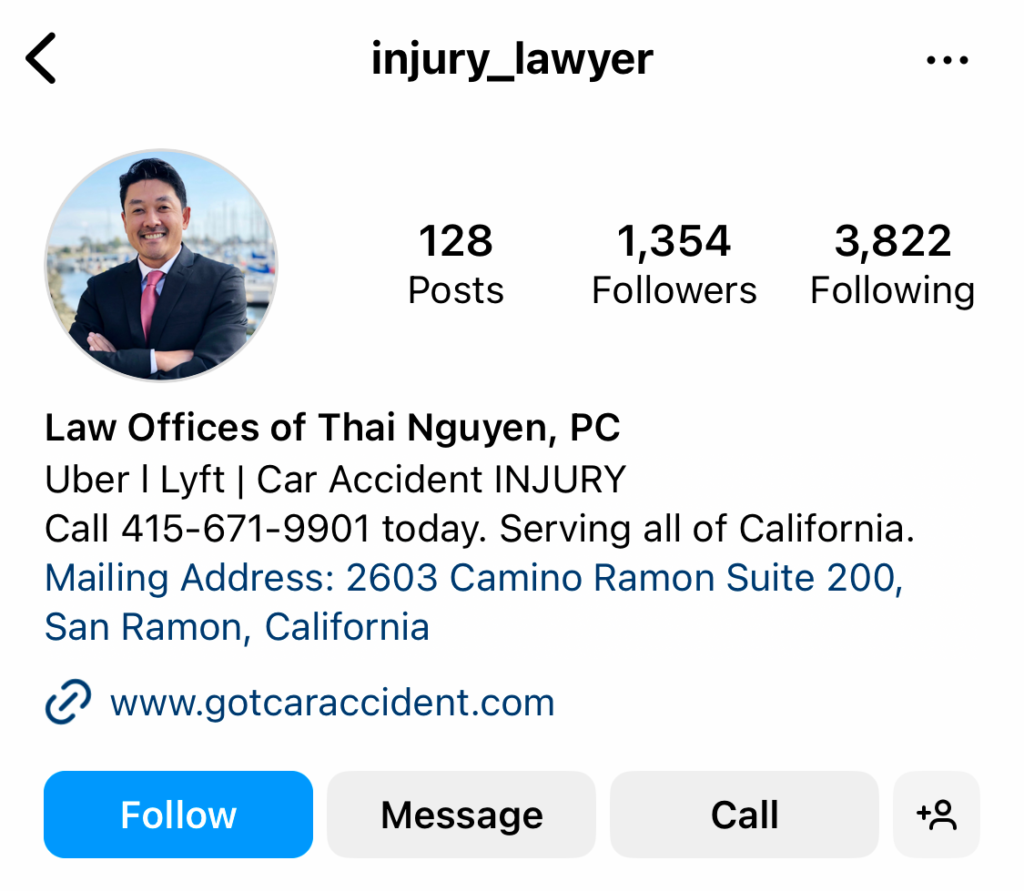
Moe the Lawyer makes his practice areas, location, and contact details very clear. While he does use an emoji, it’s only one and makes sense for his profession.

2. Include Relevant Hashtags

It is a good idea to use hashtags in your bio and throughout Instagram where relevant.

One of the most common mistakes attorneys make when it comes to hashtags is using far too many of them. The 150 character limit includes any hashtags, so use them sparingly in your bio.

The hashtag included in this bio makes sense. It makes both the firm’s practice area and geographic service area clear for any visitor who sees the bio.

3. Make it Easy to Read

Take advantage of making your content easier for a viewer to read. Spacing things out does take up valuable character space, but it also makes for a more compelling bio.

Line breaks, emojis, and other formatting options help your text stand apart. This makes it simple for someone to absorb the information quickly.

This Miami injury attorney uses line breaks and emojis really well. He also wraps things up with a clear call to action, pointing to the most relevant links on his website.

4. Make Your Bio Link Count

You only get one bio link on your profile, and many people use tools that open a pop-up of other links. This can help drive traffic to book a call directly, download a free guide, or go somewhere on your website.

Decide what’s going to get the most impact for your law firm based on your personal Instagram goals.

Your Instagram Bio is Just the Beginning

Now that you know what works for a strong Instagram profile, you can draft up an idea for your own. Once you have a bio and picture added, you’re ready for the next level of using Instagram to get clients.

Your bio is just the beginning. Choosing the right captions on your Instagram posts is an art form of its own. Knowing what kinds of law firm Instagram post ideas to use will help you reach your target audience.

Putting these elements together will help you move them through the law firm marketing funnel.

The post 100 Instagram Bio Ideas for Lawyers (And How to Craft a Unique Bio) appeared first on Rankings.

Top 75 Personal Injury Keywords for PPC and SEO (and Why Keywords Alone Won’t Help You)

For any given search on Google, the first page in the results gets nearly 32% of the traffic. Targeting the right keywords allows your site to rank on Google and capture that traffic. They also allow you to choose the highest ROI terms for Google Ads campaigns.

But finding the best keywords for your personal injury law firm’s search engine optimization or PPC campaign is only a small part of successful marketing.

We’ve put together a list of some of the best personal injury keywords for you to target. Many of the keywords below serve as an excellent jumping-off point for PPC and SEO. The important part is knowing how to use them effectively.

Keyword Volume Cost Per Click
best motorcycle accident lawyer 2700 $770.00
semi truck accident attorney 1300 $350.00
18 wheeler accident attorney 1000 $355.00
[city] trucking accident attorney 700 $500.00
trucking accident lawyers 700 $320.00
medical malpractice lawyers [city] 600 $355.00
medical malpractice lawyers in [city] 600 $300.00
[state] truck accident lawyer 500 $515.00
[state] construction accident lawyer 500 $485.00
mesothelioma cancer lawyer 500 $430.00
offshore accident lawyers 500 $320.00
personal injury attorneys [city] 500 $310.00
good car accident lawyers 450 $500.00
car accident lawyer [state] 450 $400.00
[city] construction accident attorney 450 $310.00
[city] car accident lawyers 400 $780.00
[city] personal injury attorneys 400 $445.00
personal injury attorneys [city, state] 400 $395.00
truck accident attorney [city] 350 $515.00
mesothelioma lawyers [state] 350 $480.00
accident lawyer [city, state] 350 $475.00
non injury car accident lawyer 350 $360.00
big rig accident attorneys 350 $300.00
18 wheeler accident lawyer [city] 300 $670.00
accident lawyer [state] 300 $365.00
best mesothelioma lawyer 300 $340.00
personal injury attorney [state] 300 $325.00
medical malpractice attorney [city] 300 $315.00
auto accident attorneys [city] 250 $560.00
medical malpractice lawyer [state] 250 $485.00
car accident lawyer [city] 250 $430.00
personal injury law firm [city] 250 $410.00
[city] truck accident attorneys 250 $385.00
[city] accident attorney 250 $340.00
accident lawyer [city] 250 $320.00
truck accident lawyer [state] 200 $650.00
auto accident lawyers [city] 200 $485.00
[city] truck accident lawyer 200 $395.00
boating accident attorney 200 $375.00
car accident attorney [city] 200 $345.00
[city] wrongful death attorney 200 $335.00
[city] birth injury lawyer 200 $335.00
best mesothelioma attorney 150 $840.00
car accident lawyer in [county] 150 $585.00
[city] personal injury lawyer 150 $560.00
best accident lawyers in [city] 150 $470.00
auto accident attorney [state] 150 $465.00
auto accident lawyer [city] 150 $460.00
maritime injury attorney 150 $430.00
auto accident attorney in [city] 150 $375.00
[state] personal injury lawyers 150 $370.00
[city] car crash attorney 150 $355.00
[state] accident attorney 150 $350.00
auto accident lawyers [state] 150 $350.00
[city] construction accident lawyer 150 $345.00
[city] auto accident attorney 150 $325.00
[state] car accident attorney 150 $305.00
[state] auto accident lawyer 100 $475.00
accident attorneys [state] 100 $465.00
truck accident lawyer [city] 100 $425.00
auto injury accident lawyer 100 $415.00
[city] car accident attorney 100 $410.00
best medical malpractice lawyer in [city] 100 $400.00
personal injury attorney [city] 100 $385.00
personal injury lawyer in [state] 100 $375.00
best medical malpractice lawyers [city] 100 $340.00
accident lawyers [state] 100 $310.00
semi accident attorney 100 $300.00
[city] motorcycle accident attorney 100 $300.00
best car accident lawyer in [city] 80 $395.00
auto accident lawyers in [city] 60 $440.00
should i get attorney for car accident 60 $365.00
how much do personal injury attorneys charge 30 $405.00
mesothelioma and asbestos lawyers 10 $445.00
how to choose a mesothelioma lawyer 10 $360.00

We’ve sorted this list by monthly search volume so that you can get an idea of how often people look for these terms. You can also look at these terms based on the cost per click. This is an estimate of how much you could expect to pay each time someone clicks on you ad when you bid on that term.

How Can You Use These Keywords?

You can use these keywords to inform and direct both an law firm SEO campaign and a Google PPC campaign. This can help drive traffic from prospective clients who see your website in the organic search results or the pay-per-click ads results.

In Your SEO Campaign

SEO keywords can help you choose what topics to target for content. They’ll help you select which service pages belong on your site and which topics make for good blog posts. They can also enrich that content when you use them right.

SEO keywords are what your potential clients use to search the web for information or answers to questions. The more you can align your content with their needs, the easier it is to capture that traffic. When done right, this allows you to introduce yourself and your firm to visitors.

On your personal injury website, you will use your keywords in multiple places, including:

  • URLs: the page’s web address
  • Titles and H1s: your page titles and high-level headlines on each page
  • Headings: the subheaders used to break up content on the page
  • Meta descriptions: the 1-2 sentence overviews of what’s on the page that appear on search engines
  • Body copy: the main text of your post or page
  • Image alt text: text that explains what the image is for the visually impaired

Together, keywords in all these locations signal to Google about the primary topics of the individual page and your website as a whole.

In Your Google Ads Campaign

Google Ads is built around keywords. Bidding on the right ones can help get your ads in front of people who are at the bottom of the law firm marketing funnel.

Your best bet on Google ads is to bid on high-intent keywords. These are the terms that indicate someone is ready to hire an attorney to assist with their legal issue.

PPC for personal injury lawyers can get expensive.

The value and the level of competition among lawyers can drive the cost per click up. It’s not uncommon to see terms that cost several hundred dollars per click. This makes it important to be selective with the terms you choose to bid on.

Keywords Alone Won’t Guarantee Success

Keywords are crucial for SEO and Google ads results, but on their own won’t get you the new clients you need. If you took our list of PI keywords and added them all over your website, you won’t get the traction you want.

To get the best results, you have to know how to use these terms as a component of your marketing efforts.

Haphazardly Using SEO Keywords Won’t Get You Far

Getting a list of ideal law firm keywords is the first step. Law firm keyword research is important, but it only informs the decisions you’ll need to make next.

When looking through keywords, take some time to think about search intent.

What did the person entering this term hope to find? Does this align with any possible service page types or blog posts? This process requires research and intuition as part of your lawyer content strategy.

It’s useless to create a post or page too without putting in the time to think about the searcher’s intent.

If someone lands on that page and doesn’t get the help they hoped for, they’ll just hit the back button. That doesn’t help that page to rank, and it doesn’t keep the reader on your site long enough to learn about you.

Searcher’s intent also relates back to where the reader is in the law firm marketing funnel. Content for people at the top of the funnel is different from content for someone who is on the verge of hiring a lawyer.

The hard sell can turn those top of funnel readers off. They’re looking for useful information about the topic and may not even know they need a lawyer yet.

Avoid Keyword Cannibalization

A common problem that inexperienced SEOs run into is keyword cannibalization. This is when two closely related pages on one website compete against each other on Google.

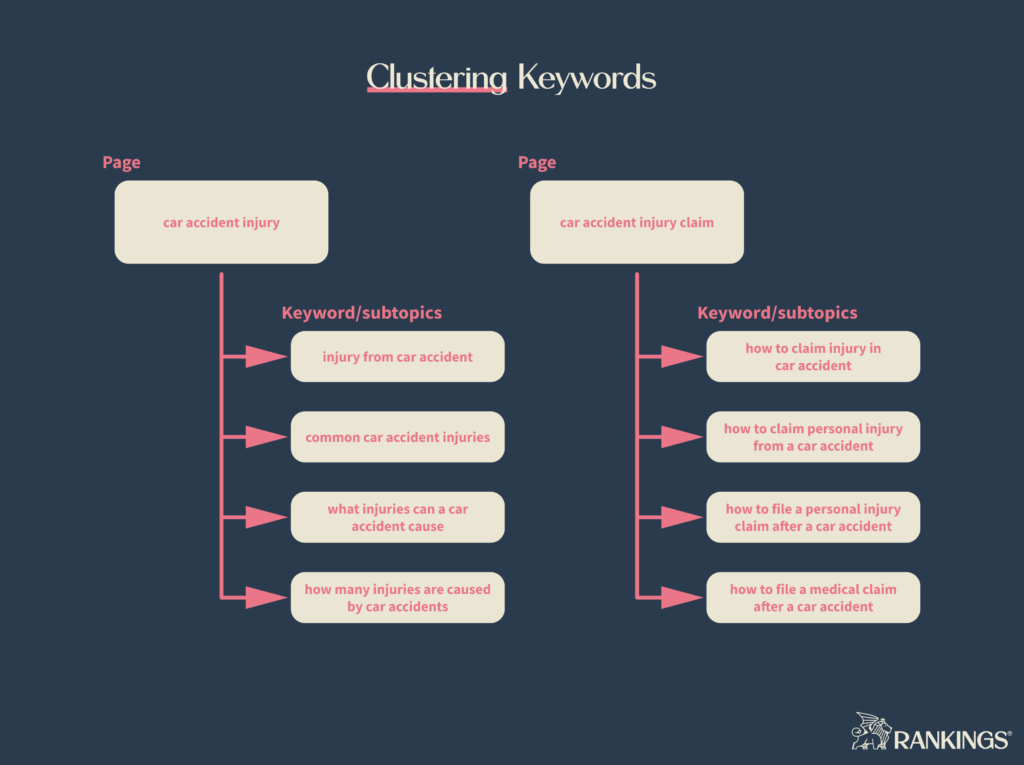
Keyword cannibalization can be caused by poor keyword research and topic selection. When Google indexes keywords, it groups them into categories.

For example, the results for the keyword car accident injury and injury from car accident are the same. That’s because Google has grouped them together into a cluster.

If you know this, then you know that you only need to create one page to target both terms.

If you tried to create two pages for these terms, those pages would confuse Google. It would see two pages both about the same thing, and would have trouble deciding which to rank.

You might end up with two site pages ranking on the third page of search results in Google, which does no good for you. Meanwhile, your competitors who created only one page get the win.

The best way to avoid this is to hire a skilled SEO expert who knows how to recognize keyword topic clusters. This takes knowledge, data, and research to figure out.

A legal SEO expert will identify related keywords to avoid cannibalization. Instead, they can create hubs of content that reinforce one another. This can draw visitors further down the marketing funnel, leading to more traffic and new cases.

Keywords Don’t Guarantee Quality Content

The content that you put on your law firm website must be high quality. To succeed, it needs to be written for both search engines and people.

It’s tempting to try to write all the content yourself or to hire someone who will write it at little cost. The former is almost always a waste of a lawyer’s time. The latter introduces a different problem.

Years ago, people would try to trick Google into ranking content through “keyword stuffing.” They’d write anything as long as the right keywords were on the page in the right amount. The end result was unhelpful content full of stilted language.

That doesn’t work anymore.

Now, Google looks for the best content that matches the searcher’s intent. The search engine looks for language that works naturally and addresses the reader’s primary concerns.

A good SEO campaign is about more than keywords. It takes an understanding of balancing those keywords with intent and natural language. It requires knowledge of technical nuances that make your site search engine-friendly. It also requires knowledge of things like internal linking and link building.

All of these elements combined make it so that users can find what they need, and Google can gather crucial context about your site, your firm, and your services.

Bidding on Low-Intent Google Ads Keywords is a Waste of Money

If you’re putting up the money to invest in law firm Google Ads, don’t waste your efforts on low-intent keywords. Some keywords might seem great on the surface but have nothing to do with the law.

If the person using them is not interested in hiring a lawyer right now, they won’t get you results. Bidding on the wrong keywords is just throwing good money after bad.

Much like SEO, winning on Google ads takes time and dedicated research. You have to find the right keywords that will net you results.

Making a good ad for Google PPC also requires copywriting skills. It’s not worth your time to try to master those, either. Find a good marketing partner who understands all elements of running these ads to get the most out of your ads.

Work with a Law Firm Marketing Partner to Get the Most Out of Your Personal Injury Campaigns

Working with a law firm marketing expert is your best bet to get the most out of organic search and paid ads on Google.

Too many law firms either try to take on everything themselves or hire a partner who doesn’t understand the legal industry. This gets bad results and leaves lawyers feeling like they wasted their time.

Personal injury lawyer SEO and Google Ads can work for personal injury attorneys when you choose a trusted expert to handle it for you.

Rankings.io is an industry leader in these services, with client testimonials to back it up. Make a sound investment by contacting Rankings.io to handle one or both for you.

The post Top 75 Personal Injury Keywords for PPC and SEO (and Why Keywords Alone Won’t Help You) appeared first on Rankings.

PPC for Lawyers: 11 Tips for Success with Digital Ads

Lawyers have many options for putting their brand out there with ads. PPC advertising is a powerful tool for lawyers. Getting the most out of it requires following a few important principles.

PPC stands for “pay per click.” You place an ad on a platform and pay each time someone clicks that ad. There are a few models out there for PPC, with the most popular being Google and Facebook.

Deciding if PPC fits into your marketing strategy is key. Many lawyers invest in PPC without realizing how it truly works, the potential cost, or how to optimize their campaigns.

Does PPC Work for Lawyers?

When done correctly, PPC has several benefits for lawyers. Before committing to PPC, consider whether it fits your overall lawyer marketing strategy. This ensures it aligns with your needs and goals.

Some of the biggest benefits of PPC include:

  • Quick results
  • Narrow targeting, especially on Facebook
  • It’s easy to control your budget
  • Many analytics and monitoring tools work for tweaking campaigns

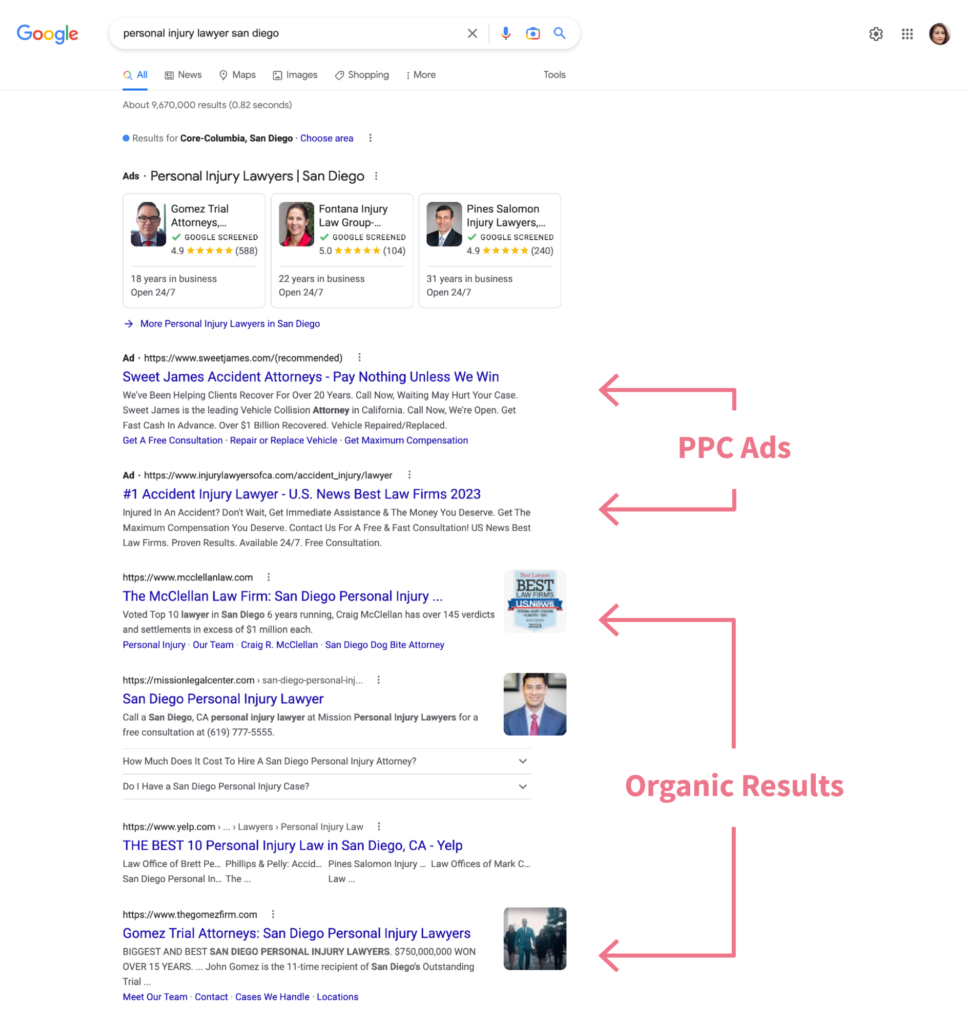
When looking specifically at Google PPC, the ads take up a lot of real estate on the search engine results page. This is one reason why so many lawyers use these campaigns.

Take this example in San Diego. Someone has to scroll through the sponsored pages before getting to the organic search engine results.

When there’s heavy competition in your local area for organic search results, you can use this to your advantage. Bidding on the right ads could position your firm above others. This could get more eyes on your business.

PPC vs. SEO

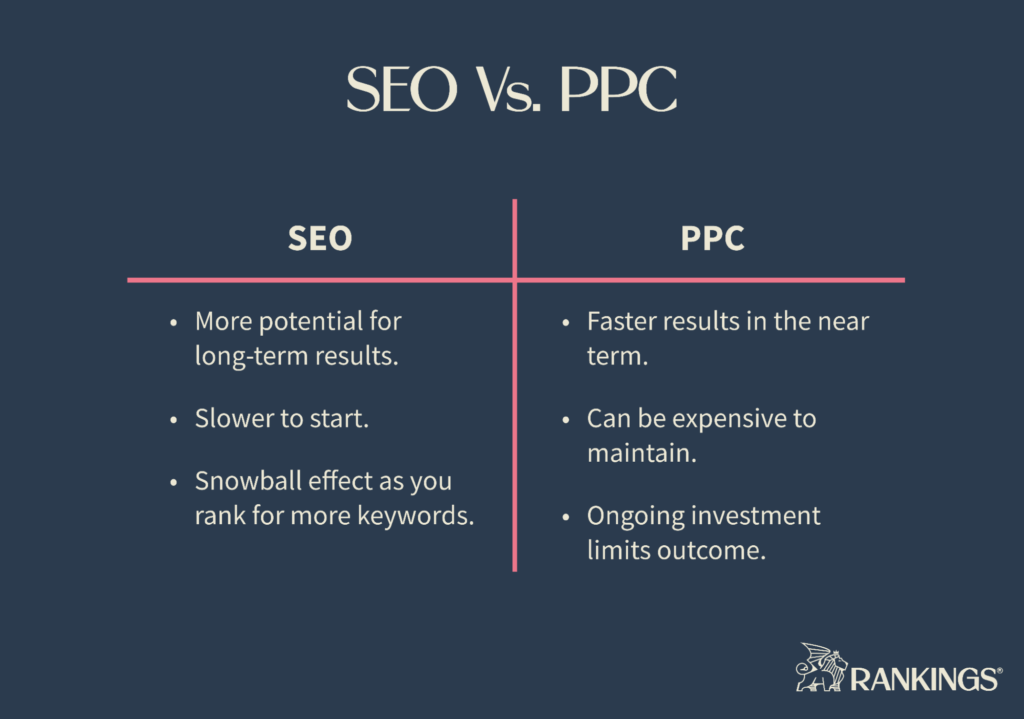
Both PPC and search engine optimization can work for law firms trying to reach more new clients. They’re not an either/or since both can work better together. Understanding the pros and cons of each is the key to deciding how to mix them into your marketing plan.

SEO has a stronger potential for long-term results but can be slower to start. You won’t get the fast results that may come from PPC.

PPC delivers faster near-term results, which may work better for a new law firm. But it can be expensive to maintain over time.

PPC systems require ongoing investment to get results, limiting your outcomes. Meanwhile, SEO work may snowball as you work to rank for multiple keywords.

With social media ads, it can be harder to target your ideal client.

Consider how things might look for a family lawyer.

You can’t use Facebook to target “people who are in debt.” But on Google, you can bid on terms like when to declare bankruptcy.

A query like that could indicate a potential law firm client who’s at the bottom of the funnel. This could be someone who’s interested in hiring a bankruptcy lawyer soon. You can’t target those same audience members on Facebook as easily.

Look for ways to balance SEO and PPC marketing tactics. You may start heavier with PPC, ramp up your SEO output, and then cut back on your PPC spend. With those considerations out of the way, here are 11 tips to get the most out of your PPC.

1. Define Your Goals

As with any initiative in your law firm, start with a plan. Goals and planning are crucial for you to define what winning looks like.

Setting the right goals will help you align your budget and tweak your advertising campaigns in the future if needed.

Your law firm’s PPC marketing goals may include metrics like:

  • Number of leads per month
  • Conversions per month
  • Generating demand or awareness through social ads (such as contact form completions)

Track this information from early on in your PPC campaign so you can monitor progress later.

2. Know Your Target Audience

Knowing your audience will help you determine what types of ads to create and which platforms to use.

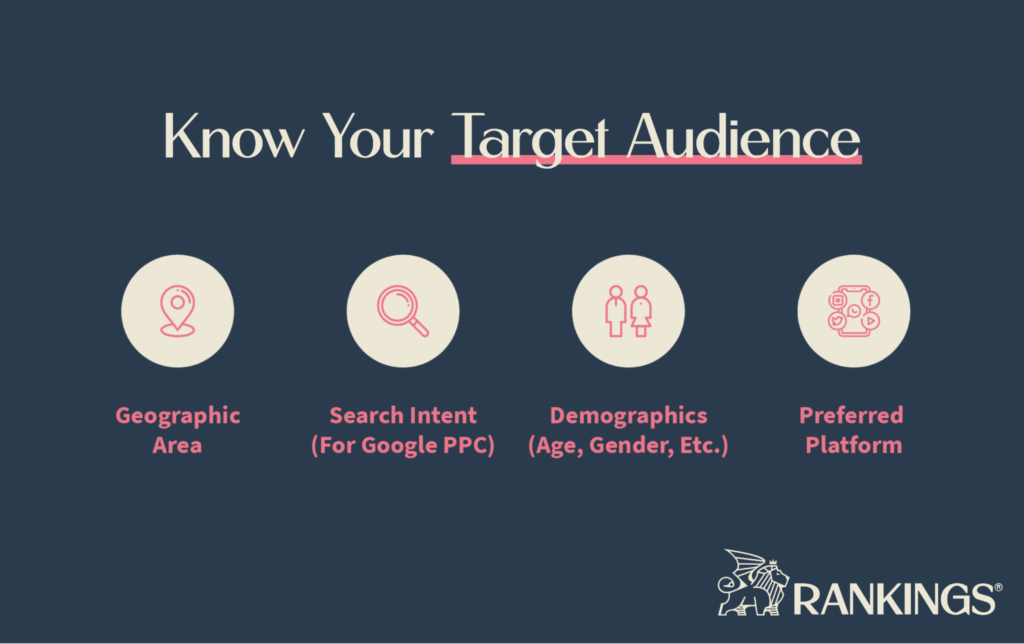
Use the following concepts to craft your target audience for any PPC ads:

  • Location
  • Search intent (for Google PPC only)
  • Demographics such as gender
  • The places they spend the most time online to choose your ad platform

Putting a lot of effort into this part of the process will pay off later. Your copy and images should also speak directly to your ideal clients to meet their needs. You may want to test a few variations for PPC ads to see what works best.

3. Set Your Advertising Budget

To advertise, you need to set your budget in advance. Develop an overall budget in your attorney marketing plan first. From there, you might have a specific portion set aside for PPC ads. You may adjust your spending over the course of the year in line with your budget as needed.

Numerous factors influence the cost of online advertising. These include your location, your existing marketing presence, and your practice areas.

If other lawyers actively advertise with PPC in your region, this can drive the cost up. And if you’re in a highly-competitive practice area, the cost of Google Ads keywords may be too high to consider. Personal injury lawyer PPC, for example, is one of the costliest ads markets of all industries

4. Choose Your Advertising Platform

There are a few different platforms available to lawyers who want to use PPC advertising. The primary options are Google and Facebook. Other niche options might work for your practice areas, too.

On Google PPC, you’ll find hot and warm traffic. This is great for targeting people at the middle or bottom of the law firm PPC funnel. These are leads looking for more information to solve their problem or to hire a lawyer immediately.

Your ads should link to informative and action-driven landing pages. These will help convince visitors that you’re the right fit to solve their problem.

On Facebook PPC, you’ll find a mix of cold and warm traffic. Reach these people with educational, informative content. This can make top of funnel audience members more aware of the problem and your solution. That way, they’re ready to seek you out when they move further down your law firm marketing funnel.

Demand gen advertising is best for law firm Facebook PPC. This involves getting your brand out there to keep it top of mind with potential future clients.

Depending on your practice area, other PPC avenues may be available to you. For example, business lawyers may reach new clients through LinkedIn ads. Intellectual property lawyers for online creators might use TikTok ads.

If you’re not sure which channels to use, consider hiring a marketing expert to help you.

This Facebook PPC ad runs for people who live in the geographic region of a recent toxic spill. Targeting is not always easy on Facebook, but you can narrow it down by things like location, age, and interests.

5. Conduct Keyword Research for Search Ads

If you’re going to do Google PPC, you must do keyword research. Keyword research tells you what your potential clients search for online. This allows you to select the phrases you’ll bid on in your campaigns.

Picking relevant keywords for law firm PPC starts with Google Keyword Planner. Enter general phrases you suspect may work for your firm there and click “get started.”

From there, you can see what keywords competitors bid on. You determine which ones are relevant to your legal services. You can also look for terms that have high search volume but low competition.

Ideally, select phrases that meet all three criteria.

You can also exclude certain keywords and build a negative keywords list. That way, you can block irrelevant searches that could waste your ad spend.

6. Create Compelling Ad Copy and Visuals

People will gloss over boring ads in their busy social media feeds. And they’re also unlikely to convert on Google. Great ads should capture someone’s attention and draw someone in to click on them.

On Google, this requires some copywriting basics. Write a great title and a description that matches the searcher’s intent for the query.

On social media, copy counts, but factor in the visuals as well. Look to make content that creates viewer interest in the services you provide.

When creating bottom of funnel ads, use a strong call-to-action. These urge clients to click and contact your firm.

Note this is only necessary for bottom of funnel ads when someone is really ready to hire you. When you target people further up the funnel, educational or entertaining ads work best.

This Google PPC ad is targeted, concise, and clear. You have limited space to make an impact, so craft your copy carefully.

7. Optimize Your Landing Pages

Once someone clicks on your PPC ad, they’re directed to a landing page. Having a great landing page for your search ads can be the determining factor for someone deciding to contact you.

Landing pages should be:

  • Relevant to the searcher’s intent for the keyword or to the social ad copy
  • Concise and to the point
  • Make it easy for potential clients to contact you with a phone number, a form, or other convenient options

It’s wise to create a few different design or copy options for a landing page to see what performs best. You can always optimize it over time to maximize your conversion rates.

8. Experiment with Different Ad Formats

Scenario explaining what A/B testing is

Creating PPC ads is not a one-and-done process. Trying different types of ads helps determine what performs best for your audience. This is particularly true on social media,

A/B testing involves evaluating at least two options to see what tracks better with your potential clients. You can create multiple variations by testing things like:

  • Video ads
  • Image Ads
  • Carousel ads

Run your A/B tests for a long enough period to get informative metrics. You may learn some lessons about which types of ads and copy really resonate with your followers.

9. Use Remarketing to Target Previous Visitors

When you connect with someone over a PPC ad, it’s vital to make a strong first impression. You may continue to put your message in front of that person using remarketing.

If someone visited your site but didn’t follow through to contact you, you can position your marketing for them again.

Up to 45% of law firms invest time and money in remarketing to follow up with potential clients. It may be easier to convert someone who’s already expressed some interest in working with you.

Remarketing performs most successfully with bottom of the funnel potential clients. These are people who are clearly interested in hiring a lawyer.

These include potential clients such as:

  • Someone who called you, but you were unable to answer
  • Someone who opened a chat on your site but didn’t finish the conversation
  • Someone who visits your site but didn’t complete a contact form.

You could also retarget cold audience members using ads that showcase your brand’s unique value proposition. But it’s less effective than targeting hot audiences.

10. Monitor and Adjust Your Campaigns

After you launch your campaigns, stay on top of performance. You’ll have a better sense of what adjustments to make for the best results.

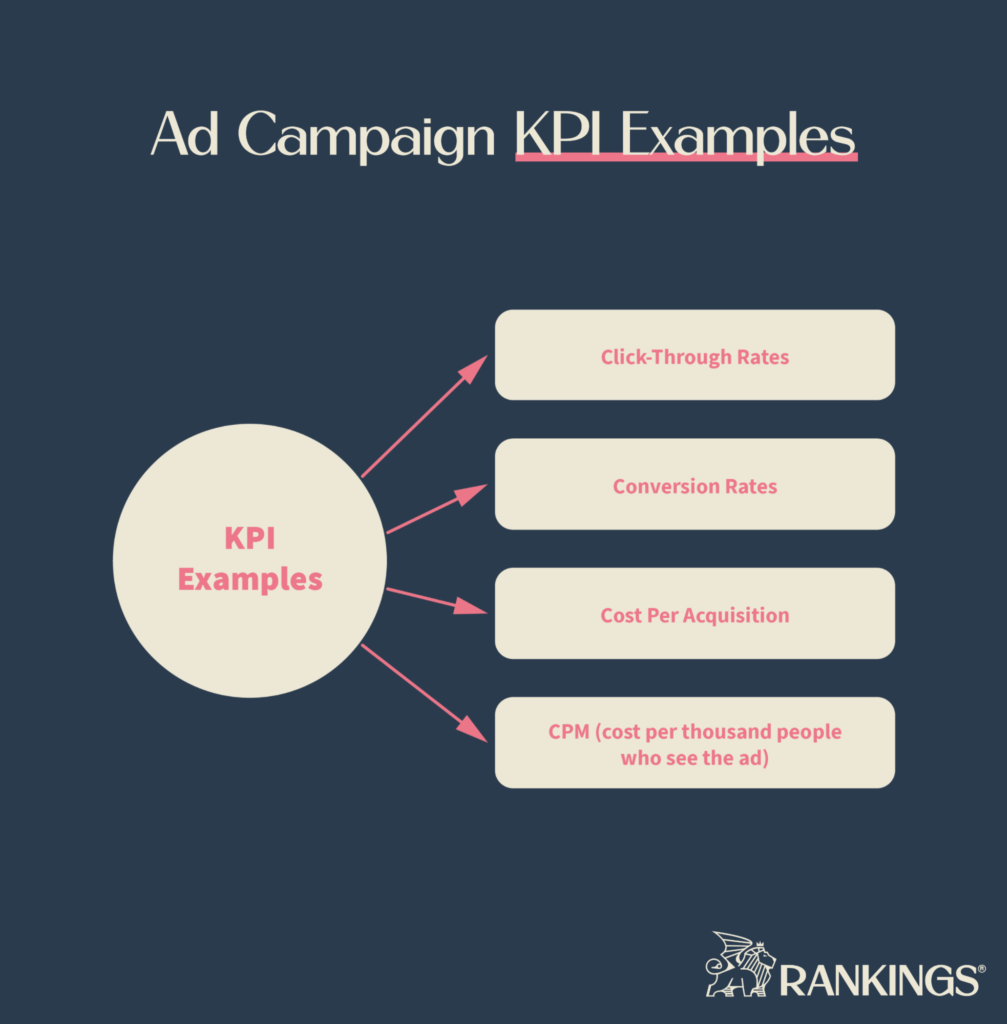
Your ad campaigns should each have KPIs that you measure against, like:

  • Click-through rates
  • Conversion rates
  • Cost per acquisition
  • CPM (cost per thousand people who see the ad)

Use the data you collect to make informed decisions and adjust your campaigns to improve performance and maximize ROI.

There are plenty of analytics tools you can use to view performance. The hard part is understanding how to interpret the data these tools give you.

If you work with a marketing expert, you can get a more accurate picture of your performance. These professionals understand what analytics data points to pay attention to. They can adjust your campaigns as needed to maximize your budgets and outcome.

11. Work with a PPC Expert

A lot goes into creating a great PPC campaign. You’ll get more out of your campaigns if you work with an expert. You’ll also waste less time that’s better spent on other areas of your firm.

There are numerous benefits to outsourcing to a law firm PPC expert:

  • Review the competition and best strategies
  • Create and optimize your campaigns
  • Monitor performance
  • Make data-driven decisions for better results

The right PPC expert will help you bring in new clients due to their knowledge in your practice area.

Fitting PPC Into a Law Firm Marketing Strategy

PPC is just one option for lawyers to reach ideal clients, but it’s not the only one. PPC works well in conjunction with an law firm SEO plan, for example. You can ultimately rely more on organic results and put less ad spend towards PPC.

Finding the right marketing partner is essential. They can help outline your goals, set your budget, and track your outcomes. The best part is you get to focus on what you do best: winning cases for your clients.

Rankings.io can help lawyers get the most out of PPC advertising. Our expertise and understanding of the legal marketing landscape put our clients in a winning position.

Contact us today to see how you can get the most out of your PPC campaign.

The post PPC for Lawyers: 11 Tips for Success with Digital Ads appeared first on Rankings.

Why Personal Branding is Important For Lawyers

Personal branding is a valuable way to build out your authority in the legal industry. It can help drive more prospective clients to you and your firm.

People in the legal space throw the word “branding” around all the time. But there’s typically a misconception about what it really means.

A strong personal brand is a strong reputation. It enables you to connect with your followers by sharing not just who you are but how what you do serves their needs.

Follow the right approach to boosting your reputation, and you can go far. It’ll help grow your online presence, establish trust with your ideal clients and make you stand in a crowded marketplace.

Enhance Your Reputation

Make no mistake: your personal brand is your reputation.

With your law firm brand, the brand itself and the firm’s reputation each stand alone. They inform each other but are separate. A lawyer’s “personal brand” is inseparable from your reputation.

Everything you say or do feeds directly into that reputation. This is why it’s so important to invest in your personal brand. A positive reputation in your region and practice area leads to referrals from previous clients.

It also builds a positive association with you and your law firm. People who have never worked with you before may still know you by reputation alone.

Build Your Online Presence for You and Your Firm

Developing your reputation online will contribute to your law firm’s reputation, by extension. The same is true for every attorney at your firm. You can raise your law firm’s visibility and online presence while focusing on your brand and reputation.

If you’re a solo attorney, your personal and firms brands are also the same thing.

If you work at or own a law firm with multiple attorneys, each of your individual reputations contributes to the firm’s reputation as a whole.

Here’s an example from Ohio injury lawyer Kyle Wright.

He successfully displays his reputation with his own website and billboards in Ohio. But he’s also found in firm-wide advertising, too.

Establish Trust and Authority with Your Target Audience

People have a very low public opinion of lawyers. You must do everything you can to overcome typical perceptions.

Putting yourself out there in a way that enhances your reputation will build trust and authority in you from your ideal clients.

This is where many lawyers have a hard time building their reputations. You can put yourself out there as much as you want and still fail at this point.

Too many lawyers think that establishing trust means talking about yourself and how great you are. Avoid stepping into this trap and instead provide real value.

Stand Out From a Crowded Market

When you offer value to your audience, they are much more likely to trust you. When they trust you, they’ll begin considering you an authority in your practice area.

Most lawyers are not willing to put in the work to build out their personal brand online. If you’re committed to doing that, you can stand out in the competitive market.

Plenty of lawyers are willing to volunteer in their communities every so often. But it’s a whole other ballgame to put in the effort to show up on a regular basis on social media.

If other lawyers refuse to play because it requires too much effort, this is a chance for you to step in. This is your chance to really make an impact with your target clients.

Where Can Lawyers Build Their Personal Brands?

There are a few great avenues for establishing and building your reputation as an attorney.

The best places to build your reputation are on social media, through a podcast, and in your community.

Building a website is not the same thing as building your brand. Your law firm website and the legal SEO efforts you put into it can help demonstrate your brand, but it will not build it alone.

Using reputation-forward content like case studies, testimonials, and reviews can reinforce your reputation. Site visitors who see that will be reassured by your previous clients’ endorsements.

Social Media

Lawyers can use social media platforms to reach a large audience of people and build a positive reputation with them. You can do so by sharing informative and engaging content with your followers and potential clients.

Some lawyers already have incredible traction on social media channels like Facebook, Twitter, and even LinkedIn. They get a lot out of social by using it to connect with their audience at a helpful level.

On YouTube, Legal Eagle does this through engaging and informative content. He’s built a reputation through creativity and consistency.

@mikerafi The only time my firm has been on rhe defense side #defense #lawfirm #plaintiff #father #family #kids #will #estate #fight #lawyok #lawyer #mikerafi ♬ original sound – Mike Rafi

On TikTok, Mike Rafi breaks down complex cases and concepts into understandable and interesting posts. He comes across as relatable, empathetic, and knowledgeable. This builds his personal brand and reputation as a lawyer.

Many people in the cases Mike talks about are in the middle of really difficult legal situations. He simply talks about the situation and why he took on the case. This demonstrates empathy and value.

Podcasts

Law firm podcasts can help you prove your expertise and authority in a longer form way than social media can. Content marketing with a podcast can showcase your credibility as you talk about solving legal problems. That may make listeners more likely to trust you when it’s time to hire an attorney.

The Atlanta Personal Injury Lawyer Podcast is a powerful example of positioning yourself as a market leader by sharing relevant content relevant to your audience.

Within Your Community

Helping out in your own community shows you’re dedicated to your local region. It also makes you more visible to other community members. That’s two great ways to build trust with the people around you.

Getting your whole team involved in community events is excellent for building brand awareness, too.

Pick something you’re passionate about for your community event. Or identify a clear need in your community to figure out how you want to help. Here are some examples:

  • Support local groups like Boy Scouts, 4H, and school clubs
  • Contribute to a park or roadside clean-up day
  • Build a house for Habitat for Humanity
  • Volunteer your firm to cook meals for a homeless shelter
  • Participate in fundraisers to raise awareness for issues
  • Start your own charity initiative and partner up with others
  • Participate in 5ks or walks for Alzheimer’s’ or breast cancer awareness

The sky’s the limit when choosing how to get involved in your community. If you can, choose something with a personal connection for you or a staff member.

Building a Great Personal Brand

The best way to build your reputation is by providing real value to your ideal client. It’s not by imitating influencers.

Too many lawyers spot something catchy on social media and then lose steam imitating it.

Don’t get sucked in by the idea of building a “personal brand story.” It’s far better to put the focus on your clients and how you help them. Niche down into your audience’s needs by thinking about things like:

  • What pitfalls or challenges do you help them navigate through?
  • What questions do your potential clients have before hiring a lawyer?
  • What concerns do your clients have about hiring an attorney?

When it comes to the content you create, you’re not the hero of the story. Your client is.

It’s not authentic to tell your “personal brand story” if it doesn’t relate back to how you serve your clients.

Look for ways to shift your focus to solving people’s problems and owning your niche. That’s when you’ll provide something new, different, and valuable to the world. That’s also where you’ll build a real, sustainable reputation.

@mikerafi How objections really work and why most are handled before trial #objections #judge #jury #lawyer #law #lawschool #court #mikerafi #tv #lawandorder #suits #lawsuit #lawtok #lawyersoftiktok ♬ original sound – Mike Rafi

Check out more of the shares posted by Mike Rafi on TikTok. At first glance, it seems like he’s taking the influencer route of talking about himself. But he’s not. Instead, he’s telling stories about how he served his clients facing difficult legal situations. People viewing that begin to imagine what it’s like to work with him.

Build Your Brand and Business

Building a law firm means thriving on multiple levels. For an online reputation that connects with potential clients, consider working with a law firm marketing expert.

Work with an experienced marketer to build the marketing strategy that’s right for you. Someone with law firm marketing experience is best equipped to help you create a strong reputation online.

Contact Rankings.io to learn more about how we can help you succeed. Whether it’s building your brand, advertising your legal services, or another digital marketing need, we’re here to help.

The post Why Personal Branding is Important For Lawyers appeared first on Rankings.

Why Strategic Planning for Law Firms Isn’t Enough

Although strategic planning is a popular phrase among law firm owners, it’s a misnomer. Strategic planning isn’t the same thing as planning. Likewise, planning is not the same thing as strategy.

You need a coherent strategy that lays out how you’ll win as a law firm. But too many business owners confuse a business strategy with aimless “strategic plans.”

What is Strategic Planning?

Stripped down, strategic planning is just glorified planning. It doesn’t have anything to do with real strategy.

Instead, strategic planning is a set of activities a company says it’ll do. The set may sound good but doesn’t really drive the results you want.

That’s because what most law firm owners call strategic planning doesn’t have any real strategy behind it. To make matters worse, they often lack an actual strategic planning process.

In short, you develop a strategy and ask strategic framework questions any time you need to make a choice. This includes developing attorney marketing plans and business plans. Strategy doesn’t stop at this level, either. Instead, it goes down to every decision level in your law firm.

Once you create your strategy, your plans can fall into place. For example, you’ll find it easier to determine which marketing channels and tactics align with your law firm’s strategy.

Business expert Roger Martin, whose work appears on our books every lawyer should read list, explains why the misconception about strategic planning harms business owners who could benefit from properly applying strategy in their companies.

Every business owner, including lawyers who manage their own firm, knows that strategy is valuable. Most leaders think that strategic planning is about preventing discomfort and fear in the future. Martin argues that dealing with those two factors is at the root of true strategy.

Rather than looking for ways to cut risk, real strategy involves thinking about ways to improve your odds of success in spite of them.

Most “strategic plans” look pretty similar from one law firm to another. They include a vision statement with a big goal. They list plans or initiatives to meet that goal. Then there’s an analysis of the relationship between those initiatives and revenue.

Projecting many years into the future feels comforting. At face value, it seems like a decent way to eliminate risk, and it’s helpful for thinking through budgets.

But that’s not the same thing as a strategy.

Strategy involves questioning assumptions and thinking carefully about what you decide not to do. “Strategic plans” can help a company form a budget. But that leaves out the opportunity to question strategies deeply. Too many plans focus on meeting quarterly or annual goals instead of answering tough questions.

Most existing plans that lawyers call strategic fail because these plans are only specific about the first year, too.

Martin notes, “… management typically commits only to year one; in the context of years two through five, “strategic” actually means ‘impressionistic.’”

Plans can certainly help you create a budget and a set of intended activities for your business. But, the activities in these plans are aimless without real strategy. Creating the plan feels comforting, but it’s not the same as setting you up in the best possible way to fight for your desired outcome.

Once you know the difference between strategy and what most organizations pass off as “strategic plans,” you’re on your way to developing your own law firm strategy.

Key Questions to Answer Any Time You’re Trying to Make a Decision

Strategy is a set of choices. Businesses like law firms are always actively making decisions. What’s key is that strategy doesn’t end at the business level.

Instead, it cascades and flows down to every decision made within the company. This means you must think about the best ways for your choices to reinforce those at the next level.

This doesn’t happen in most existing businesses where initiatives get stalled. The problem is due to poor “choice chartering.”

When a leader makes a decision in an organization, subordinates must make choices in line with that decision. Instead, most staff members are told to “execute” the manager’s decision. Without any clear direction, most staff members make their best guess. When they fail, they’re then accused of “poor execution.”

What a leader must do to avoid this is focus on choice structuring. A manager must tell their staff the choice made but also share:

  • Why the leader made that choice
  • That the decision directs staff to make choices that reinforce the leader’s choice
  • That the leader is available to help with this second-tier decision making
  • That the original choice can be revisited if staff cannot find a reinforcing one at their level

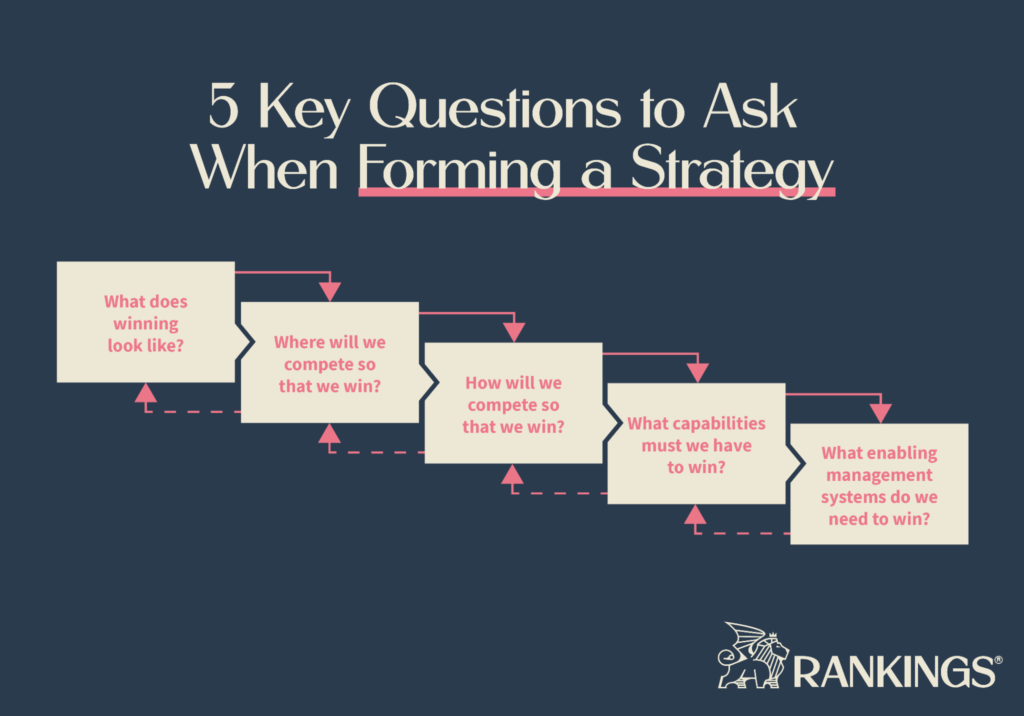
To start this process, there are 5 key questions that lawyers should ask themselves to form a law firm strategy at any level. These are:

  • What does winning look like?
  • Where will we compete so that we win?
  • How will we compete so that we win?
  • What capabilities must we have to win?
  • What enabling management systems do we need to win?

These are not linear steps. Instead, they are integrative and self-reinforcing. They demand that you circle back to the questions you asked earlier. This ensures your ideas fit together. You’ll consider each question individually and then how they influence one another.

What Does Winning Look Like?

Answering this question explains what success will look like for the decision you have made. This question creates alignment between the various goals you set for your firm. It establishes clear endpoints to get everyone on the same page about what success means overall.

You can ask this question at every level of your law firm. To define “winning,” you must reach beyond planning. Planning doesn’t actually incorporate what winning looks like. Instead, planning involves looking at a goal outcome and charting the path to that goal.

Where Will We Compete So That We Win?

Answering this question explains who you will serve, what types of cases you will take, and why taking those cases positions you in a way that will let you win. In short, it defines your playing field.

In answering this question at the business level, you’ll clearly define:

  • Your geographic service area
  • The category you service
  • Your client segment

If you’re having trouble narrowing down your answers, check out the book Niching Up. Rather than casting a broad net, limiting your market to a specific niche could work out better.

How Will We Compete So That We Win?

Answering this question explains the decisions that you need to make in your chosen playing field so that you will win.

At the business level, you must compete either on cost or differentiating factors. The latter tends to be a more viable route for lawyers.

Consider the following:

  • What makes us unique?
  • What complaints/fears do clients typically have about lawyers?
  • How do we use our unique qualities to overcome client complaints/fears?

Clients have plenty of choices in the legal market. To win them over, you must make the case that your law firm is the right choice compared to other options.

This question and the previous one are intrinsically tied together. As you approach these questions, you may find yourself revisiting them often.

What Capabilities Must We Have to Win?

Answering this explains the skills, abilities, and resources you need to win in your chosen playing field.

This is often where most lawyers struggle to decide which elements fit into “how to win” versus “capabilities to win.”

Your “how to win” is your theory of how you’re different from your competitors. To define it, you should feel confident that your competitors can’t or won’t match your competitive advantage.

Your “must-have capabilities” are the things you invest in to turn that theory of advantage into a reality. Here are some examples of how a law firm might cover capabilities:

  • A staff of lawyers with skill and experience in the chosen practice area
  • A way to get the word out about their firm to bring in new clients

What Enabling Management Systems Do We Need to Win?

Answering this question explains the systems you will use to build and maintain your must-have capabilities.

Here’s how Roger Martin breaks it down:

“A company needs management systems that build and maintain the distinctive capabilities that underpin a unique how to win in the chosen where to play that meets its winning aspiration.”

To effectively manage your law firm, you need to put systems in place to shore up your must-have capabilities. An example of this could be something like checking your legal CRM to follow up with every client throughout their cases.

The Four Seasons Hotel presents a helpful example of management systems.

They seek to win through a unique kind of service carried out by experienced staff members. They direct their resources into recruiting and hiring the right people in an industry that’s known for high turnover.

This plays out in a management system. The Four Seasons requires three in-person interviews for successful management candidates. Despite annual industry turnover rates as high as 70%, the Four Seasons keeps it below 10%.

Although the legal industry and hospitality might seem unrelated, they’re much more similar than you’d expect. In both industries, client service is key. Without exceeding client expectations, hotels and law firms bottleneck their future growth. Law firms and hotels both have to consider the best ways to attract and retain key staff, too.

To apply this to your own business, consider the following question:

Where in your law firm can you direct resources of time and money into building the systems that help you win?

Developing Your Own Law Firm Business Strategy

Running a successful law firm requires strategy for every decision you make. Working with an outside partner can help you connect your law firm strategy to your attorney marketing plan.

Rankings.io has helped many law firms that are ready to enhance their online presence. Contact us now to learn more about how we can help with your law firm strategic planning.

The post Why Strategic Planning for Law Firms Isn’t Enough appeared first on Rankings.

How to Create a Law Firm Website

79% of small business owners agree that search engine optimization (SEO) is the most effective way to bring in new clients. An effective law firm website is the best way to get a piece of that pie.

A modern website built with your ideal client in mind sets you up to convert potential clients into new cases.

Creating an effective law firm website is a complex and multi-step process. If you’re willing to put in a lot of time, effort, and energy, you could set up your law firm website on your own. Lawyers are almost always better off working with an experienced developer.

Someone who understands web design, development, and marketing can get you the most out of it from day one.

If you want to build your own law firm website, the first thing you’ll need to do is plan out the pages you’ll need. Then you can follow the steps in this guide to go from idea to published website.

What Pages Should Be On a Law Firm Website?

The best law firm websites share some similar design and navigation aspects. These familiar features make it easy for someone who lands on the site to find what they are looking for.

While every law firm is unique, there are common elements for almost all law firm websites. Despite having different page titles, you’ll find many similarities between the pages on a criminal lawyer’s website and those on a personal injury lawyer’s website.

The real differences come when you add your unique value propositions for potential clients.

The basic elements of a law firm website include:

  • A home page
  • Service or practice area pages
  • A template for blog posts
  • An about page
  • A contact page

Home Page

Your home page has the potential to capture the reader’s interest and drive them to learn more, but only when it’s focused on the client’s needs. This is your best chance to let clients know you’re the right choice to handle their legal issues, so make sure everything on your home page resonates with a client.

When your site loads, clients will see what’s “above the fold” first. This refers to everything they see on the screen before any scrolling. Your homepage should explain who your law firm helps and clearly show your unique value proposition.

You can find a great example of law firm home page design on David Bryant Law’s personal injury website. Prominent keywords make up the headline, and a navigation bar helps people find what they need. Most importantly, a tagline strikes at the heart of a big concern for legal clients: communication.

Services and Practice Area Pages

Your services and practice area pages are great for laying out the cases you take, your process, and how you help clients. These are bottom of funnel pages for your ideal clients who have a strong intent to hire a lawyer.

A personal injury lawyer’s service pages might include:

  • Car accidents
  • Truck accidents
  • Bus accidents
  • Slip and falls
  • Dog bites
  • Wrongful death

Your practice area pages cover your services for a specific geographic area. For example:

  • Car accidents in Houston
  • Truck accidents in Texas
  • Bus accidents in Dallas

These pages are excellent for both capturing lucrative keyword rankings infusion and answering common questions from ideal prospective clients.

Blog Posts

Your blog is your chance to gain traffic to your site and further connect with your ideal reader. Many potential clients have questions before they’re ready to schedule a consultation. Your blog helps answer those questions and shows why they should reach out to you.

Creating and publishing blog posts for a law firm is time-intensive, but it’s necessary if you want to get traffic from Google.

When you understand keyword research, mapping out an editorial calendar for your blog posts is easier. Many law firms who succeed with blogging outsource part or all of this process to a qualified marketing partner. This ensures that each piece can perform well without adding hours to a lawyer’s workload.

About Page

If there’s one place on your website where it’s good to dive into your personal philosophy and background, it’s your about page. Here you’ll write several paragraphs about the firm and its lawyers. These pages can help visitors confirm your credentials before reaching out to hire you.

If you have multiple attorneys, consider making an about or bio page for each one of them.

Contact Page

Your contact page is very simple in terms of content. That doesn’t mean it’s not important. This page is key to collecting leads.

This is also where you can share the best ways for people to reach you, your hours, and your location.

A good contact page gathers the most important information from new clients without overwhelming them. The best pages have a simple form along with alternate methods to reach your firm.

Now that you know what pages belong on a website, you have a general roadmap for building it. The steps below will guide you through the action to take before publishing your site.

Step 1. Choose and Purchase Your Domain Name

Before you can create a website, it needs to have a web address. Your domain name is the web address you use for the entire firm. You can buy a domain name from many places online, including:

  • Google Domains
  • GoDaddy
  • NameHero
  • NameCheap

When it comes to choosing a domain name, a .com website is still the standard option. One problem you may face is that the .com option may not be available.

For example, think of a firm with a generic name like Smith Law Firm.

The web address smithlawfirm.com is probably already taken. If not, it’s likely an expensive domain name.

If you can’t choose your ideal domain name as a .com, try to look for alternative options.

This might be something like citynameinjurylawyers.com or houstoncaraccidents.com.

The firm could even try variations like smithlawteam or thesmithlawyers. Create a brain dump of all your options to get started.

Step 2. Select Your Web Hosting Provider

Once you have a domain name, you need somewhere to host the files for your website. A website hosting provider stores your site’s files on their servers so that visitors can find it.

There are numerous places you can host your website. Some only provide hosting services. Others, like Webfolow, are both a content management system (CMS) and a host for your site.

Some reputable hosting providers include:

  • Kinsta
  • WPEngine
  • SiteGround
  • BlueHost

Along with hosting, you’ll also need an SSL certificate for your site. This is an important security protocol for your website, and it’s worth the investment. Some hosting sites will offer this for free when you sign up for their services.

Step 3. Choose Your Content Management System (CMS)

Your CMS allows you to maintain your website without dealing with the hassle of hand-coding it and all the challenges that come with that. Your CMS allows you to create, publish, and edit design and content elements on your website.

The CMS that we recommend for lawyers is WordPress. The software is free, and since it’s used heavily across the web, many devs are familiar with it.

When you first start thinking about building a website, it’s tempting to go with “do it yourself” lawyer website builders like Wix and Squarespace. These are more trouble than they’re worth. The results often don’t look as professional, and they are technically limited.

These DIY builders have fewer options for SEO and technical optimizations. They’re also less likely to integrate with the tools you use for law firm marketing. You can do a lot more with WordPress.

We recommend using WordPress.org to build your site with the native Gutenberg editor as your page builder. This ensures that your law firm’s website is reliable and fast. The Gutenberg editor and page builder is more stable than other builders like Elementor.

Working with a professional to build your site on WordPress is the best way to maximize your time and get a beautiful, functional website.

When hiring someone, consider their experience with SEO best practices and copywriting. Too many web design shops focus on the visual side of the finished product. Afterward, you might have to hire a dedicated SEO expert to help you rank your site on Google. Start off on the right foot by hiring a law firm marketing agency that understands web development and SEO.

Step 4. Choose Your Page Builder

If you choose a CMS without a built-in page builder, using a page builder plugin will save you time as you create your website.

If you selected WordPress, you need a page builder. Otherwise, you’ll be writing the code yourself. As mentioned above, we recommend keeping it simple with the native Gutenberg editor.

Step 5. Mock Up Your Web Design

While you could just dive into the page builder and start designing your site, it is almost always better to create a mockup first. This will help you keep organized and share design feedback with your collaborators.

Most CMSs and page builders have templates you can use as a starting point. You can also leverage design tools like Figma to mock up a design for key pages. This tool is excellent for:

  • Collaborating with stakeholders
  • Keeping the design process organized
  • Handing the design off to a developer if needed

The key to a great law firm web design is making sure that your potential clients can use it with ease. Your site should also appear professional. There are a few ways to do this:

  • Including important navigational elements like headers and footers
  • Making sure that the website design meets accessibility standards
  • Using attractive, original images
  • Verifying that the site loads quickly
  • Confirming that your site looks good on different devices

If you’re working with a developer, your mockup serves as a guide for the development process. A good developer will create your site pixel-for-pixel according to the mockup.

This is a bit of a double-edged sword. On the one hand, the developer will build the site exactly as in the mockup. On the other, if there are any mistakes in the design, they may end up on the live site. To prevent these issues, you can check the mockup thoroughly before handing it to a developer.

Step 6. Develop Your Website

Once you have your mockup, you’re ready to develop an optimized site in your page builder. Even with a mockup, your website may need a few iterations.

Development never really ends on a website. In this step, you’re just creating the essentials you need to launch your site.

Once the site is live, there will be plenty of opportunities to optimize your website. This includes things like technical fixes for performance, law firm SEO for rankings, and improving the copy for visitors. You may also decide to invest in additional tools like a CRM or opt-in plugins for email marketing.

Once you’re set on the launch version of your website, you’re ready for one last round of QA checks.

Step 7. Check that Everything Works and Go Live

Before publishing and indexing the site, ensure that everything works as expected. This ensures that you deal with fewer surprises after the site goes live. A quality assurance check should include more than one stakeholder.

You want to look for things like:

  • Making sure links go to the right places
  • Making sure forms work
  • Making sure that web crawlers like Google can find and crawl the site
  • Verifying that all pages are complete with the right copy or images
  • Confirming the site looks good on desktop, mobile, or tablet

Once this you’re, it’s time to publish and index the website. Indexing ensures that Google sees and recognizes your website.

Should Lawyers Build Their Websites Themselves?

In almost all cases, lawyers are better off working with an expert to build their website.

Building a sustainable and maintainable website is a laborious process. Lawyers without a web dev background will waste time, effort, and energy if they want to get things right.

Hire a professional team of people who know what it takes to build a great law firm website. You’ll get a better finished product and reduce your own stress during the process, too.

Launch Your Own Site

If you’re ready to invest in your own high-performing law firm website design, Rankings.io can help you. You can have a modern site that does more than just look good. We’ll ensure that it’s also set up to help you capture leads through organic search rankings.

Your website should be a reflection of all that you have to offer as a law firm. We’ve worked with many law firms to enhance their online presence. Contact us today and let your website bring the leads to you with the help of our law firm marketing expertise.

The post How to Create a Law Firm Website appeared first on Rankings.