Summer Fun Interrupted: Understanding Premises Liability and Slip-and-Fall Injuries
Early summer is the perfect time to enjoy outdoor shopping centers, luxury resorts, and crowded theme parks. However, the combination of wet surfaces, highly trafficked walkways, and negligent property management can quickly turn a leisurely outing into a devastating personal injury. Slip-and-fall accidents are incredibly common during the summer months and can result in severe trauma, ranging from complex bone fractures to debilitating spinal cord and brain injuries.
In Florida, property owners and commercial operators have a strict legal obligation to maintain a reasonably safe environment for all guests. If a hotel fails to repair a broken pool ladder, or a property manager ignores a slippery hazard on a walkway, they can be held directly liable for the resulting injuries. To protect your legal rights, it is imperative to report the incident to management immediately and demand a formal written incident report before leaving the premises.
Gathering critical evidence is highly time-sensitive. Take extensive photographs of the exact hazardous condition before the staff has a chance to clean it up or repair the defect. Collect the names and phone numbers of anyone who witnessed your fall. Most importantly, consult with a medical professional right away to establish a clear medical record of your injuries.
Navigating a premises liability claim requires proving that the property owner knew, or logically should have known, about the dangerous condition. We meticulously investigate the accident site, secure vital surveillance footage before it is erased, and handle all aggressive negotiations with corporate insurance defense teams. Because there are strict legal deadlines for filing these claims, retaining elevated and dedicated legal counsel early in the process ensures your case is built on an unshakable foundation.
Trucking Accidents: How to stay safe and avoid tragedy
In our practice, we see too many avoidable and tragic trucking accidents involving serious injury and many times fatalities. Sharing the road with large trucks and commercial vehicles is unavoidable. Florida has over 275,000 miles of road and they have become a dangerous place. Trucks with heavy loads and distracted drivers are weapons loaded and aimed at each of us on the highway.
The number of large trucks involved in fatal crashes was 4,965
The number of large trucks involved in injury crashes was 146,930
What is a commercial motor vehicle?
A commercial motor vehicle is used in commerce to transport property or passengers and has specific weight criteria or was designed to transport a specific number of passengers or hazardous loads. More often than not, these look like semi-trucks, 18-wheelers, or passenger buses. The rules and regulations for these vehicles are must stricter than those for cars and pickup trucks. By definition, a commercial motor vehicle is used in interstate transportation and:
A gross combination weight rating or gross combination weight of 26,001 pounds or more, including the towed unit with a gross vehicle weight rating or gross vehicle weight of more than 10,000 pounds, whichever is greater
A gross vehicle weight rating or gross vehicle weight of 26,001 pounds or more, whichever is greater
A design to transport 16 or more passengers (including the driver)
A vehicle, of any size, used to transport materials that are found to be hazardous
A commercial motor vehicle is regulated by the Federal Motor Carrier Safety Administration with standards that require safe operation, training, and inspections in order to prevent disaster. Businesses that place commercial motor vehicles on the road have a duty to other drivers to ensure their trucks and truck drivers are operating in a reasonably prudent manner. Tragically, when a trucking company does not comply with the Federal Motor Carrier Safety Regulations, innocent people on the road become victims.
Common trucking accidents:
Trucking accidents are common in Florida with our expansive highway systems and large population. Some of the most common types of truck crashes include:
Distracted truck drivers
Improperly secured load
Brake failure
Overloaded trailers
Tire blowout
Maintenance failure
Equipment failure
Truck drivers that do not qualify to drive.
Understanding the common dangers of being on the road with trucks allows you to stay vigilant. However, trucking companies also need to do their part. Truck crashes result in fatalities and serious injuries because the size and force of a truck are much greater than that of a passenger vehicle on the road. The weight of a truck and loaded trailer, in combination with the speed it is traveling when moving down the highway, explain why crashes involving trucks often turn deadly. It is also easy to understand why the Federal government has created regulations that the trucking companies must follow – because rules keep drivers safe. Trucking companies must do their part to ensure that their drivers are trained and that their trucks are maintained and safe to be on the road.
How to drive safely while on the road with trucks:
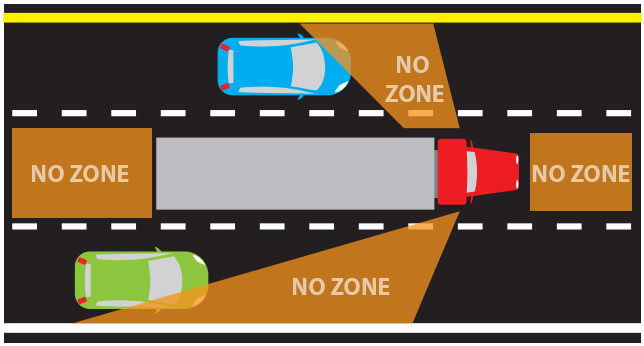
Motorists are encouraged to stay out of the “No Zone” areas. Commercial motor vehicles have large blind spots in front, behind, and on both sides of the vehicle; this is known as the “No Zone.” Even though large vehicles have several rear-view mirrors, other vehicles will be hidden from view if within the “No Zone” or blind spot.
Do not tailgate; you’ll be in the rear blind spot and may collide with the truck if it stops unexpectedly.
If you are stopped behind a truck on an upgrade, leave space in case the truck drifts back when it starts to move. Also, keep to the left in your lane so the driver can see that you’re stopped behind the truck.
Do not use high beam headlights when you are following a truck at night. Bright lights will blind the driver when they reflect off the truck’s large side mirrors.
When you meet a truck coming from the opposite direction, keep to the right to avoid a sideswipe crash.
Commercial motor vehicles often need to swing wide to the left in order make a right turn. Do not drive between the commercial vehicle and the curb—they will not be able to see you.
Never cross behind a truck that is preparing to back up or is in the process of doing so. Remember, the size of most trucks and trailers completely hide objects behind them from view.
Pass trucks on the left side for maximum visibility. Avoid cutting in too soon when passing a truck. Large vehicles cannot stop as quickly as other vehicles. Never linger besides a large truck or bus.
When a truck passes you, keep to the right side of your lane. Do not speed up while the truck is passing you.
What to do immediately if you are involved in a trucking accident:
After a trucking accident, it is critical that you reach out to an attorney immediately to preserve evidence in your case. Your attorney will do what is necessary to investigate the scene, preserve evidence and collect data from the truck’s black box. A black box or data event recorder is located inside the truck and it stores and retains information from the moments before the crash. We can use that information to learn what the truck and the truck driver did or didn’t do in the moments leading up to the crash.
As technology grows, the amount of information available in a truck’s data event recorder is expanding and sheds light on what happened and why it happened. Experts can determine which sensors were triggered, if the brakes were applied, and how fast the truck was going at the time of impact. Engineers can even use this data to build an accident reconstruction video or diagram and determine what happened. Evidence is likely to be destroyed or mishandled if there is any delay in hiring an attorney that specializes in trucking cases.
Making Waves Safely: Your Legal Rights After a Watercraft or Boating Accident
Our extensive coastlines and inland lakes make boating and jet skiing quintessential early summer activities. Unfortunately, as the waterways become increasingly crowded with seasonal enthusiasts, they also become significantly more dangerous. Severe boating accidents frequently occur due to a combination of operator inexperience, distracted navigation, reckless speeding, or individuals choosing to operate a vessel under the influence of alcohol.
When a beautiful sunny day on the water ends in a catastrophic watercraft injury, the physical, emotional, and financial toll can be entirely overwhelming for victims and their families. Watercraft and boating injuries often involve highly complex liability issues that differ from standard motor vehicle crashes. Depending on exactly where the accident occurred, your specific case might fall under state personal injury regulations or complex federal maritime laws.
If you are involved in a boating collision, you must treat it with the same urgency as a severe car accident. Ensure that everyone receives immediate emergency medical care, notify the Florida Fish and Wildlife Conservation Commission (FWC) or local marine patrol, and exchange complete information with the other boaters. Documenting the structural damage to the vessels and noting the weather and water conditions is essential for building a compelling and undeniable case.
Never rely on the at-fault boat owner’s insurance provider to automatically or fairly cover your medical expenses and ongoing recovery. Insurance companies routinely attempt to minimize payouts, particularly in cases involving recreational activities. Partnering with a highly organized and aggressive legal team ensures that your legal rights are fiercely protected from day one. We understand the specific legal deadlines and meticulous investigative requirements necessary to hold negligent operators fully accountable for their actions.
Can You Get Your Gun Rights Back if You’ve Been Convicted of a Felony or Domestic Violence?
In 2026, both federal and Wisconsin state law restrict firearm possession for people with certain convictions. Losing your gun rights after a criminal conviction for a felony or misdemeanor domestic violence charge is usually permanent. For many people, it’s one of the most frustrating consequences of a criminal record.
But depending on your situation, there may be a legal path to restoring those rights. At the very least, it’s worth understanding your options before you despair of ever having access to your Second Amendment rights again. A Milwaukee criminal defense attorney with Gimbel, Reilly, Guerin & Brown, LLP can review your record and help you understand whether gun rights restoration is realistic in your case.
How a Felony or Domestic Violence Conviction Strips Your Gun Rights Under Wisconsin and Federal Law
Federal law under 18 U.S.C. § 922(g) makes it illegal for anyone convicted of a felony or a qualifying domestic violence offense to possess a firearm. This applies no matter which state you live in. Wisconsin law adds its own layer of restrictions under Wis. Stat. § 941.29, which prohibits firearm possession by people convicted of felonies or certain misdemeanor domestic violence offenses.
Navigating Early Summer Traffic: What Florida Drivers Need to Know After a Crash
As early summer kicks off, Florida’s roads become increasingly busy with vacationers, out-of-state road trippers, and unpredictable afternoon thunderstorms. With this heavy influx of seasonal traffic comes a significantly higher risk of motor vehicle injuries. Whether you are rear-ended on a congested interstate or involved in a serious collision at a local intersection, knowing your legal rights and immediate next steps is crucial for your physical and financial recovery.
First and foremost, prioritize your safety and seek medical attention immediately. Even if you feel perfectly fine, the adrenaline rush from a crash can easily mask the symptoms of severe injuries, such as whiplash, internal trauma, or concussions. Next, make sure to thoroughly document the scene. Take clear photos of all vehicles involved, gather contact information from any witnesses, and always insist on filing an official police report.
Understanding your legal rights and deadlines is vital. Florida’s regulations are incredibly strict when it comes to time limits. For instance, you must seek medical care within 14 days of the accident to qualify for your Personal Injury Protection (PIP) benefits. Furthermore, recent legislative changes in the state have reduced the statute of limitations for general negligence claims. Failing to act within these tight windows can permanently jeopardize your ability to secure compensation for mounting medical bills and lost wages.
Dealing with insurance companies on your own can be an uphill battle. Adjusters are trained to protect their bottom line, often pushing for swift, lowball settlements that fail to cover your long-term medical needs. By securing premium legal representation, you ensure your rights are protected against these tactics. Don’t let an early summer collision derail your life—reach out to a dedicated legal professional to manage the complexities of your claim while you focus on healing.
Marina Bradley: How to Scale a Personal Injury Law Firm Without Breaking It.
Plaintiff firms often hit a ceiling because of operations, not casework. Strong verdicts hide weak systems, until volume forces every weakness to the surface. Marina Bradley, Executive Director at Ostroff Godshall Injury and Accident Lawyers, sat down with me on a recent episode of the Trial Lawyer View by Synergy podcast to talk through what scaling looks like when you stop guessing and start measuring. Here are the highest-value ideas from the conversation for trial lawyers building a real firm behind their results.
The Executive Director role most PI firms are missing
The Executive Director seat at a personal injury firm is still being defined. Most plaintiff firms run on the traditional managing partner model, where the lawyer who loves trying cases ends up running HR, intake, and finance by default. Marina’s role exists because someone has to own the operational side so trial lawyers stay focused on the work they were hired to do.
“It’s even hard to admit you need help sometimes,” she said. The work starts with separating founder-level tasks from leadership tasks built around the business itself.
Hire ahead of the need
One of the biggest mistakes Marina sees in plaintiff firms is reactive hiring.
“You can’t wait until you need the paralegal to hire the paralegal. You have to have that paralegal training six months before.”
The fix is forward-looking workforce planning. Watch file counts. Watch phone volume. Train the next role before the gap becomes a fire.
The metrics worth tracking weekly
Marina sends a firmwide scorecard every week. No mysteries. No leadership-only data. Everyone sees the same numbers and rows in the same direction. The four she watches most closely:
Signed cases, split between marketing-sourced and referred
Complaints filed
Demands sent out
Resolution, both pre-lit and in litigation
Monthly, she tracks cost per case and average fee. About 30 percent of OG’s cases move into litigation, which explains a higher average fee and a deliberate choice to file cases.
Time on desk is where the money hides
If you want to find quiet revenue inside your firm, look at time on desk.
“If you cut a couple of months off the time on desk, you’re putting revenue in the previous year. You’re doing 14 months of revenue in 12 months.”
Lien resolution sits inside this problem. Cases stall while medical liens, Medicare obligations, and reductions get worked through. Clients wait. Five-star Google reviews die in the gap between settlement and check.
Intake is the most expensive operational leak
Ask Marina where plaintiff firms lose the most money, and she points straight at intake.
“One call could be a $5 million case.”
Her position: staff intake heavier than feels comfortable. Train constantly. Listen to the recordings. Coach the conversations. Intake feeds every other metric on the scorecard, because nothing moves without the signed case.
Culture as a hiring filter
Ostroff Godshall built core values and a social contract the partners stand behind. Those values drive interviews. Predictive Index assessments help match personality to role.
The lesson Marina learned the hard way: a high-performing hire who fails the culture test pulls the rest of the team down. Her rules are simple. Hire for traits. Train for skill.
The view from the operations seat
The competitive picture is shifting fast for plaintiff firms:
· MSOs backed by private equity entering more markets
· AI tools rewriting how cases get litigated
· Marketing spend climbing in every major metro
· Gen Z workforce expectations reshaping how teams operate
Marina’s response is to focus on what you control. For her firm, that looks like a client experience built on real human contact, with automations used to free up calls rather than replace them. Community presence matters too. Her firm gave away 1,000 backpacks last year and plans to give more this year.
“Grit” is one of OG’s core values, and Marina lives it
If she were building a personal injury firm tomorrow with a goal of 30 lawyers, her first three priorities would be:
· Document every process so the founder’s knowledge lives outside their head
· Lock down cybersecurity, secure phones, and secure email
· Write an AI policy before the team starts using tools without guardrails
The takeaway for plaintiff firm leaders
Operations is the difference between a firm with great verdicts and a firm with a great business. Build the foundation, measure the numbers, protect the intake, and keep the human side of the work alive.
Listen to the full podcast conversation here:
Want more insights like this?
If you’re a personal injury lawyer ready to scale, streamline, and step into your role as CEO, let’s talk. Join the Peak Practice Community, and learn how synergy. can help you eliminate settlement bottlenecks, resolve complex liens, and maximize recoveries. Learn more here: https://partnerwithsynergy.com/peak-practice/
If you want to grow and scale your law firm more effectively, consider partnering with Synergy for lien resolution. Learn more at: https://partnerwithsynergy.com/liens/
Vacuum Extraction Delivery: Procedure, Risks, and Possible Birth Injuries
For most expectant parents, childbirth feels like a process they cannot fully prepare for. You read the books, take the classes, and tour the hospital, but no one tells you what will actually happen if labor takes a turn. One of the situations that often catches parents off guard is when a doctor reaches for a vacuum extractor in the middle of delivery. Vacuum extraction is one of the most…
Beyond McCutchen: Practical Strategies for Reducing ERISA Liens
When the Supreme Court decided US Airways v. McCutchen in 2013, recovery vendors declared victory. The Court held that ERISA plan language governs reimbursement rights, and equitable defenses cannot override clear contractual terms.
Many attorneys took this to mean ERISA liens were now untouchable. Pay what the vendor demands or litigate.
That’s wrong.
McCutchen changed the landscape, but it didn’t eliminate opportunities for lien reduction. It simply requires a more sophisticated approach. You need to know where the vulnerabilities are, how to identify them in plan documents, and how to convert them into negotiating leverage.
Here are the strategies that work.
Strategy 1: Examine Plan Language for Ambiguities
McCutchen said plan terms govern. But what happens when those terms are unclear?
Under the doctrine of contra proferentem, ambiguities in a contract are construed against the drafter. For ERISA plans, that means ambiguous reimbursement or subrogation language can be interpreted in favor of the beneficiary.
What to look for:
Undefined terms in reimbursement provisions
Conflicting language between the SPD and the Master Plan Document
Provisions that could be read multiple ways
Inconsistent use of “subrogation” versus “reimbursement”
Even sophisticated plans drafted by major insurers and TPAs sometimes contain ambiguities. The question is whether you’re looking for them.
Strategy 2: Verify Whether Equitable Doctrines Are Actually Disclaimed
McCutchen held that equitable defenses can’t override plan language. But the Court also acknowledged that if the plan is silent on equitable principles, those principles may still apply.
The made-whole doctrine: This equitable principle holds that the plan should only be reimbursed if and when the beneficiary has been fully compensated for all losses, including pain and suffering, lost wages, and future medical expenses. If the plan doesn’t explicitly disclaim this doctrine, you can argue it applies.
The common fund doctrine: This principle requires the plan to share in the attorney’s fees and costs incurred in obtaining the settlement. The plan’s recovery should be reduced proportionally to account for the legal expenses that created the fund. Again, if the plan doesn’t explicitly waive this doctrine, it may apply.
Key point: Recovery vendors often assert that McCutchen eliminates these defenses categorically. That’s not accurate. McCutchen said plan language controls. If the plan language doesn’t address these doctrines, they remain available.
This strategy is independent of McCutchen entirely. It creates leverage through a separate statutory mechanism.
Under 29 U.S.C. § 1024(b)(4), plan administrators must provide plan documents upon written request within 30 days. Failure to comply triggers discretionary penalties of up to $110 per day under 29 U.S.C. § 1132(c)(1)(B).
Plan administrators frequently fail to respond on time. When they don’t, penalties accrue. We’ve seen cases where $15,000 to $25,000 in penalties accumulated before the vendor even engaged in substantive negotiations.
Recovery vendors take this exposure seriously. A $50,000 lien becomes much more negotiable when there’s $20,000 in potential penalty exposure on the other side.
Strategy 4: Understand and Apply the Montanile Case
In 2016, the Supreme Court decided Montanile v. Board of Trustees, which established an important limitation on ERISA plan recovery.
The Court held that an ERISA equitable lien by agreement attaches only to the specific fund identified in the plan, typically the settlement proceeds. If the participant dissipates those funds on nontraceable items before the plan files suit, the plan cannot recover from the participant’s general assets.
The practical implication: timing matters. If settlement proceeds are spent on ordinary living expenses before the plan takes enforcement action, the plan’s remedy may be extinguished.
Caveats:
This is a strategy of last resort, not a primary strategy
Plans can seek to trace funds or impose constructive trusts
Professional and ethical obligations must be considered
The facts of each case are critical
Dealing with Recovery Vendors: Rawlings, Conduent, and Others
In most ERISA lien matters, you’re negotiating with recovery vendors, not the plans themselves. Companies like Rawlings, Conduent, Trover, and others handle subrogation recovery for thousands of plans.
These vendors are sophisticated. They know the law. They’re paid based on what they recover. They have every incentive to maximize reimbursement.
How to negotiate effectively:
Know more than they expect you to. Most attorneys don’t obtain plan documents or analyze them carefully. When you demonstrate detailed knowledge of the plan language, vendors adjust their approach.
Document your leverage. Put your arguments in writing. Calculate 1024(b)(4) penalties precisely. Cite specific plan provisions and case law.
Be patient. Vendors often start with aggressive positions expecting quick capitulation. Firms that push back methodically often achieve significantly better results.
Escalate when appropriate. If a front-line representative isn’t authorized to negotiate meaningfully, request escalation to a supervisor with settlement authority.
Putting It Together: A Framework for ERISA Lien Reduction
Here’s the approach we use on every ERISA lien:
Determine funding status. Self-funded or fully insured? This determines the applicable legal framework.
Obtain plan documents via 1024(b)(4). Track compliance and document any penalties.
Analyze plan language. Look for ambiguities, missing disclaimers, and weaknesses.
Identify applicable defenses. Made whole, common fund, allocation, Montanile.
Build your negotiating position. Document all leverage points.
Negotiate strategically. Present your position in writing. Be prepared to push back and escalate.
The Bottom Line
McCutchen made ERISA lien reduction more challenging. It didn’t make it impossible.
The firms that achieve the best outcomes are the ones that know where to look, understand the pressure points, and negotiate from a position of documented leverage.
At Synergy, we’ve resolved thousands of ERISA liens since McCutchen. We know what works. If you have a challenging lien, we’re happy to take a look.
$15 Million Verdict for Tulsa Family After Missed ER Diagnosis
A Tulsa County jury has returned a $15 million verdict for the family of a young child who suffered permanent brain damage and lifelong disabilities after a bacterial infection was misdiagnosed and left untreated by an emergency department physician. The verdict was secured by Wais Vogelstein Forman Koch & Norman partner Sharon Morgan and associate Natalie D’Antonio, along with co-counsel Jeff…
 Listen to the full podcast conversation here:
 Want more insights like this?