5 Ways Lawyers Can Maximize Their Wealth By Deferring Fees

Leif Lundberg, LL.M and Ben Eisler, JurisPrudent Deferral Solutions

Takeaways

  1. Defer compensation like Fortune 500 executives do, so your money grows faster.
  2. Tie your fee to the returns of investments that you select – stocks, bonds, real estate, etc.
  3. Gain access to low-interest loans, as needed, to fund cases (currently 3-4%).
  4. Use “golden handcuffs” to retain key associates, so if they leave too soon their deferred bonus comes back to the firm.
  5. Do this with the same benefits and protections offered to Fortune 500 CEOs.

A few months ago, we met a trial attorney in Florida. He was like a lot of people reading this post; well-respected, successful, hardworking. He had just settled a big case for his client, and they were a couple of weeks away from finalizing the release. He was excited about the result, but also frustrated that he had to pay a ton in taxes, when some people, like big wigs at Fortune 500 companies for example, can defer their compensation and taxes, effectively earning interest on the government’s money.

He looked at structuring his fees with an annuity – one way to defer taxes. But he didn’t like that annuities are conservative investments and with a lower interest rate than market based investments. And just as he was about to pay taxes on his fee, Synergy told him about a product provided by JurisPrudent Deferral Solutions. We explained how our program allows you to defer taxes and tie your fee to the returns of a customized portfolio of investments that you (or your financial advisor) select – stocks, bonds, real estate, etc. In that sense it’s a lot like a 401(k) plan for trial lawyers. Though like deferred compensation for corporate executives, there is no limit on how much you can defer.

We also explained how in addition to reducing your tax burden and increasing your wealth accumulation, deferring fees can increase your access to cash to fund cases, because as we get to know your firm, our company will make loans at very low rates – currently 3-4% interest. And we shared how he could use deferred fees as “golden handcuffs” to retain key associates, so if they leave too soon their deferred bonus comes back to the firm.

So ultimately this attorney did his due diligence and decided to defer a large portion of his fee and take some in cash to cover expenses. As a result, he avoided a big tax hit without sacrificing his investment returns. He is now earning interest on the government’s money and has access to low-interest loans.

You may be thinking how do the guys at JurisPrudent know so much about deferred compensation? Combined, our leadership team has more than 100 years of experience in this industry. Our parent company administers almost two billion dollars in deferred compensation plans for some of the largest companies in the country – current clients include Microsoft, Cisco, and Bank of New York Mellon. Our program is administered by Newport Group, the country’s largest administrator of deferred compensation plans for corporate executives, and Bank of New York Mellon is the trustee and custodian of the assets backing the program. No other fee deferral program provides this level of safety and service.

So please consider deferring your fees with us. Synergy is a strategic partner with JurisPrudent and works daily with their highly skilled team to create cutting edge solutions for lawyers looking to pay less in taxes. Visit www.structuredfees.com for more info.

What to Consider When Representing a Catastrophically Injured Client With Special Needs

By Jason D. Lazarus, J.D., LL.M., MSCC, CSSC

In the confusing landscape of public benefits and planning issues that arise today for trial lawyers, finding your way can be a daunting task.  Should the client seek Social Security Disability (“SSDI”) benefits and become Medicare eligible?  Doesn’t that trigger the need for a Medicare Set Aside?  What if the client is receiving needs based benefits such as Medicaid and/or Supplemental Security Income (“SSI”)?  Is coverage under the Affordable Care Act (“ACA”)[1] a better or even an available option?  How should the recovery be managed from a financial perspective?  Is a trust appropriate?  Should a structured settlement be considered?  There are no easy answers to these questions.  In the paragraphs that follow, you will find useful information related to these issues that will give trial lawyers the ability to issue spot when settling a case for a catastrophically injured client. 

Let’s use a real world example to identify the issues.   Take Jan Smith who was the victim of medical malpractice at a hospital.  Jan was in her early forties when she decided to have elective surgery on her back for degenerative disc disease.  During the surgery, a problem developed while being intubated and the procedure was cancelled.  Mrs. Smith was moved to the ICU and no neurologic monitoring was performed that evening after being moved from the surgical suite.  The next morning Mrs. Smith was found to be quadriparetic.  Unfortunately for Mrs. Smith, her condition was irreversible.  Suit was brought against multiple defendants with a significant seven figure recovery secured.  Mrs. Smith and her family had Medicaid coverage and SSI.  She had also applied for SSDI.  At the time of settlement, there was no Medicare eligibility since she had not been approved for SSDI and she wasn’t sixty five.  How do you protect the client’s eligibility for public benefits?  Is that the right thing to do?  Should ACA coverage be considered?  What about protection of the monies recovered on Mrs. Smith’s behalf?  Should a trust be created?  What about structured settlements?  Let’s explore these questions further.

Public Benefits versus ACA Coverage

As a starting point, the first question is whether it makes sense for Mrs. Smith to give up her needs based benefits completely by taking the settlement in a lump sum and becoming privately insured through coverage under the Affordable Care Act.  This isn’t a question that can be answered with a simple yes or no.    There are multiple considerations before deciding to eschew coverage afforded by Medicaid and Medicare along with the needs based Social Security benefit, SSI.  First is whether the ACA coverage will be around for the long term.  Will it be repealed at some point?  Will portions of it be repealed making it a non-viable option?  Second, does the case involve needs that aren’t provided for by the affordable care act coverage such as in-home skilled attendant care or long term facility care?  These services can be very costly and may be covered by Medicaid in many states but are not covered by ACA plans.  In Mrs. Smith’s case, she will have a significant amount of attendant care needs that can be covered by certain Medicaid programs available in her home state but not by the ACA.  So does that mean she shouldn’t apply for ACA coverage?  Should she create a special needs trust to protect Medicaid and SSI?  The answer lies in an analysis of the costs of the plans available under the ACA and the amount of spendable income that results if a special needs trust is utilized.

According to a 2013 article authored by Kevin Urbatsch and Scott MacDonald entitled “The Affordable Care and Settlement Planning”[2] the numbers favor combining ACA coverage with a special needs trust.  The following chart illustrates the financial benefits of combining an SNT with ACA coverage in California.

PLANNING PROJECTIONS

(40 YEAR OLD FEMALE)

SETTLEMENT NET ASSET LEVEL =>

$100K

$396K

$500K

$1 M

$2.868 M

Net Spendable Income — Annual Amount [u][3]

SNT Only [v][4]

$12,610

$23,751

$22,208

$33,484

$67,500

No SNT, Buy ACA Insurance [w][5]

EM[6]

EM

$11,196

$15,794

$67,504

SNT with ACA Supplemental [w]

EM

EM

$17,700

$20,684

$53,766

No SNT, Expanded Medi-Cal

$3,614

$14,291

NQ[7]

NQ

NQ


Income Percent of Federal Poverty Limit [x][8]

34.80%

138% [y][9]

174.06%

348.13%

600.70%

Average Annual ACA Premium (Net Subsidy) [z][10]

$0

$0

$4,508

$12,800

$15,552

Average Monthly ACA Premium (Net Subsidy)

$0

$0

$376

$1,067

$1,296

Source: Merrill Lynch Wealth Management Analysis through the Wealth Outlook Program, May 2013.

As the chart demonstrates, there can be some distinct advantages from a financial perspective to utilizing ACA coverage but also keeping Medicaid/SSI eligibility.  While that is true, it also is true that a special needs trust, which would preserve Medicaid and SSI, places many restrictions on how settlement monies may be used.  Accordingly, it isn’t a decision that should be made just for financial reasons.  A careful analysis of all of the issues is necessary.  In the case of Mrs. Smith, other considerations outweighed the use of a special needs trust.  She and her family didn’t want the restrictions that come with the special needs trust.   Since monies were allocated to her spouse and their children, all of the family’s assets disqualified her for needs based benefits.

Even though she was currently ineligible for needs based benefits, that didn’t mean she could never become eligible again in the future.  Because she might need means tested benefits such as Medicaid/SSI in the future and could become a Medicare beneficiary at some point as well, a trust with provisions that would protect these benefits was created.  The trust was created had provisions that would allow the trustee to move money into a “special needs sub-trust” and a “Medicare set aside sub-trust”.  The set aside sub-trust was contained within the “special needs sub-trust” so that in the event that the client was “dual eligible”, the set aside wouldn’t cause an eligibility problem for needs based benefits.  This planning technique will make more sense after the explanation below about the different types of public benefits and planning that can protect such benefits.  Also, let’s now make the assumption that the ACA coverage isn’t an option or perhaps might not be around well into the future.  What are the types of benefits an injury victim should be concerned about preserving and what are the techniques used to preserve them? 

Public Assistance Primer

Because Mrs. Smith is eligible for Medicaid and SSI as well as having applied for SSDI, further explanation of these benefits makes sense to adequately understand the issues involved in planning for her recovery.  There are two primary public benefit programs that are available to those that are injured and disabled.  The first is the Medicaid program and the intertwined Supplemental Security Income benefit (“SSI”).  The second is the Medicare program and the related Social Security Disability Income/Retirement benefit (“SSDI”).  Both programs can be adversely impacted by an injury victim’s receipt of a personal injury recovery.  Understanding the basics of these programs and their differences is imperative to protecting the client’s eligibility for these benefits.

Medicaid and Supplemental Security Income (hereinafter SSI) are income and asset sensitive public benefits that require special planning to preserve.  In many states, one dollar of SSI benefits automatically provides Medicaid coverage.  This is very important, as it is imperative in most situations to preserve some level of SSI benefits if Medicaid coverage is needed in the future.  SSI is a cash assistance program administered by the Social Security Administration.  It provides financial assistance to needy aged, blind, or disabled individuals.  To receive SSI, the individual must be aged (sixty-five or older), blind or disabled and be a U.S. citizen.  The recipient must also meet the financial eligibility requirements.[11]  Medicaid provides basic health care coverage for those who cannot afford it.  It is a state and federally funded program run differently in each state.  Eligibility requirements and services available vary by state.  Medicaid can be used to supplement Medicare coverage if the client is eligible for both programs (“dual eligible”).  For example, Medicaid can pay for prescription drugs as well as Medicare co-payments or deductibles.  Because Medicaid and SSI are income and asset sensitive, creation of a special needs trust may be necessary which is discussed in greater detail below.

Medicare and Social Security Disability Income (hereinafter SSDI) benefits are an entitlement and are not income or asset sensitive.  Clients who meet Social Security’s definition of disability and have paid in enough quarters into the system can receive disability benefits without regard to their financial situation.  The SSDI benefit program is funded by the workforce’s contribution into FICA (social security) or self-employment taxes.  Workers earn credits based on their work history and a worker must have enough credits to get SSDI benefits should they become disabled.  Medicare is a federal health insurance program.  Medicare entitlement commences at age sixty-five or two years after becoming disabled under Social Security’s definition of disability.  Medicare coverage is available again without regard to the injury victim’s financial situation.  Accordingly a special needs trust is not necessary to protect eligibility for these benefits.  However, the MSP may necessitate the use of a Medicare Set Aside discussed in greater detail below.

How Do We Protect Mrs. Smith Current and Potential Future Benefits? 

Planning Techniques for Keeping Mrs. Smith Eligible for Medicaid/SSI

Since Mrs. Smith receives Medicaid/SSI, a special needs trust can be created to hold the recovery and preserve public benefit eligibility since assets held within a special needs trust are not a countable resource for purposes of Medicaid or SSI eligibility.  The creation of a special needs trust is authorized by Federal law.[12]  Trusts commonly referred to as (d)(4)(a) special needs trusts, named after the Federal code section that authorizes their creation, are for those under the age of sixty five.[13]  However, another type of trust is authorized under the Federal law with no age restriction and it is called a pooled trust, commonly referred to as a (d)(4)(c) trust.[14] 

The 1396p[15] provisions in the United States Code govern the creation and requirements for such trusts.  First and foremost, a client must be disabled in order to create a SNT.[16]  There are two primary types of trusts that may be created to hold a personal injury recovery each with its own requirements and restrictions.  First is the (d)(4)(A)[17] special needs trust which can be established only for those who are disabled and are under age 65.  This trust is established with the personal injury victim’s recovery and is established for the victim’s own benefit.  It can only be established by a parent, grandparent, guardian or court order.  The injury victim can’t create it on his or her own.  Second is a (d)(4)(C)[18] trust typically called a Pooled Trust that may be established with the disabled victim’s funds without regard to age.  A pooled trust can be established by the injury victim unlike a (d)(4)(A). 

Planning Techniques for Making Sure Mrs. Smith Will Not Lose Medicare Coverage in the Future

Mrs. Smith has applied for SSDI which means technically, according to CMS guidance, she has a “reasonable expectation of becoming a Medicare beneficiary within 30 months”.  A client who is a current Medicare beneficiary or reasonably expected to become one within 30 months should concern every trial lawyer because of the implications of the Medicare Secondary Payer Act (“MSP”).  Under the MSP, Medicare isn’t supposed to pay for future medical expenses covered by a liability or Workers’ Compensation settlement, judgment or award.  CMS recommends that injury victims set aside a sufficient amount to cover future medical expenses that are Medicare covered.  CMS’ recommended way to protect an injury victim’s future Medicare benefit eligibility is establishment of a Medicare Set Aside (“MSA”) to pay for injury related care until exhaustion. 

In certain cases, a Medicare Set Aside may be advisable in order to preserve future eligibility for Medicare coverage. A Medicare set aside allows an injury victim to preserve Medicare benefits by setting aside a portion of the settlement money in a segregated account to pay for future Medicare covered healthcare. The funds in the set aside can only be used for Medicare covered expenses for the client’s injury related care. Once the set aside account is exhausted, the client gets full Medicare coverage without Medicare ever looking to their remaining settlement dollars to provide for any Medicare covered health care. In certain circumstances, Medicare approves the amount to be set aside in writing and agrees to be responsible for all future expenses once the set aside funds are depleted.

Dual Eligibility: The Intersection of Medicare and Medicaid – SNT/MSA

Since Mrs. Smith is potentially a Medicaid and Medicare recipient, extra planning is in order.  If it is determined that a Medicare Set Aside is appropriate or needed in the future, it raises some issues with continued Medicaid eligibility.  A Medicare Set Aside account is considered an available resource for purposes of needs based benefits such as SSI/Medicaid.  If the Medicare Set Aside account is not set up inside a Special Need Trust, the client will lose Medicaid/SSI eligibility.  Therefore, in order for someone with dual eligibility to maintain their Medicaid/SSI benefits the MSA must be put inside a Special Needs Trust.  In this instance you would have a hybrid trust which addresses both Medicaid and Medicare.  It is a complicated planning tool but one that is essential when you have a client with dual eligibility.

Financial Settlement Planning Considerations

While we have discussed Mrs. Smith’s public benefit preservation issues above, what about the management of her significant recovery?  Should a part of it be in the form of a structured settlement?  What about ongoing management of her financial affairs?  Will she need help from a fiduciary such as a corporate trustee?  There are noright or wrong answers to these questions.  Instead, there are options for Mrs. Smith to consider and they should be presented so that she can make an informed decision. 

The first option is to take all of the personal injury recovery in a single lump sum.  If this option is selected, the lump sum is not taxable, but once invested, the gains become taxable and the receipt of the money will impact his or her ability to receive public assistance.[19]  A lump sum recovery does not provide any spendthrift protection and leaves the recovery at risk for creditor claims, judgments and wasting.  The personal injury victim has the burden of managing the money to provide for their future needs be it lost wages or future medical. Needs based public benefits would be lost if a lump sum is taken and any reduction in the premium costs for the ACA insurance programs would also be lost. 

The second option is receiving “periodic payments” known as a structured settlement[20] instead of a single lump sum payment.   A structured settlement’s investment gains are never taxed[21], it offers spendthrift protection and the money has en
1024(b)(4) – Send It To The Right Place!

In Allena Burge Smiley v. Hartford Life and Accident Insurance Company, et. al, No. 15-10056 (11th Cir. 2015), the Eleventh Circuit reiterated what Synergy regularly advises clients to do regarding the statutory document request pursuant to 29 U.S.C. 1024(b)(4) – send it to the right place! The first step in properly defending against an asserted subrogation or reimbursement claim from an ERISA plan is making a request for documents pursuant to 29 U.S.C. 1024(b)(4). On July 17, 2015, the Eleventh Circuit in Allena Burge Smiley v. Hartford Life and Accident Insurance Company, et. al, No. 15-10056 (11th Cir. 2015), reaffirms the rule that unless this statutory request is sent to the “plan administrator” no penalties will be assessed.

A proper 29 U.S.C. 1024(b)(4) request is of the utmost importance for two (2) reasons: to obtain the necessary documents to evaluate the strength of the ERISA plan’s recovery rights, and to exert pressure by means of 29 U.S.C. § 1132 (c) (1) (B) penalties.

29 U.S.C. § 1024(b)(4) – The administrator shall, upon written request of any participant or beneficiary, furnish a copy of the latest updated summary, plan description, and the latest annual report, any terminal report, the bargaining agreement, trust agreement, contract, or other instruments under which the plan is established or operated.

29 U.S.C. § 1132(c) – Any administrator who fails or refuses to comply with a request for any information which such administrator is required by this subchapter to furnish … within 30 days after such request may … be personally liable … in the amount of up to $100 a day.

29 C.F.R. § 2575.502c-1 – The civil monetary penalty established by … ERISA is hereby increased from $100 a day to $110 a day.

As the Eleventh Circuit found in Smiley, despite arguments that the third-party administrator was a de facto plan administrator, the plan language of the ERISA statute places these responsibilities on the plan administrator alone, not its agents. One bright spot for the plaintiff’s bar is the Court’s affirmation that in order to obtain penalties (where the request was sent to the correct party) there is no need for the plaintiff to demonstrate “prejudice, bad faith, [or] harm” in order to obtain penalties, Byars v. Coca-Cola Co., 517 F. 3d 1256 (11th Cir. 2008); Daughtrey v. Honeywell, Inc. 3 F.3d 1488, 1494 (11th Cir. 1993).

Aranki v. Burwell – Nothing New When it comes to Liability Medicare Set-asides

By Jason D. Lazarus, J.D., LL.M, MSCC

Recently, an Arizona Federal judge ruled that he would not make a determination on whether a Medicare Set-Aside (MSA) is necessary on a medical malpractice case. According to Judge Stephen McNamee:

[t]he Court finds that there is no justiciable case or controversy ripe for review. As such, the Court does not have subject matter jurisdiction to hear this case. This case is not ripe for review because no federal law mandates CMS to decide whether Plaintiff is required to create a MSA. That CMS has not responded to Plaintiff’s petitions on the issue, is not reason enough for this Court to step in and determine the propriety of its actions. There may be a day when CMS requires the creation of MSA’s in personal injury cases, but that day has not arrived.

We have received a flood of inquiries as to whether or not this case eliminates the need to do an MSA in liability settlements. The answer is “no”.  This decision does not give the plaintiff or counsel a pass on considering Medicare’s future interests in a liability settlement. The opinion actually says that an MSA isn’t required, which simply reaffirms Medicare’s position on set-asides. An MSA is never required, whether it be for a workers compensation or liability settlement. This decision does not change the current Medicare secondary payer landscape.  Attorneys still need to consider Medicare’s future interests when resolving claims.

The Aranki case is similar to other cases that have addressed the question of the necessity of a Liability Medicare Set-aside (LMSA) to “protect Medicare’s interests” under the Medicare Secondary Payer Act (MSP).  All of the cases that have been reported revolve around the confusion of the necessity of MSAs in liability settlements or the inability to get CMS approval of a liability set aside.  The area is so rife with confusion that most lawyers just don’t know what to do when resolving a case with a Medicare beneficiary.  Courts, like the one in Aranki, acknowledge the confusion but do little to clarify.  My previous articles and blog posts regarding this subject have tried to debunk the myths surrounding the MSP and liability settlements.  In a recent Florida Supreme Court opinion regarding collateral sources, Joerg v. State Farm, one such article was cited by the Court.  Despite all of the foregoing, many lawyers fail to recognize the potential risks of failing to advise clients about these issues.  Analyzing the Aranki case and the issues presented is a good opportunity to discuss this very important issue.

The plaintiff, Rachel Aranki, was the victim of medical malpractice in 2009, which left her partially paralyzed and in chronic pain.  She filed a medical malpractice action in Arizona state court against the treating physician.  The case was settled prior to going to trial.  At the time of settlement, Ms. Aranki was a Medicare beneficiary.  The question of whether CMS would mandate a set-aside stymied the finalization of the settlement.  The plaintiff, in an effort to comply with the MSP, sought a response from CMS on the necessity of an LMSA, but they got no response.  The state court judge enforced the agreement to settle and ordered Ms. Aranki to file a declaratory judgement action in federal court on the LMSA issue.  The United States District Court for the District of Arizona issued its order dismissing the matter for lack of subject-matter jurisdiction.  In the opinion, the Court stated that “no federal law or CMS regulation requires the creation of a MSA in personal injury settlements to cover potential future medical expenses.”  This is a true and accurate statement of the current state of the law as it pertains to set-asides.  However, that is not the end of the story.

While there is currently no regulation or law that mandates set-asides in liability settlements, it does not mean there will be no consequences when a plaintiff attempts to shift the burden to Medicare for future injury-related care.  It is very clear from Medicare’s public statements that the agency believes that set-asides are the best method to protect the program from paying for injury-related care when future medicals are funded by a settlement.  That does not mean it is the only way to demonstrate that Medicare’s interests were taken into account when a case involving a Medicare beneficiary is settled, it just means it is one way.  It is Medicare’s preferred method of protecting their future interests.

The real issue when a case involving a Medicare beneficiary is settled boils down to the risk taken by the plaintiff in terms of coverage of their future injury-related care by Medicare.  It isn’t a defense issue.  It is a plaintiff issue.  The plaintiff, if he/she does nothing without legal justification, could face a situation where Medicare denies future injury-related care since nothing was set aside.  The plaintiff needs to understand this risk before settling their case.  Since the settlement will be reported to Medicare under the Mandatory Insurer Reporting laws, Medicare will be on notice of the settlement and the injury related ICD codes.  That could trigger a denial of care and a lengthy internal appeals process before Medicare payments for accident related care might be reinstated by a Federal District Court.

While on the subject of Mandatory Insurer Reporting, it is important to address a few things.  As a practice point, plaintiff counsel should be proactively dealing with the defense in terms of what they report, as inaccurate reporting can cause problems with conditional payments as well as eligibility for future benefits.  For example, if a case involves neck and back injuries, but the defense takes the position that the neck is pre-existing and settles for payments exclusively for the back, then reports the ICD codes for the neck along with the back – that is a problem.  Another problematic issue is reporting the wrong date of accident which could trigger Medicare to issue a new final demand for conditional payments.  Another important practice point is to be leery of Medicare language being included in the release, as many times it has inappropriate language along with inaccurate references to the Medicare Secondary Payer Act.

Given all of the foregoing, what do you do?  “Nothing” isn’t the answer.  The answer is to consult competent experts on the subject to help navigate the complexities, advise the client about the risks and document your file as to what you did along with why.  I like to use the acronym of CAD, Consult Advise Document, to remember the steps.  The bottom line for personal injury practitioners is that the LMSA issue poses a legal malpractice threat, not some type of legal action by CMS against you. There is no mechanism for the government to bring any type of legal action related to Medicare Set-asides.  If you don’t pay back a conditional payment, the government can bring an action against the trial lawyer as the regulations do provide for this but there is no corollary for set-asides.

Similarly, the defendants don’t have any exposure or liability if nothing is set aside.  They simply don’t have a dog in the fight.  Their insistence on requiring a set-aside may expose them to some liability which is a good counter argument to a recalcitrant defendant.  According to Medicare, the defendant’s only obligations are to report a settlement to Medicare under the Mandatory Insurer Reporting laws and put the plaintiff on notice if future medicals are funded.  There is amemorandum from CMS MSP Regional Coordinator Sally Stalcup that lays out this obligation for defendants.  Providing that policy memo to defense counsel can also be helpful in allaying fears the defense has about their responsibilities/exposure.

To summarize, the best practice is to evaluate the case and document what is being done along with why.  This is especially critical if nothing is being done and the client is eligible to receive Medicare benefits (or has a “reasonable expectation”).  There are certainly justifications for doing nothing in proper situations.  For example, nothing may be done because after educating the client, the client refuses to set anything aside.  Or, it could be that future medicals aren’t funded.  It could be that, due to liability issues, the case was settled for less than full value and when you run an equitable distribution calculation the amount of future medicals covered by Medicare is minimal.  On the other hand, in certain cases there might be a desire or need to set something aside. In those cases, an estimate of future medical expenses that are Medicare covered should be obtained or a full allocation done.  That is appropriate documentation.

Also, don’t forget about CMS’ exception memorandum which was disseminated back in September of 2011.  In that memo, the Baltimore HQ office indicated there are cases where a Liability Medicare Set-aside wasn’t necessary, period.  The memo stated that if the treating physician certified in writing that there would be no future medical expenses covered by Medicare for the injuries suffered in the accident, then nothing needed to be set aside.  To document this exception, the treating physician’s letter should be obtained and retained by both the trial lawyer, as well as the client.

Finally, it is important to understand that certain injury victims will be dual eligible.  This means that they receive not only Medicare, but Medicaid as well.  When someone is dual eligible additional planning concerns arise.  If it is determined that a Medicare Set-aside is appropriate or needed in the future, it raises some issues with continued Medicaid eligibility.  A Medicare Set-aside account is considered an available resource for purposes of needs-based benefits such as SSI/Medicaid.  If the Medicare Set-aside account is not set up inside a Special Needs Trust, the client will lose Medicaid/SSI eligibility.  Therefore, in order for someone with dual eligibility to maintain their Medicaid/SSI benefits the MSA must be put inside a Special Needs Trust.  In this instance, you would have a hybrid trust which addresses both Medicaid and Medicare.  It is a complicated planning tool but one that is essential when you have a client with dual eligibility.

Finally an ERISA Subrogation Victory for Plaintiffs

Montanile v. Board of Trustees of National Elevator, 577 U.S. ____ (2016)

In the post McCutchen world wherein trial attorneys find themselves at the mercy of ERISA Plans, it was with a measure of dread that we anticipated another unfavorable ruling from the U.S. Supreme Court in Montanile. (See previous blog post). However, Justice Clarence Thomas who delivers the opinion in Montanile deals a serious blow to ERISA Plans and their overreaching recovery efforts against personal injury victims. In Montanile, the Court found that should the plaintiff fully exhaust the settlement funds so that they are no longer in the possession and control of the plaintiff, then the ERISA Plan cannot make a claim against the plaintiff since the subject of their claim, the settlement fund, is fully dissipated.

“We hold that, when a participant dissipates the whole settlement on nontraceable items, the fiduciary cannot bring a suit to attach the participant’s general assets under §502(a)(3) because the suit is not one for ‘appropriate equitable relief’.”
Id. at pg 2.

The facts of this case are tragic and typical of the kind of situation most plaintiff attorneys often find themselves dealing with in their cases. Mr. Montanile was severely injured when a drunk driver collided with his vehicle. Mr. Montanile incurred substantial medical bills, of which his ERISA Plan paid $121,044.02. During the course of litigation, Mr. Montanile executed an additional agreement reaffirming the reimbursement language contained in his ERISA Plan’s contract. Eventually the personal injury action was settled for $500,000 from all sources, including Mr. Montanile’s UIM coverage. After attorney fees and costs, Mr. Montanile was to net $240,000.00. Trial counsel began negotiations with the ERISA Plan but was unable to reach an agreement. Trial counsel then notified the ERISA Plan in writing that he would disburse the remainder of the funds to Mr. Montanile unless the Plan objected within fourteen days. The Plan failed to respond and the funds were disbursed. Six months later, the ERISA Plan filed suit in federal district court against Mr. Montanile by which time Mr. Montanile contends the settlement funds were spent. The ERISA Plan asserted that despite Mr. Montanile spending all the settlement funds, they can still recover the amount of their claim from his general assets. Appropriately, Justice Thomas writing for the majority reaffirmed that ERISA requires “appropriate equitable relief” and a claim against Mr. Montanile’s general assets is not authorized.

This well-reasoned and well written opinion makes clear the requirements and limitations placed on an ERISA Plan’s recovery efforts. As we noted in our previous blog, the Court was concerned with the cost ERISA Plan’s might incur if their recovery efforts were limited to funds “in the possession and control” of the plaintiff. Justice Thomas addressed that squarely and accurately characterizing the ERISA recovery industry.

“More than a decade has passed since we decided Great-West, and plans have developed safeguards against participants’ and beneficiaries’ efforts to evade reimbursement obligations. Plans that cover medical expenses know how much medical care that participants and beneficiaries require, and have the incentive to investigate and track expensive claims. Plan provisions—like the ones here—obligate participants and beneficiaries to notify the plan of legal process against third parties and to give the plan a right of subrogation.

The Board protests that tracking and participating in legal proceedings is hard and costly, and that settlements are often shrouded in secrecy. The facts of this case undercut that argument. The Board had sufficient notice of Montanile’s settlement to have taken various steps to preserve those funds. Most notably, when negotiations broke down and Montanile’s lawyer expressed his intent to disburse the remaining settlement funds to Montanile unless the plan objected within 14 days, the Board could have—but did not—object. Moreover, the Board could have filed suit immediately, rather than waiting half a year.”
Id. at pg 14.

It is important to note, as the Court does repeatedly, that Mr. Montanile’s counsel kept the ERISA Plan informed, cooperated with signing additional agreements, gave fourteen (14) days’ notice and even gave them an opportunity to object before he disbursed the remaining settlement funds.

This opinion is likely to encourage quicker action by the ERISA Plan’s and their recovery vendors. Though the Court is clear in stating:

“[D]efendant dissipat[ion] [of] the entire fund on nontraceable items … eliminated the lien. Even though the defendant’s conduct was wrongful, the plaintiff could not attach the defendant’s general assets instead. Absent specific exceptions not relevant here, “where a person wrongfully dispose[d] of the property of another but the property cannot be traced into any product, the other . . . cannot enforce a constructive trust or lien upon any part of the wrongdoer’s property.” Restatement §215(1), at 866 (emphasis added); see also Great- West, 534 U. S., at 213–214 (citing Restatement §160).”
Id. at pg 9

ERISA Plan Administrators and recovery vendors will also note that the Court made it clear that had they taken more aggressive action, and sooner, then their recovery rights may have been preserved.

“The Board had an equitable lien by agreement that attached to Montanile’s settlement fund when he obtained title to that fund. And the nature of the Board’s underlying remedy would have been equitable had it immediately sued to enforce the lien against the settlement fund then in Montanile’s possession.”
Id. at pg 7

This opinion finally provides some guidance to the trial bar on how to address ERISA subrogation claims. Here the Court recognizes that a plaintiff who honors the contractual obligations of their ERISA Plan but is unable to reach a final resolution regarding their subrogation/repayment demand is not stuck in perpetual limbo following resolution of the underlying personal injury action. If trial counsel provides a reasonable opportunity for the Plan to enforce its recovery rights, here the Court found fourteen days to be reasonable, then exhausting that separately identifiable settlement fund on nontraceable items prevents the ERISA Plan from seeking a recovery.

The term “nontraceable” is only defined in this opinion as items “like food or travel” whereas “traceable” items are defined as “identifiable property like a car.” (Id. at pg 8). However, the court does make it clear that simply comingling the settlement funds with general assets is not to be considered exhausting the fund on “nontraceable” assets (Id. at pg 13). Unfortunately, this does not provide much guidance for plaintiff’s who use their settlement funds to purchase a structured settlement annuity, or place the entirety of the settlement in a Special Needs Trust/settlement trust. However, given the clear requirement that the settlement funds be in the “possession” and under the “control” of the plaintiff, there is a good argument that both monies used to purchase a structured settlement as well as funds placed in a Special Needs Trust are “nontraceable”. These arguments are bolstered by the following passages from Justice Thomas’ opinion:

“[A]ll types of equitable liens must be enforced against a specifically identified fund in the defendant’s possession. See 1 Dobbs §4.3(3), at 601, 603.”
Id. at pg 10.

And when the Court wrote:

“[E]quitable liens by agreement … depend on “the notion . . . that the contract creates some right or interest in or over specific property,” and are enforceable only if “the decree of the court can lay hold of ” that specific property. 4 Pomeroy §1234, at 694–695.
Id. at pg 8

In this case, the majority held that it was unable to determine from the record how much of the subject settlement funds were dissipated by Mr. Montanile prior to the Plan’s suit. The case was remanded to the trial court to determine

“whether Montanile kept his settlement fund separate from his general assets or dissipated the entire fund on nontraceable assets.”
Id. at pg 14

To avoid this confusion, trial counsel should have the plaintiff keep the settlement funds in a separate account so when it is fully exhausted there is no uncertainty for the ERISA Plan to color. Though this SCOTUS opinion is quite clear on many points, it does illustrate the complex nature and exacting steps that must be taken by trial counsel in seeking to resolve reimbursement demands from ERISA Plans. Trial counsel is encouraged to seek the guidance of experts in the area of ERISA lien resolution so that their clients can take advantage of this encouraging clarification by the Court.

Traditional Structured Attorney Fees with Life Contingency Payments

Bet On Your Health!

A pre-tax and tax-deferred attorney fee structure offers great benefits to attorneys who earn contingent legal fees.  In essence, it is an unlimited retirement investment vehicle exclusively for attorneys.  Using annuity based fee structures, an attorney can get a guaranteed competitive fixed rate of return.  The returns are typically similar to other fixed instruments such as bonds.  However, there are ways to boost return by using a life contingent plan.

The traditional attorney fee structured settlement has a fixed payment stream.  The payment is guaranteed for the term of the contract.  However, when you have a life contingent component you add in a variable element.  It is not variable like the returns on a stock.  The variable is your ability to outlive the insurance company’s life expectancy.  The longer you live, the greater the ultimate return.

The pricing methodology for an annuity is based upon the guaranteed payment stream coupled with the mortality tables.  To illustrate this point, an attorney can defer $375,000 into a traditional structured settlement.  Let’s assume the payment stream selected is for life with a 20 year guarantee.  Let’s also assume for easy math the payment is 2,000 per month.  In order to figure out the rate of return, we typically look at the following:

  • Rate of Return Worst Case Scenario (Only 240 Payment are Made) –        2.6%
  • Rate of Return at 30 years (the last 10 years were not guaranteed) –        5.0%
  • Rate of Return at 40 years (the last 20 years were not guaranteed) –        5.7%

For an extremely healthy client with a family history of longevity, betting on your own life expectancy can create a much higher rate of the return.  By analyzing the impact of the guarantee periods in a traditional structured settlement, you can look at the option of taking on more life expectancy risk to create the potential for higher returns.  This is accomplished by potentially using a shorter guarantee period and betting on a longer life expectancy.  In the above scenario, the attorney’s rate of return will be between 2.6% and 5.7% depending on how long they live.

No matter what, it is still a conservative approach to investing by using a fixed annuity.  With proper planning, you can do the assessment with your settlement planner on what guarantee periods make sense for you and your family.  There is risk in all investments.  Using a fee structure annuity with a lifetime component is something every attorney should consider in their retirement planning.  The proper investment and product allocations will ultimately determine the success of your retirement plan.  You should consider all the options for deferring attorney fees as part of your retirement plan.

Synergy offers unique solutions for trial lawyers to invest their fees on a pre-tax and tax-deferred basis.  Visit www.structuredfees.com for more information.

New Medicare Portal Goes Live January 2016

On November 9th 2015 The Centers for Medicare & Medicaid Services (CMS) announced the much anticipated, and long overdue, start date for the new Medicare Secondary Payer Recovery Portal (MSPRP).  The new MSPRP will begin functioning on January 1, 2016.  The current the MSP Web portal permits authorized users to register through the Web portal in order to access MSP conditional payment amounts electronically and update certain case-specific information online. (more…)

New Medicare Portal Goes Live January 2016

New Medicare Portal Goes Live January 2016

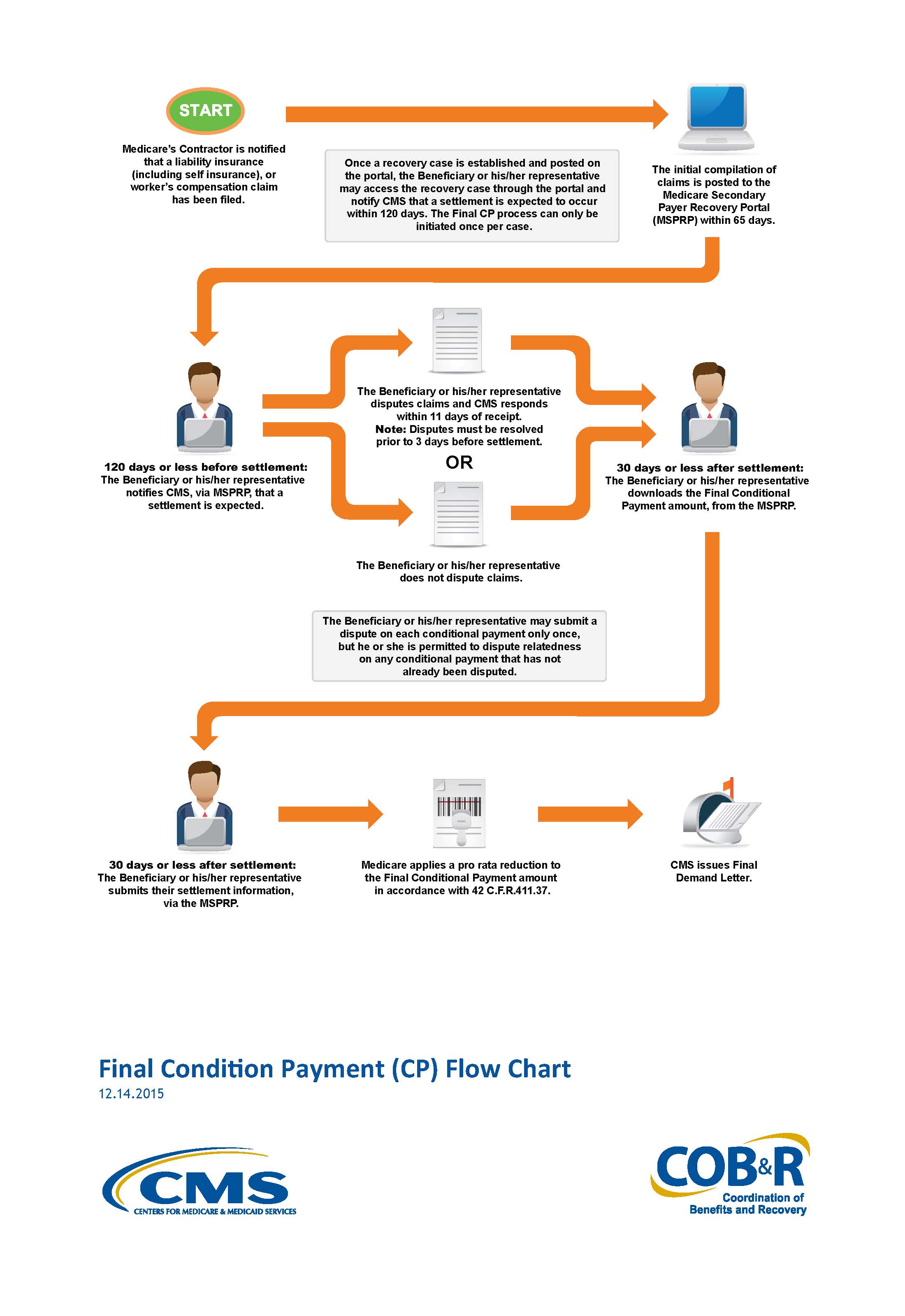
On November 9th 2015, The Centers for Medicare & Medicaid Services (CMS) announced the much anticipated, and long overdue, start date for the new Medicare Secondary Payer Recovery Portal (MSPRP).  The new MSPRP will begin functioning on January 1, 2016.  The current MSP Web portal permits authorized users to register through the Web portal in order to access MSP conditional payment amounts electronically and update certain case-specific information online.

CMS is adding functionality to the existing MSP Web portal that will permit users to notify them when the specified case is approaching settlement, download or otherwise obtain time and date stamped Final Conditional Payment Summary forms and amounts before reaching settlement.  Additionally, the new MSP Web portal will ensure that relatedness disputes and any other discrepancies are addressed within eleven business days of receipt of dispute documentation.

The process is rather straight forward and will address many of the issues that have plagued the plaintiff’s bar in attempting to settle a personal injury action without any certainty of the repayment amount due Medicare.  The process will begin when the beneficiary, their attorney or other representative (such as Synergy) provides the required notice of a pending liability insurance settlement to the appropriate Medicare contractor at least one hundred eighty five days before the anticipated date of settlement.

If the beneficiary, their attorney or other representative (Synergy), believes that claims included in the most up-to-date Conditional Payment Summary form are unrelated to the pending liability insurance “settlement”, they may address discrepancies through a dispute process available through the MSP Web portal.  This dispute may be made once and only once.  Following the dispute CMS has only eleven business days to resolve the dispute.

After disputes have been fully resolved, and a final claims refresh has been executed on the MSP Web portal, then a time and date stamped Final Conditional Payment Summary may be downloaded through the MSP Web portal. This form will constitute the Final Conditional Payment amount if settlement is reached within 3 days of the date on the Conditional Payment Summary.

The plaintiff attorney will complete the process by providing, within thirty days, the settlement information to CMS via the MSP Web portal. This information will include, but is not limited to: the date of “settlement”, the total “settlement” amount, the attorney fee amount or percentage, and additional costs borne by the beneficiary to obtain his or her “settlement”.  If this information is not provided within thirty days, the Final Conditional Payment amount obtained through the Web portal will expire.

Final-Conditional-Payment-Flow-Chart

Florida Supreme Court Cites Synergy CEO as an Authority in Important Collateral Sources Ruling

The Supreme Court issued its ruling in John Joerg, Jr., etc. et. al. v. State Farm Mutual Insurance Company on October 15, 2015. The opinion is exceedingly important as it reinforces application of the collateral sources rule to bar evidence of future Medicare benefits which may be potentially received by the plaintiff. (more…)