Learjet N880Z:  Another Circling Approach Crash

Instrument approach procedures are pre-determined paths and maneuvers that, if followed, will guide an aircraft to a runway in reduced visibility.  The last leg of an instrument approach procedure is typically a straight line (more or less) to the end of the runway.  The straight line minimizes the turns the pilot must make to land the aircraft.
N880Z
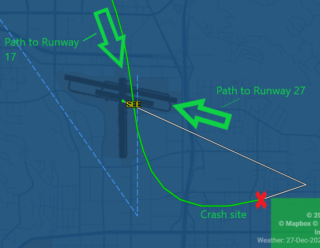
N880Z Crashes during Circles to Runway 27

Sometimes a pilot flies an instrument approach procedure but, just before landing the aircraft, turns the aircraft to land on a different, perpendicular runway.  Flying an instrument approach procedure to one runway and landing on another is called a “circling approach” or a “circle-to-land” maneuver.  A pilot might opt for a circling approach because the winds favor landing on the perpendicular runway, or the length of the perpendicular runway is more suitable to the aircraft.  To perform a circling approach, the weather must be good enough that, as the aircraft gets close to the airport, the pilot can actually see the runways and the surrounding environment.  Circling approaches are challenging maneuvers, especially in jets.  It is hard enough to circle close to the ground when visibility is good.  Harder still when visibility is restricted due to weather.  Proving the point, a Bombardier jet crashed a few months ago during a circling approach at Truckee.

Circling approaches are even more difficult at night.  Some pilots have a personal rule: No circling approaches at night. Those pilots will either land on the assigned runway, regardless of unfavorable winds, or proceed to a different airport.  Better safe than sorry.

But even those pilots might circle at night at his or her home airport.  That’s because the maneuver is easier if the pilot is familiar with the runway lighting, the surrounding lights, and the surrounding terrain. There’s less risk of getting disoriented.

Learjet N880Z operated as an air ambulance.  Last night it was making a short flight from John Wayne Airport to Gillespie, its home base, reportedly with four on board.  It appears it was a “repositioning flight.”  That is, the aircraft was not flying a medical transport mission, but rather was simply returning home. It was dark. The weather was marginal but certainly acceptable.  The pilot began the instrument approach to Runway 17.  The surface winds and the runway length made a landing on Runway 17 a straightforward affair.

As he approached the runway, the pilot decided to circle to land on the perpendicular runway.  It isn’t apparent why he decided to circle. Perhaps landing on the perpendicular runway would leave him with a shorter taxi to the aircraft’s hangar.

In any event, as the pilot began the circling maneuver, he asked the tower controller to turn up the runway lights.  His request indicates that, due to the reduced visibility, the pilot was having difficulty making out the runway lights.  The controller replied that the lights were already at 100% intensity. Shortly thereafter, as the pilot began his turn to line up with the perpendicular runway, the pilot lost control of the aircraft and crashed.

This type of accident is exactly why many pilots will not conduct a circling instrument approach at night.
FEMA Help and the Dixie Fire

FEMA aid is now available for Dixie Fire survivors.  Aid can include money for temporary housing, for repairs, and for certain personal properly losses.

Deadline for registering is October 15.

The catches:

  • By and large, FEMA helps only when the loss is uninsured or underinsured.  For example, if your insurer provides Alternative Living Expense coverage, FEMA will not provide money for temporary housing.
  • You will have to repay any benefits you receive from FEMA out of any settlement you receive from PG&E as part of a Dixie Fire Claim.

To apply:

  1. Visit DisasterAssistance.gov
  2. Download the FEMA App
  3. Call the FEMA Helpline at (800) 621-3362

You will need to provide FEMA with information concerning your insurance coverage and information concerning any denial of benefits.  You’ll hear from FEMA concerning your eligibility after you’ve completed the registration process.

PG&E Dixie Fire and the Truckee Jet Crash

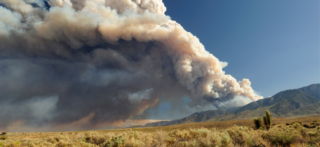
Some media outlets have reported that poor visibility from the PG&E Dixie wildfire smoke may have caused the Bombardier Challenger jet crash in Truckee.   If true, would that make PG&E liable?

Probably not.

PG&E is liable to those whose property burned in the Dixie Fire, or those whose property was damaged by smoke from the fire.  That’s because California’s inverse condemnation doctrine essentially makes PG&E  automatically liable for property damage claims resulting from fires that its equipment sparks.  Further, PG&E may be liable to affected property owners for things like emotional distress under the legal doctrine of “Trespass by Fire.”  Finally, PG&E would be liable for personal injuries or death resulting from the fire if the individual proves that the Dixie Fire was the result of PG&E’s negligence.  That is, one injured by the Dixie Fire or its smoke can hold PG&E accountable if the Dixie Fire was the result of PG&E’s lack of due care in operating its facilities or in keeping the trees around its powerlines property trimmed.

Assuming for argument’s sake that the smoke for the fire contributed to the crash, it’s still unlikely PG&E can be held liable.  The doctrine of inverse condemnation applies only to property damage claims, not to personal injury or death resulting from fires. The doctrine of Trespass by Fire applies only to injury suffered as a result of fire coming onto property owned or occupied by the one injured.  So that wouldn’t apply either.

That leaves the doctrine of negligence. Assuming PG&E caused the Dixie Fire, and further assuming PG&E’s conduct that caused the fire was negligent, it still wouldn’t be enough.  To recover on a negligence claim, the family members would also have to prove that PG&E had a “duty” to not subject their loved ones to the type of risk that PG&E’s conduct exposed them to.  The concept of legal duty is tricky.  Certainly, PG&E had a duty to those whose homes were burned because it was reasonably foreseeable that if it started a fire, property damage would result.  But it’s a stretch to say that PG&E should have foreseen that smoke from a fire would reduce visibility for flights in the area and could contribute to a plane crash.  Because such harm was not a “foreseeable” risk of igniting a fire, it’s unlikely a court would hold PG&E liable.

PG&E’s liability for Dixie Fire claims is most likely limited to property damage and injuries it’s fire caused on the ground.

Dixie Fire and California FAIR Plan Coverage

I was covered for the Dixie Fire under the California FAIR Plan.  What now?

The good news is that FAIR Plan policies pay for the cash value of your dwelling, and the cash value of its contents.  But that’s about it.

  1. No rebuilding costs. Most FAIR Plan policies pay only for the dwelling’s actual cash value.  They don’t pay for the costs of replacing or rebuilding the home, which is almost always substantially more than its value.
  2. Limited relocation costs. Most FAIR Plan policies cover the cost of renting a place to live while you are out of your house, but only up to a dollar limit of 10% of your dwelling coverage, regardless of how long it takes to rebuild or replace your home. And while private fire insurance policies pay for “Additional Living Expenses” such as the costs extra mileage, pet boarding, meals, furniture rentals, and so on, FAIR Plan policies do not.

And of course, regardless of whether you have private insurance or a FAIR Plan policy, insurance won’t cover the costs of replacing trees that were burned, the true value of sentimental items that burned, income you may lose, or emotional trauma you may suffer.  To be made whole, you need to make a Dixie Fire claim against PG&E.

To make a claim against your FAIR Plan, it’s not enough to call your insurance broker.  You have to make a claim on the FAIR Plan website.  You’ll need your policy number.  Here’s the link:  Make a FAIR Plan claim.

Dixie Fire: More on PG&E’s Ability to Pay

The Dixie Fire is now the second largest wildfire in California history, at nearly 500,000 acres.   So far, it has destroyed more than 1000 structures, including 550 homes.  It has totally destroyed the town of Greenville.

Though the fire boundaries are huge, it’s unlikely that PG&E’s financial liability from the Dixie Fire will come close to its liability for the Camp or North Bay Fires.  Those fire burned more than 25,000 structures.

Estimates of the dollar amount of damages caused by the Dixie Fire thus far are hard to come by.  Guggenheim  Securities says that total damages may already exceed $1 Billion.  If that is true, and if PG&E must pay for all of it, then PG&E’s liability would exceed the limits of its private insurance.  To pay survivors’ claims,  PG&E would then have to draw from the state-sponsored wildfire insurance fund. Currently, there is $10 billion available in the fund for that purpose.  (The insurance fund is unrelated to the Fire Victims Trust Fund, which was set aside for the victims of the Camp, North Bay, and Butte Fires.)

Right now, then, there’s money to cover the Dixie losses.  The worry is that we’re still early in the fire season.  The Dixie Fire might not be the only drain on the state-sponsored fund.


Dixie Fire: PG&E Likely Liable, But Can It Pay?

PG&E now acknowledges that its equipment likely ignited the Dixie Fire.  In its July 18 report to state regulators, it admits that there was a power outage, that a troubleman went to investigate, that the troubleman saw a tree leaning against PG&E wires, that the troubleman saw blown fuses on the ground nearby, and that he also saw a fire starting near the base of the tree.

“The responding PG&E troubleman observed from a distance what he thought was a blown fuse on the PG&E Bucks Creek 1101 12kV Overhead Distribution Circuit uphill from his location. Due to the challenging terrain and road work resulting in a bridge closure, he was not able to reach the pole with the fuse until approximately 1640 hours. There he observed two of three fuses blown and what appeared to him to be a healthy green tree leaning into the Bucks Creek 1101 12 kV conductor, which was still intact and suspended on the poles. He also observed a fire on the ground near the base of the tree. The troubleman manually removed the third fuse and reported the fire, his supervisor called 9-1-1, and the 9-1-1 operator replied they were aware of the fire and responding. CAL FIRE air support arrived on scene by approximately 1730 hours and began dropping fire retardant and water.”

PG&E is supposed to keep trees trimmed at least 4 feet from its electrical lines to prevent just this sort of fire.  PG&E failed to do that.  It appears PG&E is liable for the Dixie Fire.

But can PG&E pay?  PG&E is now out of bankruptcy, so claims for damages will be made in state court directly against the “New PG&E,” not in federal bankruptcy court against the Fire Victims Trust.  According to PG&E recent filing with the Securities and Exchange Commission, PG&E has approximately $300 million in insurance coverage for the Dixie Fire.  Fires that PG&E ignites after August 1 are covered by an additional $600 million:

“In April 2021, the Utility purchased approximately $268 million in wildfire liability insurance coverage for the period of April 13, 2021 to April 1, 2022, and approximately $32 million in wildfire liability reinsurance for the period of April 1, 2021 to April 1, 2022 at a cost of approximately $220 million. This coverage is in addition to approximately $11 million in existing wildfire reinsurance for the period of July 1, 2020 to July 1, 2021 and approximately $600 million in existing wildfire liability insurance purchased by the Utility in August 2020 for the period of August 1, 2020 to August 1, 2021. On August 1, 2021, the $600 million of existing wildfire liability coverage is scheduled to renew for the period of August 1, 2021 to August 1, 2022 at a cost of approximately $516 million pursuant to multi-year policy terms. The Utility’s wildfire liability insurance is subject to an initial self-insured retention of $60 million.”

Will PG&E’s ultimate liability for the Dixie Fire exceed the $300 million in available insurance coverage?  It’s too soon to tell.


Bombardier Challenger N605TR Crash at Truckee-Tahoe Airport: Looks Like Base-to-final Stall/Spin

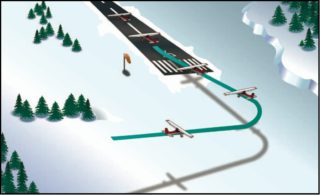
Few turns in aviation are as dangerous as the “base-to-final” turn.  That’s the last turn the pilot executes to line up with the runway.

When that final turn is made, the aircraft is always low and slow. If the pilot tightens the turn too much, the aircraft can stall and crash.  The factors that contribute to a base-to-final crash include:

  • The pilot carrying too much speed, thus requiring a tighter turn so as not to overshoot the runway centerline;
  • A tail wind requiring a tighter turn so as not to overshoot the runway centerline;
  • The aircraft being low in the turn, leading the pilot to compensate by pulling the nose up;
  • High density altitude conditions which result in an indicated airspeed yielding a higher groundspeed than normal;
  • High density altitude conditions which results in decreased aircraft performance.

It’s of course too early to tell why the Challenger N605TR crashed at Truckee.  But the accident has all the earmarks of a base-to-final stall/spin.  All of the above-listed contributing factors may have been at play, making the base-to-final turn especially hazardous for the crew. And witnesses report seeing the aircraft in an extreme left wing down attitude shortly before impact – just as is typical in these sorts of accidents..

All too frequently, smaller general aviation aircraft fall victim to the base-to-final stall/spin . But large jet aircraft like the Challenger typically avoid the risk by lining up with the runway centerline while still miles away from the airport. Because large jets cannot fly slow, and because jet engines respond to throttle inputs relatively slowly, jets such as the Bombardier Challenger are ill-suited for tight maneuvering flight low to the ground near landing speeds.

Seems as though in attempting to maneuver to the runway, these pilots had the deck stacked against them.

The animation below syncs ATC communications with the aircraft’s flight path.

Challenger 605 crashes during approach at Truckee/Tahoe, CA – YouTube

Cirrus SR20 Crash at Truckee Airport: High Density Altitude to Blame?

At first glance, this week’s crash of Cirrus N89423 at Truckee looks like yet another “high density altitude” accident.  Such accidents are, after all, perhaps the most common type of accident at Truckee airport.  Due to the thin air, the aircraft cannot climb fast enough to clear rising terrain or to maintain altitude in

Accident Aircraft

downdrafts.  Sometimes the climb performance might be adequate but the pilot, growing impatient, asks more of the aircraft than it can then provide, usually with lethal results.

Certainly, this accident has many of the earmarks of the typical high-density altitude crash:

  • Truckee is at altitude – 5890 feet.
  • The weather was warm, meaning the air was even thinner thus further degrading climb performance.
  • Breezy conditions were conducive to generating downdrafts on the lee side of the surrounding terrain.
  • The Cirrus SR20 is of low horsepower for its weight and thus has little climb performance to spare

But there seems to be more to it than that.  High density altitude accidents often catch those who are unfamiliar with high density altitude operations, or at least are unfamiliar with the terrain surrounding an airport.  When the pilot asks of the aircraft more climb performance than the aircraft can deliver, the aircraft gets too slow to continue flying, the wing stalls, and the aircraft crashes.

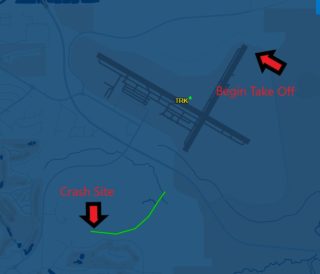
N89423 flight path

But this was an instructional flight.  The flight school, Mountain Lion Aviation, was based at Truckee airport.  The school boasts experience in Cirrus aircraft and so, presumably, the instructor was well familiar with the modest climb performance capabilities of the Cirrus Sr20 and familiar with the airport, the surrounding terrain, and the effects of high density altitude as they then existed.  Further, per the air traffic control tapes, the plan was not to depart the area, but rather stay within the relative safety of the traffic pattern.

Definitely not the usual “high density altitude” accident profile.

Maintenance Error that Brought Down Navajo at Myrtle Beach Not Uncommon

In May, a Piper Navajo PA-31 crashed shortly after takeoff from Myrtle Beach.  The pilot was ATP-rated and worked for American Airlines.  He knew he was in trouble almost immediately after takeoff.  He tried to return to the airport.  He reached an altitude of about 1000 feet, then dropped 475 feet, then climbed 700 feet, then dropped off radar at 450 feet.  The pilot was killed in the crash.

The NTSB now says the aircraft had just come out of an annual inspection.  The control surfaces had been removed and repainted during the annual. It appears that the aircraft’s trim tabs were installed upside down and backward. That would make the aircraft largely uncontrollable.  Once the aircraft was in the air and building speed, the more the pilot attempted to get the aircraft’s nose to point up, the more it would point down.  And vice versa.

As unthinkable as the maintenance error would seem, it is not uncommon.  Many aircraft have crashed after maintenance because aircraft trim mechanisms were installed incorrectly.  The outcome is usually fatal.  But below is the story of one that ended in a safe landing.  It’s instructive from  the perspective of both the pilot and the mechanic.

When you read about these accidents, you are sometimes left wondering why the pilot could not figure out that his controls were reversed and proceed accordingly.  The pilot in the story below explains.  Then the mechanic responsible for the misrigging explains how he had heard stories of crashes that resulted from a mechanic misrigging elevator trim tabs, and that he was sure he would never make such an unforgiveable mistake.  And yet he did.