WHY DIDN’T MY AIRBAGS DEPLOY DURING THE CRASH?

In the realm of automobile safety, few innovations have been as transformative as airbags. These cushioning devices are designed to provide additional protection during collisions, helping to reduce the risk of serious injury or even death. However, there are instances when these lifesaving mechanisms fail to deploy, leaving drivers and passengers bewildered and concerned.

Airbags are integral to a vehicle’s supplemental restraint system (SRS). These systems work in conjunction with seatbelts to provide optimal protection during a collision. When a vehicle experiences a sudden deceleration during a crash, sensors within the vehicle send signals to the airbag control module (ACM). The ACM processes this information and triggers the deployment of the airbags if the conditions warrant it. This entire process happens within milliseconds, aiming to shield occupants from potential harm.

Some Reasons for Airbag Non-Deployment

Severity of the Impact

One of the primary factors influencing airbag deployment is the severity of the impact. Airbags are typically designed to deploy in moderate to severe collisions, so minor accidents might not activate them. This is because deploying airbags in every minor bump could potentially cause more harm than good. If the impact does not meet the predetermined threshold for airbag deployment, they may remain inactive.

Angle of Impact

Airbags are designed to deploy primarily in head-on or frontal collisions. Side impacts or rear-end collisions might not meet the criteria for airbag deployment. The angle of impact and the location of the sensors play a crucial role in determining whether the airbags should deploy.

Sensor Failure or Malfunction

The sensors responsible for detecting an impact and communicating with the ACM must work properly. Sensor failure, damage, or malfunctions can prevent the system from accurately assessing the situation and deploying the airbags when necessary.

Vehicle Design and Quality

Manufacturing defects or design flaws in the airbag system can also lead to non-deployment. These issues might include faulty wiring, software glitches, or inadequate quality control during production.

The non-deployment of airbags in an auto crash can be a puzzling and distressing experience. While these life-saving devices have come a long way in enhancing road safety, their deployment is subject to many complex factors. Understanding the principles behind airbag activation and the conditions required for deployment can shed light on why they might not have deployed in a specific crash scenario.

Romano Law Group has decades of experience

If you find yourself in a situation where your airbags did not deploy during a collision, it’s essential to work with an experienced attorney to investigate the matter thoroughly. Romano Law Group has a team of experienced product liability attorneys who work with experts to help assess the vehicle’s systems, conduct diagnostic tests, and determine whether any contributing factors played a role in the non-deployment.

Authored by Jessica Latour, Esq.

Attorney Jessica Latour

The post WHY DIDN’T MY AIRBAGS DEPLOY DURING THE CRASH? appeared first on Romano Law Group.

WHY DIDN’T THE AIRBAGS DEPLOY DURING MY CRASH?

In the realm of automobile safety, few innovations have been as transformative as airbags. These cushioning devices are designed to provide additional protection during collisions, helping to reduce the risk of serious injury or even death. However, there are instances when these lifesaving mechanisms fail to deploy, leaving drivers and passengers bewildered and concerned.

Airbags are integral to a vehicle’s supplemental restraint system (SRS). These systems work in conjunction with seatbelts to provide optimal protection during a collision. When a vehicle experiences a sudden deceleration during a crash, sensors within the vehicle send signals to the airbag control module (ACM). The ACM processes this information and triggers the deployment of the airbags if the conditions warrant it. This entire process happens within milliseconds, aiming to shield occupants from potential harm.

Some Reasons for Airbag Non-Deployment

Severity of the Impact

One of the primary factors influencing airbag deployment is the severity of the impact. Airbags are typically designed to deploy in moderate to severe collisions, so minor accidents might not activate them. This is because deploying airbags in every minor bump could potentially cause more harm than good. If the impact does not meet the predetermined threshold for airbag deployment, they may remain inactive.

Angle of Impact

Airbags are designed to deploy primarily in head-on or frontal collisions. Side impacts or rear-end collisions might not meet the criteria for airbag deployment. The angle of impact and the location of the sensors play a crucial role in determining whether the airbags should deploy.

Sensor Failure or Malfunction

The sensors responsible for detecting an impact and communicating with the ACM must work properly. Sensor failure, damage, or malfunctions can prevent the system from accurately assessing the situation and deploying the airbags when necessary.

Vehicle Design and Quality

Manufacturing defects or design flaws in the airbag system can also lead to non-deployment. These issues might include faulty wiring, software glitches, or inadequate quality control during production.

The non-deployment of airbags in an auto crash can be a puzzling and distressing experience. While these life-saving devices have come a long way in enhancing road safety, their deployment is subject to many complex factors. Understanding the principles behind airbag activation and the conditions required for deployment can shed light on why they might not have deployed in a specific crash scenario.

Romano Law Group has decades of experience

If you find yourself in a situation where your airbags did not deploy during a collision, it’s essential to work with an experienced attorney to investigate the matter thoroughly. Romano Law Group has a team of experienced product liability attorneys who work with experts to help assess the vehicle’s systems, conduct diagnostic tests, and determine whether any contributing factors played a role in the non-deployment.

Authored by Jessica Latour, Esq.

Attorney Jessica Latour

The post WHY DIDN’T THE AIRBAGS DEPLOY DURING MY CRASH? appeared first on Romano Law Group.

Determining fault in truck crash cases caused by improper lane change with no witnesses

Fault in truck crash cases with no witnesses or video can be established through evidence of lug nut pattern damage and vehicle transfer.

He said. She Said.

Imagine that you are cruising north on Interstate 95 with the windows down and your favorite playlist is blaring. You’ve not a care in the world as you are within minutes of your destination for your long weekend. Imagine too that a box truck or a tractor-trailer is next to you, and you are both traveling at similar speeds relative to each other, or perhaps one of you is passing the other. Suddenly, the side of your car collides with the truck, causing you to spin and come to a stop. There are no witnesses and no video of the crash.

There is no physical evidence in the roadway to establish which lane the collision occurred in. You are adamant you were in your designated travel lane, and you tell the investigating trooper that the truck driver came into your lane. The truck driver is just as adamant and tells the investigating trooper that you drifted into the truck driver’s lane. The classic “he said, she said.”

Crash report shows fault as 50/50

The investigating trooper is unable to determine fault and issues a crash report stating as much. The insurance adjusters chalk it up, at best, as a 50/50 when it comes to fault and repairing your car. At worst, the adjuster for the trucking company accepts only the truck driver’s version and refuses to pay for your car repairs and any resulting injuries or damages you’ve suffered. You may be forced into a long and expensive legal process to establish fault on the part of the truck driver.

Determining fault in a sideswipe or lane change accident can be complicated, despite laws on using turn signals and merging. Blind spots, yielding, and speeding can further complicate matters. Accidents can happen even when following guidelines, making it difficult to sort out the details later. This is where the location and type of damage on the vehicles can frequently provide indisputable clues.

But damage to vehicles tells the true story.

Lug pattern damage can be analyzed to reconstruct a crash using established engineering methods and protocols. Similarly, in other sideswipe or lane change collisions, engineers are often able to reconstruct a crash – or at least determine relative speeds of involved vehicles – by assessing the vehicle’s crush damage, paint transfer, rear-to-front damage or front-to-rear damages (indicative of which vehicle was passing), or a rotating tire sidewall’s rubber transfer. Such evidence on the body of the vehicles or on their wheels or tires can go a long way in establishing fault where there is no other physical evidence and where the “he said, she said” versions of what happened would otherwise hinge on which driver is most credible.

Illustration of a recent case handled by Romano Law Group

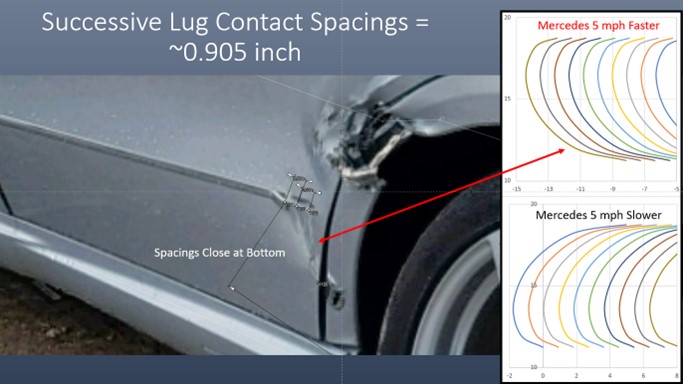
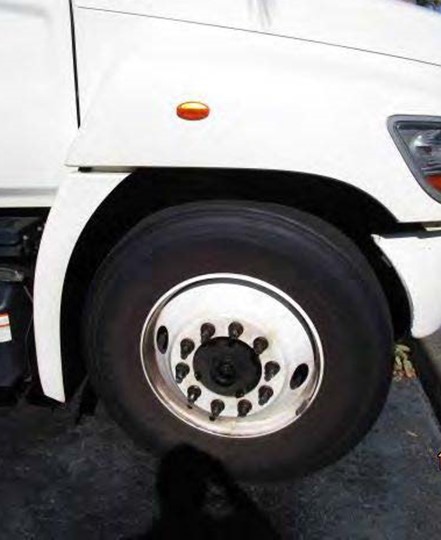
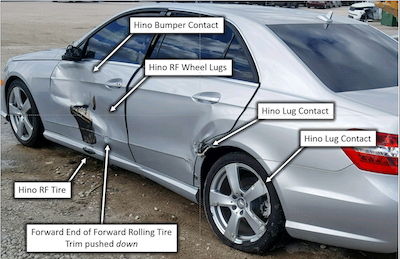
As a brief illustration using one recent sideswipe truck crash case handled by our firm’s truck crash attorneys, the images below depict lug pattern damage from a truck’s front right steer wheel lugs that transferred to the driver side of our client’s vehicle. There was no video of the crash and there were no witnesses other than the drivers, and both had conflicting versions of how the crash occurred and in which lane the impact occurred. Neither vehicle was available for inspection nor event data recorder (EDR) download. However, we were fortunate to have post-crash photos of both vehicles showing lug pattern damage, tire rubber transfer, and some crush damage.

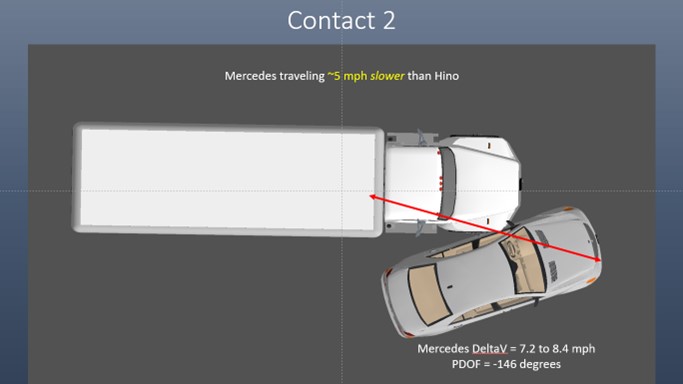
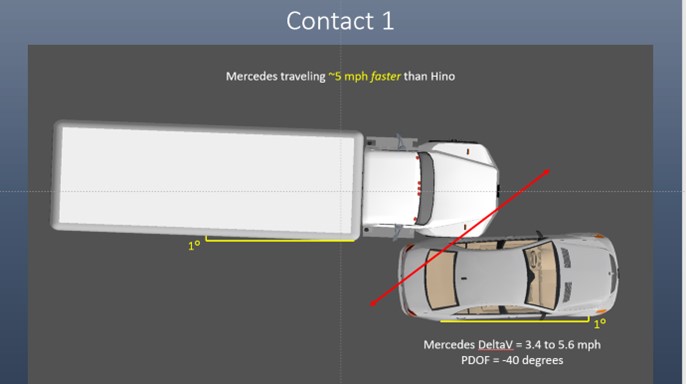
The crash reconstruction engineers we retained utilized the photographs to model the damage patterns and help reconstruct the collision. In doing so, the experts were able to determine the relative speeds of the vehicles, the principal direction of force, the change in velocity of the vehicles, and the nature of the impact between the vehicles. Sound engineering principles and reconstruction methods supported this evidence, and it proved to be invaluable in supporting our theory of fault and our client’s version when considering the sworn testimony of both drivers.

Front right steer tire/wheel of truck depicting lug nuts


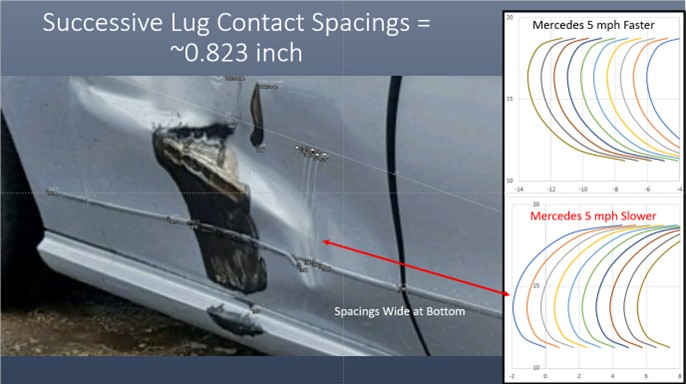
Driver side of vehicle depicting truck’s rubber tire transfer, crush damage, and lug nut damage


Engineering reconstruction depicting initial contact between truck’s front right tire/wheel on rear driver side of vehicle


The truck’s lug damage pattern suggests the vehicle was traveling 5mph slower than the truck.


Engineering reconstruction depicting secondary contact between truck’s front right tire/wheel on driver door of vehicle


Depiction of rubber tire transfer, crush damage, and truck’s lug damage pattern on driver door of vehicle at secondary impact establishing slowing of vehicle relative to truck’s speed during sideswipe scenario


Physical evidence tells the story.

Fault can be determined even without witnesses or video evidence in a sideswipe or lane change collision. The physical evidence found on the vehicles involved in a crash can often provide insight into what happened. Experts in crash reconstruction can usually determine fault or at least support the version of events that is most supported by the physical evidence, in cases where there are conflicting accounts. Crash reconstruction engineers can utilize the physical evidence to make reliable determinations about relative speeds, changes in velocity, and the principal direction of force. The physical evidence can almost always be utilized in conjunction with the testimony of the drivers to help determine fault.

Evidence must be preserved quickly.

The key takeaway here? If you have been involved in a “he said, she said” sideswipe collision or lane change collision and there no witnesses or video, it is not “game over” in terms of determining fault. However, to the extent practicable, the condition of the damage to the vehicles must be preserved so that the vehicles can be inspected quickly before repairs are made. At the very least, the damage to the vehicles must be photographed or video-recorded as contemporaneously as possible to the time of the collision. Remember, the minutes and hours after a truck crash are critical.

If you are involved in such a sideswipe or lane change collision with a truck or with another car, it is imperative that you act quickly by retaining an experienced truck crash lawyer who can help ensure preservation of the evidence by hiring the right investigators and experts who can immediately collect and preserve the physical evidence from the vehicles. Having an experienced and skilled truck crash lawyer onboard to represent you can be the difference-maker in establishing fault in a contested “he said, she said” sideswipe or lane change collision.

Romano Law Group has decades of experience and results.

Romano Law Group has a skilled team with years of experience handling truck and motor vehicle accidents, including sideswipe and lane change collisions. We have also established protocols for rapidly deploying investigators and experts who are well-versed in preserving evidence and determining fault in sideswipe and lane change crashes. If you have been involved in a sideswipe or lane change collision, Romano Law Group stands ready to assist.

Authored by Todd Romano

Attorney Todd Romano

The post Determining fault in truck crash cases caused by improper lane change with no witnesses appeared first on Romano Law Group.

Artificial Intelligence and Insurance Claims

“In a few words, tell me about your injuries”

Remember when companies started automating customer service calls? At first, it was “Press 1 for …” though more and more its systems are designed to sound like humans that greet you with “In a few words, tell me why you’re calling…” and “AI” chatbots.

Artificial Intelligence (“AI”) is here. Well, kinda’. It depends on who you ask. Regardless, the “AI” (e.g., ChatGPT) of today is being implemented into almost every industry you can think of. From fast food to retail to medicine and law. Those at the top love it. It cuts labor, automates processes, and yields end results quicker. They say that it can be used to reduce “human error”. As this trend progresses, the effects will be dramatic and harmful not only to workers but also to injury victims.

Imagine this

You’re involved in an automobile accident. You (or your attorney) submit all of your information to the tortfeasor’s insurance company and instead of a human adjuster (with emotions, life experiences, and industry-based experience), your information is dumped into a machine. Next, it’s processed with some form of machine learning identified as “AI” at that time. The machine doesn’t care who you are. It doesn’t care about your particular circumstances. It doesn’t have life experience, emotion, or industry-based experience. It’s a machine “made to think like a human” but, doesn’t really think like a human.

The information inputted is then benchmarked into and by an underwriting system that categorizes, calculates, rations, and ultimately comes up with a value for your claim based on nothing other than datasets. Do you have a herniation? Which level? Category Z1. Did you break an arm? Dominant or non-dominant? Category X9. Soft-tissue? Denial. The single goal of that machine will be to maximize shareholder profits. And, to do this, it must collect as much as it can in premiums, and minimize claim payouts. Additionally, if you’re the insured and the “system” deems you too much of a risk (i.e., incompatible with the ultimate goal of maximizing shareholder profits), your insurance will be canceled automatically, of course.

Maybe there will be an appeal process where an actual human will review the claim. But, it’s just a matter of time until that process is, itself, automated.

Increase in lawsuits filed

The likely scenario, in an effort to get a real person to understand you, your claim, and your injuries, will be to litigate your claim (until that’s automated, too). You’ll have to file a lawsuit in court and hope that you get a sympathetic defense attorney or jury. Obviously, this is going to increase docket sizes which will cause one of two things to happen. Either, your lawsuit will stagnate, or, you’ll be put on a “rocket docket” where you’re not able to have the court hear everything necessary as the case develops.

The results aren’t positive. The days of talking through injuries and treatment and negotiations with human adjusters are limited.

ChatGPT

Don’t take my word for it; Just ask ChatGPT.

Me: Are there negative effects of AI?

ChatGPT: Yes. There are negative effects of AI (ChatGPT provides this long list):

  1. Job Displacement. Automation driven by AI can lead to job losses in certain industries, affecting employment opportunities for many individuals.
  2. Bias and Discrimination. AI algorithms can inadvertently perpetuate biases present in the data they are trained on, leading to discriminatory outcomes in areas like hiring, lending, and law enforcement.
  3. Privacy Concerns. The widespread use of AI-powered technologies can lead to privacy breaches and data misuse, raising concerns about the protection of personal information.
  4. Security Risks. AI can be used for malicious purposes, such as creating sophisticated cyber attacks or deep fake content, posing risks to security and trust.
  5. Dependence on AI . Over-reliance on AI systems can diminish human skills and decision-making abilities, potentially leading to human complacency or negligence in critical situations.
  6. Ethical Dilemmas. AI can raise complex ethical dilemmas, such as decisions made by autonomous vehicles in life-threatening situations or the use of AI in military applications.
  7. Psychological Impact. The integration of AI into various aspects of life may influence human behavior, social interactions, and emotional well-being in unforeseen ways.
  8. Control and Governance. The lack of proper regulation and governance of AI technologies can lead to misuse or abuse, undermining trust in AI systems.

Striking a balance

To mitigate these negative effects, it is essential for society to prioritize responsible AI development, transparent algorithms, unbiased data, and ethical considerations in AI applications. Striking a balance between the benefits and potential risks of AI will be critical for ensuring its positive impact on humanity.

“Why do our lives today feel so alienated when our technologies are supposed to improve lives? And why do we feel so disconnected when our inventions are meant to connect each and every one of us?” – Anicka Yi

Authored by Corey Friedman

Attorney Corey Friedman


The post Artificial Intelligence and Insurance Claims appeared first on Romano Law Group.

Florida No-Contact Rule for Attorneys and Clients

Unraveling the No-Contact Rule: A Must-Know Guide for Florida Attorneys and Clients

The legal profession often encourages individuals to network and engage with various groups. However, there exists a critical exception: under no circumstances should you, as an attorney or client, converse with opposing parties in a legal case who already have legal representation. Below, we explain the significance of this unbreakable cornerstone, guiding you on the ethical path to successful advocacy and representation.

In the practice of law, maintaining the integrity of the legal process and protecting the rights of all parties involved is of utmost importance. A significant aspect of upholding these principles is adhering to the ethical rules governing attorney conduct. In the state of Florida, Rule 4-4.2 of the Rules Governing The Florida Bar addresses the “no-contact rule,” which regulates communication between attorneys and represented parties.

Overview of Rule 4-4.2

Rule 4-4.2, titled “Communication with Person Represented by Counsel,” is a foundational ethical rule for attorneys in Florida. Lawyers must obtain the consent of an individual’s attorney before communicating with them directly, according to the principle. The rule extends to any party, organization, or entity represented by legal counsel.

Rationale for the No-Contact Rule

The no-contact rule serves several essential purposes:

  • Protecting the Represented Party: The primary goal of the rule is to safeguard the interests of individuals and entities who have legal representation. By prohibiting direct communication between opposing counsel and represented parties, the rule aims to prevent any potential coercion, undue influence, or manipulation that may harm the represented party’s legal rights.
  • Preserving the Integrity of Legal Representation: The rule is designed to maintain the sanctity of the attorney-client relationship and the privilege that accompanies it. Allowing direct contact could undermine the trust and confidence that clients place in their attorneys to act in their best interests.
  • Encouraging Professionalism and Civility: Upholding the no-contact rule fosters an atmosphere of professionalism and civility among attorneys. It promotes a respectful and fair legal process, encouraging attorneys to resolve disputes through appropriate channels rather than resorting to aggressive tactics.

Key Provisions of Rule 4-4.2

Rule 4-4.2 contains essential provisions that attorneys must familiarize themselves with to ensure compliance:

  • Definition of “Represented Person”: The rule applies to individuals or entities who have retained legal counsel or have an attorney-client relationship, even if the representation is informal or temporary.
  • Prohibition of Communication: Attorneys are prohibited from directly contacting a represented person about the subject matter of the representation without the consent of the represented person’s counsel. This prohibition applies regardless of whether the communication occurs in person, via telephone, email, social media, or by any other means.
  • Communication Through Authorized Channels: Attorneys may only communicate with represented parties through the appropriate legal channels. This means contacting the represented party’s counsel or seeking court approval if necessary.

Exceptions to the No-Contact Rule

While Rule 4-4.2 generally prohibits direct communication with represented parties, like most facets in the legal world, certain exceptions exist:

  • Consent: If the represented person’s attorney provides explicit consent for direct communication, then attorneys from the opposing side can engage in such communication. The consent exception also applies if the communication is authorized by law or court order.
  • Communication in Open Court: Attorneys can communicate with represented parties during open court proceedings, hearings, or depositions.
  • Governmental and Organizational Representatives: The rule does not apply to communications with agents, employees, or representatives of an organization or governmental entity, provided the communication is within the scope of their authority and responsibility.

Implications of Non-Compliance

Failure to comply with Rule 4-4.2 can have serious consequences for attorneys. Disciplinary actions, including sanctions, fines, or even disbarment, may be imposed for intentional or repeated violations. Additionally, communications made in violation of the rule could be subject to exclusion as evidence in court proceedings, potentially damaging the client’s case.

Understanding the key provisions and exceptions of R. Regul. FL. Bar 4-4.2 is crucial for attorneys to ensure compliance and uphold the highest ethical standards while representing their clients effectively. By respecting the attorney-client relationship and adhering to the no-contact rule, legal professionals contribute to a fair and just legal system in the state of Florida. Moreover, if you’re a Florida lawyer facing an ethical dilemma or uncertain about potential violations of the Florida Rules of Professional Conduct, you have a lifeline – the Florida Bar’s Ethics Hotline at 800-235-8619, available at no cost. Embracing the willingness to seek guidance in ambiguous situations and consulting an ethics attorney via this hotline could be the very key to salvaging your client’s case or safeguarding your career in the long run.

Authored by Mikayla T. Taylor, Esq.

Photo of Mikayla T. Taylor, Esq.

The post Florida No-Contact Rule for Attorneys and Clients appeared first on Romano Law Group.

Questions About Private Disability Insurance Benefit Claims

What are private disability insurance benefits?

Short-Term and Long-Term Disability Insurance, commonly called STD or LTD insurance, is a private insurance plan that pays your missing wages when illness or sickness takes you out of work. You do not need an on-the-job injury, like with workers’ compensation, to claim private insurance benefits.

STD or LTD insurance differs from the most common disability insurance: social security disability (SSD) insurance. SSD insurance is a federal insurance plan each American worker can qualify for by paying taxes. To verify your social security projected benefits, simply log into www.ssa.gov

On the other hand, people must pay for private STD or LTD insurance or get it as an employee benefit, it is not covered by payroll taxes. STD insurance typically covers the first 6 months of disability, replacing about 2/3rds of lost wages. STD insurance benefits help you recover or decide if you must pursue government SSD benefits.

After STD benefits expire, LTD insurance is another private insurance plan paid by you or your employer that kicks in, typically after six months of disability.

Why would I want a private disability insurance plan?

Private insurance benefits aim to give the disabled more immediate relief. If you suffer an injury or illness that keeps you off work, STD benefits should arrive shortly after you apply.

Contrast this process with government or SSD benefits: you must be disabled for 6 months to qualify. Also, government reviews of SSD applications are often delayed plus they must determine you cannot work at any gainful employment before you get benefits.

Private plans aim to provide benefits quickly, and often apply for a time even if you could work another job. If you have an issue with your private plan, you can sue in court for a breach of contract. SSD appeals are only handled at special administrative hearings, which have been backlogged.

Also, private insurance plans will cover you if you cannot work at your current job. Remember, SSD only covers you after six months if you cannot work in any job. This can make a huge difference.

How does a private disability insurance plan work?

There are many different private insurance companies with different plans, but a typical claim requires providing the insurance company with doctors’ reports detailing your disability. The insurance company must then approve or deny. They also may ask for more information or ask you to see a doctor. Their doctor may evaluate you by asking you for a functional capacity examination.

With both STD and LTD coverage, the plans work better than government insurance because for the first two years after disability, most private plans pay you if you cannot work at your “own occupation.” This is different from SSD benefits which do not approve your disability claim unless you are out of work for over six months and if you cannot work any job.

Why would I get denied private disability insurance benefits?

As discussed, for the first two years after your disability, you are disabled under most LTD plans if you cannot do your “own occupation,” or the job you held when you became disabled. After that period, the insurance company will now only deem you disabled if you cannot do “any occupation” which “you are or can become qualified to perform by education, training, or experience,” like under SSD benefits.

Some people face denial when they reach two-years post-disability. For example, if you injured your back and cannot do manual labor, you are disabled under your “own occupation.” But the insurance company might later decide you are qualified for another job. That means you no longer qualify as disabled under the policy if a set amount of time has passed.

These limitations are not in each plan. There is a LTD policy for doctors that deems them disabled if they cannot work in their medical specialty due to disability. This type of policy is far more helpful if you get disabled, but also more expensive.

How do I avoid getting my private disability benefits denied?

If your benefits were denied because, for example, you went back to work full-time, that is an expected denial. Most people want to return to work, and only pursue benefits if they are truly disabled. But you may face a tough choice about returning to work if you fear losing disability benefits. Many disability plans include language that lets you try to go back to work, without punishment if you fail, to encourage such a return to work. Review your plan for specific details so you do not lose benefits for returning to work.

Sometimes people get denied for not providing sufficient medical records, or after the insurance company doctor’s examination. You must provide the insurance company with your medical records and meet with their doctor, when asked, to qualify for benefits.

Sometimes people get denied if your doctor grows disinterested in continually filling out requests for information from an insurance company. I doubt people attend medical school with a burning desire to complete insurance forms. It may be hard to get a treating physician interested in reviewing the opinion of a doctor the insurance company hired, and so you might get denied since the insurance company relies on their own doctor’s report.

How could a lawyer help me with private disability benefits denial?

If your private disability benefits get denied, you should seek a lawyer who has successfully handled such cases. For example, you might just need to send in additional clarifying paperwork, like additional medical records explaining your disability. Other times, the denial may be more complex. The insurance company could have a fundamental misunderstanding about your job or your disability.

In my experience, the more nuanced your job qualifications or the nature of your disability, the more you may fear denial. Many lawyers will handle your case on a contingency fee basis, meaning you don’t have to pay unless they secure you benefits after getting the denial reversed.

One reason to talk to a lawyer before you get denied benefits is that these sorts of lawsuits do not focus on whether you are, in fact, disabled. You must provide proof of disability, under the definition of your policy, to the insurance company before you go to court.

“ERISA” stands for the Employee Retirement Income Security Act of 1974. An ERISA case or disability benefits denial appeal will focus on the administrative record. This means the case is about how well you presented your case during the appeal of benefits denial. When you go to Court, the issue is not if you can now prove you are disabled, it is whether you earlier proved your disability.

Seeing a lawyer after your administrative appeal can be risky since if you failed to make certain objections or arguments, it may be too late. This means if you wait too long after denial, your case might end before you reach out to a lawyer.

Many people do not understand the reasons why they are denied benefits under the private disability contract. It helps to have an experienced lawyer to help you understand the process. Even if you consider handling your own appeal, talk to a lawyer first. Many lawyers give a free initial consultation so you can decide how a lawyer can help you before you proceed.

What is the process of a lawsuit challenging a private disability benefits denial?

In an ERISA benefits denial case, the court will act more as an appellate tribunal than the trial court you may know. There will be no jury and no testimony in these cases, so there are no witnesses either. The court will evaluate the reasonableness of the insurance company’s administrative decision by reviewing the disability file or administrative record, as well as hearing legal arguments. Do not forget, insurance companies have experienced and talented lawyers to represent them in these suits.

When you file a disability benefit appeal lawsuit, the court may determine if the insurance company acted wrong (or a de novo review). The insurance company’s lawyers may argue the decision should be reviewed for what is called an ‘abuse of discretion.’ The ‘abuse of discretion’ standard means that the insurance company wins unless the insured can prove, based purely on the administrative record, that the insurance company was not merely wrong, but that the denial decision was “arbitrary and capricious.” This is a much higher standard than in many other cases. Again, this is all decided by a judge, not a jury.

A lawyer can help you argue that the court should review your case under a more favorable standard. But even if the court ultimately uses the “arbitrary and capricious” standard, you are better equipped to show how the insurance company acted in such a manner, citing the facts of your specific case, if you retained skilled legal counsel who understands your case.

Authored by Aaron Clemens, Esq.

The post Questions About Private Disability Insurance Benefit Claims appeared first on Romano Law Group.

Hidden Hazards Can Put You in Danger & Impact Your Personal Injury Claims

In our daily lives, we often encounter objects and situations that seem harmless.  Some, seemingly harmless, actually pose a significant risk to our safety and negatively impact a legitimate personal injury claim. It is crucial to recognize these hidden dangers and understand how they can compromise our well-being and legal rights.

Claw Clips in Cars

While wearing a claw clip in a moving vehicle may seem harmless, it can actually pose a significant danger in the event of a crash. When your hair is held up by a claw clip, it creates an additional barrier between your head and the seat/headrest. In a sudden impact or collision, this can prevent your head from properly hitting the seat, increasing the risk of severe injuries. Additionally, the force exerted during an accident can cause your head to forcefully collide with the claw clip, leading to scalp injuries, lacerations, or even the clip becoming embedded in your scalp. Moreover, the presence of a rigid object like a claw clip can interfere with the effectiveness of seat belts and airbags, compromising their ability to protect you during a crash. It is crucial to prioritize safety in a vehicle by removing hair accessories like claw clips and ensuring that nothing obstructs the proper functioning of safety restraints. By doing so, you can reduce the risk of unnecessary harm and better protect yourself in case of a motor vehicle collision.

Worn-out Shoes

Walking around in shoes with worn-out soles can pose significant dangers to your feet and overall well-being. Firstly, worn-out shoes lack proper support and cushioning, can lead to an array of foot-related issues. The worn-out soles may fail to absorb shock effectively, causing increased pressure on your feet and joints, leading to discomfort, pain, and potential injuries like sprains or fractures. Additionally, worn-out shoes often have uneven surfaces, worn-down treads, or exposed nails, making you vulnerable to slip and falls or trip and falls and the severe injuries that may arise from them. Moreover, worn-out shoes may no longer provide adequate protection against external elements like sharp objects, debris, or extreme temperatures. This increases the risk of cuts, punctures, or burns while walking. Therefore, it is crucial to prioritize regular shoe maintenance and replace worn-out shoes promptly to ensure your safety, comfort, and foot health.

Texting and Walking

Walking around while distracted by a mobile phone can be incredibly dangerous for an individual looking to avoid an accident. When engrossed in their phone, people tend to lose awareness of their surroundings, making them more susceptible to accidents and injuries when doing things like traversing a parking lot or crossing a busy street. They may fail to notice hazards such as uneven sidewalks, potholes, or obstacles in their path, increasing the risk of tripping, falling, and sustaining injuries. Further, distracted walking can lead to collisions with other pedestrians, vehicles, or stationary objects, causing not only physical harm but also potential property damage. Being distracted with a mobile phone while walking can also significantly impact a personal injury claim. Insurance companies may argue that an individual’s negligence in failing to exercise reasonable care contributed to an accident, potentially reducing the compensation they may be entitled to. Therefore, it is crucial to prioritize safety by staying attentive and avoiding distractions while walking to mitigate the risk of accidents and ensure a strong personal injury claim if needed.

Inadequate Car Maintenance

Neglecting routine car maintenance tasks such as tire rotations, checking tire pressure, brake inspections, fluid checks, or oil changes can lead to mechanical failures while driving. In such cases, insurance companies like to argue that an individual’s negligence in maintaining their vehicle contributed to an accident, potentially weakening their personal injury claim. Furthermore, inadequate car maintenance can compromise the overall safety features of the vehicle. For instance, failing to replace worn-out windshield wipers or malfunctioning headlights can impair visibility, making it difficult to see and react to road conditions, especially in adverse weather. Therefore, it is crucial to prioritize regular car maintenance, follow manufacturer recommendations, and address any issues promptly to ensure the safety of oneself and potential legal standing in case of an accident.

Clunky Keychains

Often people attach multiple keys, keychains, and other decorative items to their key rings. In the event of a car accident or sudden stop, these objects can become dangerous projectiles, and the weight and momentum of the keychain can amplify the force and cause greater injury and harm to the occupants. It is important that no matter the size of your key ring and its accessories, it is stored in a safe place that will prevent it from making a bad crash even worse.

Authored by Mikayla T. Taylor, Esq.

Photo of Mikayla T. Taylor, Esq.

The post Hidden Hazards Can Put You in Danger & Impact Your Personal Injury Claims appeared first on Romano Law Group.
Camp Lejeune Litigation Update

As many of our Veterans and our clients know, the Camp Lejeune claims are moving forward in the federal court in the Eastern District of North Carolina. The Camp Lejeune Justice Act of 2022 allows anyone who lived, worked, or served at Marine Corps Base Camp Lejeune, North Carolina between August 1, 1953 and December 31, 1987 to assert claims for damages for harm due to exposure to contaminated water at Camp Lejeune.

The Act further requires that an administrative claim be submitted to the Office of the Judge Advocate General of the Navy. The Navy is entitled to consider the claim for a period of no longer than six months before a lawsuit may be filed. The first six months after the passage of the Act recently expired, permitting the first group of lawsuits to be filed.

The Act requires that all lawsuits be filed in the Eastern District of North Carolina where four judges currently preside over all of the Camp Lejeune cases. Managing Partner of the Romano Law Group, John Romano made his appearance in front of the Honorable Judge James C. Dever, III. Judge Dever recently held the first Status Hearing to occur in the cases. The Court expressed a desire for the parties to work together and create a plan to move all of the cases, including those in front of other judges, to a resolution.

How are the cases being handled?

It is important to remember that these cases are not considered a class action lawsuit. A class action lawsuit is brought on behalf of a group of individuals who have suffered common injuries as a result of the defendant’s conduct. In those cases, only one plaintiff acts as a representative for all of the others. That is not the case here. Each case filed under the Act is currently being filed individually, with one plaintiff, for all diseases and injuries experienced by that one person. Each of our clients’ cases are individuals and, as such, need individual evidence for their cases.

What evidence is going to be necessary?

“To meet the burden of proof, a party shall produce evidence showing that the relationship between exposure to the water at Camp Lejeune and the harm is –

(A) Sufficient to conclude that a causal relationship exists; or

(B) Sufficient to conclude that a causal relationship is at least as likely as not.”

Camp Lejeune Justice Act of 2022.

To meet this burden, those making claims should collect as many documents as possible. That may include a DD-214, medical records, birth certificates, death certificates, letters that are addressed to their residence on base, journal entries, and other miscellaneous items that indicate their time spent at Camp Lejeune.

Do I need to open an Estate?

The Camp Lejeune Justice Act of 2022 encompasses over 30 years of wrongdoing. Because it spans back to the 1950s, it is very likely that many people affected by the contamination are no longer with us. An estate provides the opportunity for a party to act on the deceased’s behalf and will likely be needed if there is recovery, if not sooner. However, the government agencies reviewing claims, nor the Court, have not advised that it is necessary to open an estate to make an initial claim. If that occurs, contacting your Counsel will provide the most up-to-date, accurate way to ensure that your claim is in compliance and maintains its viability.

What injuries are attributable to water contamination at Camp Lejeune?

The injuries covered by the Camp Lejeune Justice Act of 2022 have not been limited by the Act nor by the parties involved. The Act and subsequent lawsuits under the Act should not be confused with the analysis performed by the United States Department of Veterans Affairs for treatment and disability compensation of “presumptive conditions.” The presumptive conditions were a finite list of diagnoses that the VA determined to be related to military service and were automatically presumed to have caused those specific diagnoses.

In the litigation for Camp Lejeune, the Department of Veterans Affairs’ presumptive conditions have not been adopted. It cannot be assumed that this will happen in the future. Therefore, you should discuss any injuries that you have experienced after your time at Camp Lejeune that could be attributable to the water contamination at Camp Lejeune, whether or not they have been treated or considered by the VA in the past.

What will the future bring?

The future is unknown as this is unprecedented litigation. However, Judge Dever and his fellow Judges of the Eastern District of North Carolina have agreed to allow the United States Department of Justice an extension of time to file the defense response to the Plaintiffs’ complaints. Additionally, the Court has asked Plaintiff’s attorney to work together to come up with a trial process and work with the U.S. DOJ to bring cases to a resolution.

If you resided, worked, were stationed, or were otherwise exposed to the water at Camp Lejeune for no less than 30 days between August 1, 1953 and December 31, 1987, and suffered from an injury, disease or diagnosis of a medical condition thereafter, do not wait to contact an attorney today! Your claim must be filed within the required time period which is approaching! The Attorneys at Romano Law Group are at the forefront of this litigation and are here to help you get the recovery you deserve.

Authored by Marjorie H. Levine, Esq.

Attorney Marjorie Levine

The post Camp Lejeune Litigation Update appeared first on Romano Law Group.
Five Key Considerations for Medical Malpractice in Florida

A loved one just suffered a tragic death or catastrophic injury, and you think it may involve medical negligence. Here are five key considerations to keep in mind.

Measuring Damages

In medical malpractice claims, some recoveries may reach tens of millions of dollars. How can damages be so high?

Economic Damages:
  • Money you paid or will pay for medical expenses:
    • Medical care is expensive. Those with catastrophic or severely disabling injuries, or who need multiple past and future surgeries, can require a lifetime of expensive medical care.
  • Lost wages and loss of earning capacity:
    • High-wage earners or younger workers can have substantial wage losses when their injuries prevent them from working. When an injury causes a long-term reduction in earning capacity, the financial loss can be significant.
Non-economic damages:

These damages are more difficult to measure, but are usually substantially more than the economic losses.

  • Pain and suffering
    • Physical pain from the injury
    • Stress, fear, worry, anxiety and distress you experience from the injury, including emotional and psychological suffering
  • Permanent impairment and disfigurement
    • Long-term loss of body part or reduction of bodily function
    • Scars or other anatomical changes that spoil your appearance
  • Loss of consortium
    • Loss or impairment of a close relationship with a loved one, including their comfort, care, affection, and companionship.

Proving the Case

How can one prove a Medical Malpractice case?

A bad outcome or a less-than-perfect result does not equal malpractice. After all, most medical professionals will explain to you the many risks inherent in medical care, and complications can happen even with the best of care.

Florida law requires all health care professionals to meet “that level of care, skill, and treatment which, in light of all relevant surrounding circumstances, is recognized as acceptable and appropriate by reasonably prudent similar health care providers.” Malpractice (or professional negligence) occurs when the medical provider fails to meet or falls below that standard.

In Florida, this requires a person who wishes to pursue a case, before even making a claim, to get another doctor to review the record and conclude that the standard of care was not met, and it was this failure to meet the legally required standard of care that led to injury. This can be difficult to prove because often there are many providers involved in the patient’s care.

Florida’s Good Samaritan Act makes claims for emergency medical treatment even more difficult. If a patient requires immediate, emergency services, no suit can succeed against hospitals and emergency room personnel unless they are shown to have a “reckless disregard” for the effects on the life or health of the patient during these stabilizing procedures.

Relationships Matter

Florida’s Free Kill Law treats the lives of some patients as worthless. If a patient dies from medical malpractice, and that patient is unmarried and has no children under 25, the negligent doctor is immune from liability and is allowed a “free kill”. Because Florida has a large population of older patients with grown kids and no spouse, this law frequently allows negligent doctors to avoid accountability for their misconduct.

Medical malpractice cases are exceptionally difficult and expensive, as Florida law is designed to protect negligent doctors by imposing highly restrictive barriers for patients and their families to hold bad doctors accountable. For this reason, lawyers must carefully evaluate all aspects of the case before pursuing it to make sure that it has sufficient merit and value to overcome those obstacles.

Act Fast

Florida has deadlines which, if missed, prevent a claim. The limits include:

  • 2-year statute of limitations – suit must be filed within 2 years of discovery of the medical malpractice (or when you should have discovered it).
  • 4-year statute of repose – suit must be filed within 4 years of the malpractice
  • 7-year maximum cap – suit must be filed within 7 years even if the doctor deceives you using fraud, concealment, or intentional misrepresentation.

The statute of limitations does not apply to a minor if the case starts on or before a child’s 8th birthday.

Contact an Attorney

The most important issue is saved for last. No amount of online research can help you decide if you have a valid claim. After an extreme loss to you or a loved one that you fear involved medical negligence, you should consult with an experienced attorney as early as possible. If you suspect that you or a loved one was injured by medical malpractice, contact an attorney immediately to discuss your options and evaluate you claim.

Authored by Aaron Clemens, Esq.

The post Five Key Considerations for Medical Malpractice in Florida appeared first on Romano Law Group.