Wisconsin Passes Law Enhancing Criminal Penalties Against Vulnerable Adults

Milwaukee Criminal Defense AttorneyOn April 2, 2026, Wisconsin enacted 2025 Wisconsin Act 149. This is new legislation that adds onto existing legislation to significantly expand the criminal penalties and procedural protections that apply when the victim of a crime is a vulnerable adult. 

The law began as Assembly Bill 19 and extends several protections that previously applied only to elder persons — individuals 60 or older — to a broader category called “adults at risk.” For anyone facing criminal charges in Milwaukee or elsewhere in Wisconsin that allegedly involve a vulnerable adult, this law is directly relevant to your case. Our Milwaukee criminal defense attorneys can explain more. 

What Is Wisconsin Act 149?

Wisconsin Act 149 amends several sections of the Wisconsin Statutes to bring adults at risk under many of the same legal protections that have long applied to older adults. The changes affect criminal penalties, battery and sexual assault charges, restraining order procedures, and a court’s ability to freeze a defendant’s assets. The major changes include:

AI Reality Check: What Is Working in Personal Injury Firms Right Now

Every personal injury firm is being pitched AI tools right now. Very few are seeing real returns.

A recent MIT study found 95 percent of companies cannot draw a straight line from their AI spend to any measurable result. Uber’s COO admitted the company burned its entire 2026 token budget by April with nothing to show for the money. If a company with Uber’s engineering resources struggles to prove ROI, your firm should approach every AI sales pitch with healthy skepticism.

This is not a reason to sit out. This is a reason to be smarter about what AI does well, where AI fails, and how to evaluate the tools landing in your inbox every week. I have spent the past year talking with technologists and firm leaders on the Trial Lawyer View by Synergy podcast about this exact question. Two of those conversations, one recent one with Shim Hirsh and one with Kyle Wright, shaped the framework below.

The capability overhang problem

Shim Hirsh describes this moment as capability overhang. AI models perform far beyond what most organizations know how to leverage. The question is no longer whether AI handles a given task. The question is whether your firm operationalizes the output. Anthropic and OpenAI have both announced multi-billion dollar investments in integration companies, deploying engineers to help enterprises put AI to work inside their operations. The frontier labs understand something most law firms have not absorbed yet. Intelligent output sitting on a separate platform does not translate into ROI.

What AI does well in PI operations

AI performs best when you give a specific problem, specific instructions, and specific tools, and require a specific output. The high-value applications in PI firms today follow this pattern. Document extraction and summarization across medical records, police reports, and intake transcripts. Intake transcription, so your agents never touch a keyboard and focus entirely on the client conversation. Workflow automation, flagging matters needing action and routing cases to the right person. End-to-end medical record requests, from provider extraction to vendor submission to follow-up. Finding information across thousands of files instantly and moving the data where the work happens.

The common thread is administrative burden. AI absorbs the repetitive work so your people focus on client service and legal work. The same logic applies to lien compliance. Lien identification, verification, and resolution consume enormous staff hours and carry real malpractice exposure when handled poorly. This is exactly the category of work technology with a human in the loop should remove from your team’s plate. At synergy., we built our lien resolution process on this premise, pairing technology with specialists so your paralegals work cases instead of sitting on hold with Medicare contractors.

What AI does badly, and where firms get burned

Shim is emphatic on one point. AI should never talk to your clients. The apparent savings look tempting on a spreadsheet, and the client experience suffers every single time. Injured people hire you because they want a human advocate. Hand the relationship to a bot and you erode the one asset a plaintiff firm cannot replace.

Autonomous case management is a mistake for the foreseeable future. The vision of an AI case manager making decisions and moving files around sounds impressive in a demo and fails in practice. AI is all knowledge and no experience. A model does not understand precedent, weight, or context the way a practitioner does after twenty years of reading adjusters and judges.

Generic AI built into your case management platform deserves the same caution. Built-in features produce average outputs by design. Your firm has its own playbook, case types, jurisdictions, and business model. Generic does not work. The “let AI handle everything” pitch is snake oil. AI builds solutions. AI is not the solution.

The human-in-the-loop imperative

Kyle Wright’s firm offers the model worth copying. AI assists with intake transcription, document population, and workflow automation, and staff clicks, verifies, and approves at every checkpoint. The structure matters as much as the tool. If your system requires users to assign tasks to an AI agent, adoption fails. People forget, skip the step, or do the work themselves. The fix is to flip the direction. Surface completed work to humans for confirmation. Yes, no, or edit.

Staff buy-in matters as much as architecture. Involve your team in technology decisions and explain how their roles change and improve. Without buy-in, even well-built implementations die quietly.

The questions to ask after the demo

Every AI demo looks impressive. Your job starts when the demo ends. First, ask how the vendor got the inputs. Did someone manually key in data? Is there a bot logging into a portal, the kind of integration breaking every two weeks? Second, ask whether you tailor the output. Will the tool reflect your case types, jurisdictions, and business model, or are you getting a generic response dressed up for the sales call? Third, ask where the output lives. Does the result integrate with your case management system and trigger processes, or does the work sit on another platform waiting for someone to retrieve and rekey? Fourth, ask for other clients’ ROI stories and how the vendor proved them. This one question tells you most of what you need to know.

Watch the pricing model too. Do you need medical records review on every case, or only the complex ones?

The integration problem

AI living outside your case management system creates another source of truth, and another place where information goes to die. The real value comes from embedding AI in your existing stack, triggering processes, moving files, and prompting action inside the system your team already uses. Shim estimates 75 percent of the work is not the AI feature at all. The work is the interpretation and orchestration layer. When does the automation fire? Where does the output go? Who gets notified? Building technology is no longer the barrier. Defining the specific problem and operationalizing the output is the barrier.

The operational know-how gap

The firms getting ROI from AI are not the ones with the most tools. They are the ones with operational discipline. You need people who speak your operational language, understand your pain points, and translate those needs into working systems. Those people are expensive and scarce, and right now Anthropic is recruiting them, not your law firm. The practical alternative is partnering with specialists who understand PI operations and sell outcomes rather than software. The same principle drives how we approach lien resolution compliance at Synergy. You should buy a resolved lien, not another login.

A practical starting point

Map your processes before you buy anything. What is step one, step two, step three, and where do people drop off? Identify the administrative tasks pulling time away from client service and legal work. Lien identification/verification, medical record requests, and intake transcription usually top the list. Then start small. Pick one workflow with clear, measurable ROI and prove the result before expanding. Measure adoption, not capability. If your team is not using the tool, sophistication is irrelevant.

The bottom line

AI is an extraordinary tool. AI is not a solution. The firms seeing real returns understand the value sits in operational know-how and business judgment, not technical capability. The question for firm leaders is simple. Are you buying AI tools, or are you solving specific problems with measurable outcomes? The hype will keep coming. The firms cutting through the hype will win.

Why Synergy is the Answer to Help You Scale

Synergy exists to help firms confront the operational realities being driven by technology and scaling pressure. By removing administrative burdens related to lien identification, verification and resolution, from your staff, we help you strengthen your practice’s capacity for high-value legal work and sustainable growth.

🔗 Want more insights like this?

If you’re a personal injury lawyer ready to scale, streamline, and step into your role as CEO, let’s talk. Join the Peak Practice Community, and learn how Synergy can help you eliminate settlement bottlenecks, resolve complex liens, and maximize recoveries.  Learn more here: https://partnerwithsynergy.com/peak-practice/

If you want to grow and scale your law firm more effectively, consider partnering with Synergy for lien resolution.  Learn more at: https://partnerwithsynergy.com/liens/

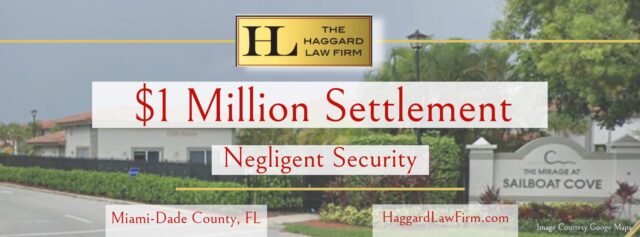
$1 Million Negligent Security Settlement for Family of Food Delivery Driver Killed at Apartment Complex


The Haggard Law Firm’s Maegan Bridwell, Adam Finkel, and Michael Haggard secured a $1 Million settlement in a negligent security case involving the shooting death of a food delivery driver.

On June 8, 2024, Alejandro Linares-Millan, a 40-year-old DoorDash delivery driver, arrived at The Mirage at Sailboat Cove, a townhome community in Miami-Dade County, Florida, to deliver groceries to a resident. What should have been a routine delivery turned into a tragedy that claimed his life and forever changed the lives of his wife and two children.

As Alejandro unloaded groceries from his vehicle around 8:00 a.m., an armed assailant approached and shot him. Alejandro collapsed while awaiting emergency assistance and was transported to a local hospital, where he later died from his injuries.

Following an extensive investigation, attorneys at The Haggard Law Firm uncovered alarming security failures at The Mirage at Sailboat Cove that contributed to the dangerous conditions that allowed this fatal shooting to occur.

Security Failures at The Mirage at Sailboat Cove

Property owners and management companies have a legal obligation to provide reasonably safe premises for residents, guests, and authorized visitors. This duty becomes especially important in communities where families live, work, and receive services from delivery drivers, contractors, and visitors.

Despite marketing itself as a family-oriented residential community, The Mirage at Sailboat Cove  failed to implement even basic security measures designed to deter criminal activity.

The investigation revealed:

  • No effective access control at community entrances
  • Broken gates that allowed unrestricted entry
  • No surveillance camera system
  • No security guards or physical security presence
  • No meaningful monitoring of who was living within the community
  • No policies designed to identify unauthorized residents

These security deficiencies created an environment where unauthorized individuals could access and remain on the property without detection.

The Alleged Shooter Was Living in the Community Undetected

One of the most troubling discoveries involved the individual accused of killing Alejandro.

The Haggard Law Firm discovered, the alleged shooter, was residing in the community with his grandmother despite not being properly vetted or screened by property management.

Industry standards often require property owners and managers to maintain procedures that help identify unauthorized occupants and monitor who is residing within residential communities. The investigation found that The Mirage at Sailboat Cove allegedly lacked meaningful policies or practices for monitoring residents and occupants.

As a result, the alleged shooter was reportedly able to reside within the community without scrutiny and ultimately commit a violent act against an authorized visitor delivering groceries to a resident.

Why Security Guards and Active Monitoring Matter

In many negligent security cases, the presence of trained security personnel can serve as a powerful deterrent against criminal activity.

Security officers can:

  • Monitor entrances and exits
  • Identify suspicious behavior
  • Enforce community rules
  • Screen unauthorized individuals
  • Respond quickly to developing threats
  • Coordinate with law enforcement when necessary

According to the findings in this case, active security personnel may have identified unauthorized occupants, questioned suspicious individuals, and potentially prevented the circumstances that led to Alejandro’s death.

When residential communities fail to implement reasonable security measures despite foreseeable risks, they may be held accountable under premises liability law in most states, including Florida.

Understanding Negligent Security Claims in Florida

Negligent security is a type of premises liability claim that arises when a property owner or manager fails to take reasonable steps to protect lawful visitors from foreseeable criminal acts.

Examples of negligent security failures include:

  • Broken or ineffective gates
  • Lack of access control systems
  • Poor lighting
  • Failure to employ security personnel
  • Inadequate surveillance cameras
  • Failure to address known criminal activity
  • Lack of policies to monitor residents and guests

Property owners are not automatically responsible for every crime that occurs on their property. However, when foreseeable risks exist and reasonable security measures are not implemented, liability may arise.

The central question often becomes whether the criminal act was foreseeable and whether reasonable security measures could have prevented or reduced the risk.

The Haggard Law Firm Secures a $1 Million Settlement

Based on the extensive security failures identified during the investigation, The Haggard Law Firm secured a $1,000,000 settlement from The Mirage at Sailboat Cove before extensive litigation was necessary, and despite issues with insurance coverage that limited the family’s access to a recovery.

Nevertheless, the settlement provides financial accountability for the devastating loss suffered by Alejandro’s family.

Protecting Delivery Drivers, Residents, and Visitors

The  death of Alejandro Linares-Millan highlights an important reality: delivery drivers, rideshare drivers, contractors, guests, and service providers often enter residential communities with the expectation that reasonable security measures are in place.

When communities fail to maintain those safeguards, innocent people can become victims of preventable violence.

Property owners and management companies must recognize that security is not merely an amenity—it is a responsibility.

Contact The Haggard Law Firm

The Haggard Law Firm has litigated nearly 500 negligent security cases nationwide and has recovered hundreds of millions of dollars on behalf of victims and families harmed by preventable criminal acts.  Click here

If you or a loved one has been injured or killed due to inadequate security at an apartment complex, condominium, hotel, shopping center, or residential community, contact The Haggard Law Firm to learn about your legal rights.

Beyond Ahlborn. How Wos Protects Injury Victims from Arbitrary State Recovery.

How the 2013 Supreme Court decision in Wos v. E.M.A. constrained the state statutory schemes that tried to work around Ahlborn, and what trial lawyers can do with the framework today. 

Why does a 2013 Supreme Court case still control how state Medicaid agencies recover from your client’s personal injury settlement? Because Wos v. E.M.A. answered a question Ahlborn did not. Federal law limits state Medicaid recovery to the medical portion of a settlement. But what happens when a state writes a statute that simply declares a fixed share of every recovery to be “medical,” with no procedure to rebut?  The Court answered that question in March of 2013. The state cannot do it. And the language of that holding still controls every state allocation default in effect today. 

The Ahlborn Ceiling, and Why It Was Not Enough 

In Arkansas Department of Health and Human Services v. Ahlborn (2006), the Supreme Court read the federal anti-lien statute at 42 U.S.C. § 1396p as a strict limit on state Medicaid recovery from a tort settlement. State Medicaid reaches the portion of a recovery attributable to medical expenses. It cannot reach pain and suffering, lost wages, or other non-medical damages. 

The Ahlborn parties stipulated that Heidi Ahlborn’s total damages were $3,040,708 and that her settlement represented one-sixth of that amount. Arkansas was therefore entitled to one-sixth of its $215,645 medical lien, or $35,581. That ratio, called the pro-rata methodology, became the starting point in most jurisdictions. 

What Ahlborn did not decide was how a state should determine the medical portion when the settlement is unallocated and the parties have not stipulated.  

The State Statutory Response 

After Ahlborn, states with third-party liability statutes had a problem. Their default rules, often written before Ahlborn, typically allowed Medicaid to recover its full lien from a settlement without any allocation analysis. That position no longer worked. 

Some states amended their statutes to incorporate the pro-rata methodology. Others took a different route. They wrote in a fixed percentage that the statute deemed to be the medical portion of every recovery. North Carolina was one of those states. Its statute provided that up to one-third of any damages recovered by a Medicaid beneficiary in a third-party action must be paid to Medicaid to reimburse it for the cost of care. 

On its face, the rule looked like a compromise. Medicaid would never take more than a third. On any settlement large enough to cover the full Medicaid lien within that one-third figure, the rule was easy to apply and predictable. 

But Ahlborn had said something more specific than “do not take too much.” It had said that the state could only reach the portion of the settlement attributable to medical expenses, full stop. A statute that declared one-third of every recovery to be medical, regardless of the case, was not applying Ahlborn. It was working around it. 

Wos v. E.M.A.: Facts, Holding, Reasoning 

The case that drew the question to the Supreme Court began in the Fourth Circuit. In E.M.A. v. Cansler, a North Carolina toddler suffered catastrophic injuries during birth. Her medical care was covered in part by North Carolina Medicaid. The case settled in a tort action for an amount substantially less than the value of her future care needs. North Carolina invoked its statute and demanded one-third of the settlement as reimbursement, without any allocation between her medical damages and the future loss claims at the center of the case. 

The Fourth Circuit held that the statute was preempted by federal law. The state could not place a lien on, or force an assignment of, settlement proceeds that were not properly allocable to past medical expenses. A statutory default that imposed a fixed percentage without any opportunity to rebut violated that rule. 

The Supreme Court granted certiorari and, in March of 2013, affirmed the Fourth Circuit in a 6-3 decision. The opinion in Wos v. E.M.A. is short and direct. The majority pointed out that an injury victim has a property right in the proceeds of a settlement, which brings it within the protection of the federal anti-lien provision. That property right is subject to the narrow exception that requires a state to seek reimbursement for the medical portion of the recovery. The remainder of the settlement is protected. 

North Carolina’s statute did not respect that line. The Court wrote that if “a State arbitrarily may designate one-third of any recovery as payment for medical expenses, there is no logical reason why it could not designate half, three-quarters, or all of a tort recovery in the same way.” That observation captured the structural problem with any fixed allocation rule that has no factual basis in the particular case. 

The holding follows from that observation. “An irrebuttable, one-size-fits-all statutory presumption is incompatible with the Medicaid Act’s clear mandate that a State may not demand any portion of a beneficiary’s tort recovery except the share that is attributable to medical expenses.” 

The Procedure Requirement 

The Supreme Court did not stop at striking down the North Carolina statute. It explained what kind of state procedure could survive. 

A state may use a default allocation rule as a starting point. But it must also provide a procedure that allows a dissatisfied beneficiary to challenge that default through a fair and impartial adversarial process. The Court did not require that the procedure be a separate judicial proceeding. A hearing within the Medicaid administrative system, a special master, a probate court order, or a stipulation built into the underlying settlement can all work, depending on the state. 

What it cannot be is nothing. The Wos Court reaffirmed an earlier observation from Ahlborn about how a sound procedure looks. When “there has been a judicial finding or approval of an allocation between medical and nonmedical damages, in the form of either a jury verdict, court decree, or stipulation binding on all parties, that is the end of the matter.” The federal anti-lien provision protects the portion of the recovery that the allocation does not assign to medical expenses. 

Legal professionals should read that language closely. It defines both the trigger for federal protection and the form of order that triggers it. 

Reading Your State’s Third-Party Liability Statute 

Most state third-party liability statutes still rely on a default rule of some kind. Some apply a fixed percentage. Others apply a pro-rata formula at the agency’s discretion. A few have written in a full hearing procedure. After Wos, the analysis for legal professionals is the same in every state. 

First, identify what the state’s default allocation rule is and how it is applied in practice. Statutory text and recovery contractor practice are not always the same thing. Recovery contractors including Optum, Conduent, and others assigned to state Medicaid recovery work often start with the statutory default in their first demand. Whether the agency itself will entertain a challenge depends on state procedure. 

Second, ask whether the state has a procedure for challenging the default. Some states require a Medicaid lien hearing. Others permit a probate court order that allocates damages. A few allow the parties to stipulate to an allocation that binds the agency, provided proper notice is given. 

Third, you can attempt to build the allocation into the resolution of the case. A binding stipulation between the parties, a court order approving the settlement that includes a damages allocation, or a probate court order can all satisfy the Wos procedure requirement, depending on the state. The form matters less than the substance. Was there a fair allocation, was it on the record, and is it binding. 

Where Synergy Fits 

Synergy resolves state Medicaid liens for personal injury firms across all fifty states. The Synergy team includes attorneys and lien specialists who apply the Ahlborn framework to each state’s third-party liability statute and to the recovery contractor handling the file.  

If you have an open state Medicaid lien where the default formula does not work for the case, or where the recovery contractor is not engaging in fair negotiations, send it over. Synergy will give you our read on the lien and the state-specific posture. 

Download the Wos Compliance Guide

Send us Your Toughest Open Medicaid Lien for a Free Consult


Click here

Nick Norden: Your Ego Is the Thing Slowing Your Firm Down

Most trial lawyers think the hard part is winning. You try the case, you get the verdict, you move on to the next one. Then you start your own firm and learn the truth. Winning cases and running a firm are two very different jobs. Being great at one does not make you good at the other.

I

The Executive Director role most PI firms are missing

The Executive Director seat at a personal injury firm is still being defined. Most plaintiff firms run on the traditional managing partner model, where the lawyer who loves trying cases ends up running HR, intake, and finance by default. Marina’s role exists because someone has to own the operational side so trial lawyers stay focused on the work they were hired to do.

“It’s even hard to admit you need help sometimes,” she said. The work starts with separating founder-level tasks from leadership tasks built around the business itself.

Hire ahead of the need

One of the biggest mistakes Marina sees in plaintiff firms is reactive hiring.

“You can’t wait until you need the paralegal to hire the paralegal. You have to have that paralegal training six months before.”

The fix is forward-looking workforce planning. Watch file counts. Watch phone volume. Train the next role before the gap becomes a fire.

The metrics worth tracking weekly

Marina sends a firmwide scorecard every week. No mysteries. No leadership-only data. Everyone sees the same numbers and rows in the same direction. The four she watches most closely:

  1. Signed cases, split between marketing-sourced and referred
  2. Complaints filed
  3. Demands sent out
  4. Resolution, both pre-lit and in litigation

Monthly, she tracks cost per case and average fee. About 30 percent of OG’s cases move into litigation, which explains a higher average fee and a deliberate choice to file cases.

Time on desk is where the money hides

If you want to find quiet revenue inside your firm, look at time on desk.

“If you cut a couple of months off the time on desk, you’re putting revenue in the previous year. You’re doing 14 months of revenue in 12 months.”

Lien resolution sits inside this problem. Cases stall while medical liens, Medicare obligations, and reductions get worked through. Clients wait. Five-star Google reviews die in the gap between settlement and check.

Intake is the most expensive operational leak

Ask Marina where plaintiff firms lose the most money, and she points straight at intake.

“One call could be a $5 million case.”

Her position: staff intake heavier than feels comfortable. Train constantly. Listen to the recordings. Coach the conversations. Intake feeds every other metric on the scorecard, because nothing moves without the signed case.

Culture as a hiring filter

Ostroff Godshall built core values and a social contract the partners stand behind. Those values drive interviews. Predictive Index assessments help match personality to role.

The lesson Marina learned the hard way: a high-performing hire who fails the culture test pulls the rest of the team down. Her rules are simple. Hire for traits. Train for skill.

The view from the operations seat

The competitive picture is shifting fast for plaintiff firms:

·         MSOs backed by private equity entering more markets

·         AI tools rewriting how cases get litigated

·         Marketing spend climbing in every major metro

·         Gen Z workforce expectations reshaping how teams operate

Marina’s response is to focus on what you control. For her firm, that looks like a client experience built on real human contact, with automations used to free up calls rather than replace them. Community presence matters too. Her firm gave away 1,000 backpacks last year and plans to give more this year.

“Grit” is one of OG’s core values, and Marina lives it

If she were building a personal injury firm tomorrow with a goal of 30 lawyers, her first three priorities would be:

·         Document every process so the founder’s knowledge lives outside their head

·         Lock down cybersecurity, secure phones, and secure email

·         Write an AI policy before the team starts using tools without guardrails

The takeaway for plaintiff firm leaders

Operations is the difference between a firm with great verdicts and a firm with a great business. Build the foundation, measure the numbers, protect the intake, and keep the human side of the work alive.

🎧 Listen to the full podcast conversation here:

🔗 Want more insights like this?

If you’re a personal injury lawyer ready to scale, streamline, and step into your role as CEO, let’s talk. Join the Peak Practice Community, and learn how synergy. can help you eliminate settlement bottlenecks, resolve complex liens, and maximize recoveries.  Learn more here: https://partnerwithsynergy.com/peak-practice/

If you want to grow and scale your law firm more effectively, consider partnering with Synergy for lien resolution.  Learn more at: https://partnerwithsynergy.com/liens/

Nick Norden: Your Ego Is the Thing Slowing Your Firm Down

Most trial lawyers think the hard part is winning. You try the case, you get the verdict, you move on to the next one. Then you start your own firm and learn the truth. Winning cases and running a firm are two very different jobs. Being great at one does not make you good at the other.

I sat down with Nicholas Norden, founder of Norden Leacox Accident & Injury Law in Orlando, for a recent episode of the Trial Lawyer View by Synergy podcast. Nick left the defense side, built a true trial firm, and scaled it to seven attorneys. What he shared is a clear playbook for any plaintiff lawyer who wants to grow without grinding themselves into the ground.

Here is what stood out.

Run it like a business from day one

Here is where Nick separates from most firm owners. He has a finance degree. His partner, Zach Leacox, has an MBA. Before they opened the doors, they spent hundreds of hours writing a real business plan. A budget. A marketing plan. One-year, three-year, five-year, and ten-year targets.

Most lawyers do the opposite. They hang a shingle, start practicing, and figure out the business side later. By then they are already behind.

The business mindset shows up most in how Nick makes decisions. He pointed to a trap a lot of smart lawyers fall into:

“In business you learn it is about getting 80 percent of the information and making a decision. A lot of my lawyer friends fall into paralysis by analysis. They want to know every single thing, and then it is too late.”

If you do not have a business background, you do not have to go get an MBA. You do have to treat the firm like the business it is. Know your numbers. Make the call with the information you have.

The ego problem nobody wants to name

This was the sharpest moment in the conversation. Nick and Zach belong to Fireproof Performance, a coaching and mastermind program for PI firms. At one conference, Mike Morse called them out in front of the room. He asked who the best trial lawyer at the firm was. Both Nick and Zach said they were.

Mike told them that answer was the problem. Their egos were the ceiling. If they wanted to scale, they needed to hire trial lawyers who were better than them, then step back and run the business.

“We cannot let our ego get in the way. We have to go find a group of lawyers who care as much as we do and may be better at some things than we are, and let them do it.”

That is the breakthrough for a lot of founder-led firms. You are the bottleneck. Your skill at trying cases is exactly what keeps you trapped in the work instead of building the firm.

Hire on values, fire fast when they do not fit

Nick shared the personnel mistake that cost his firm the most. Early on they kept a high performer who was a poor cultural fit. The person was good at the job, so they held on too long. The result:

•     Other team members did not want to work with the person.

•     Good people left because of them.

•     The whole atmosphere turned negative.

When they finally made the call, the change was night and day. People who had left asked to come back. Now Nick and Zach hire, fire, and train on core values. If someone does not meet the values, skill does not save them.

“You gain the respect of your employees when you do that. They know you will hold people accountable to your core values. That is what they want.”

You cannot do it alone

Nick is candid about the loneliness of ownership. He had an advantage most founders do not. His partner is also his best friend of twenty years, which gives him a sounding board at 10:30 at night when a new worry hits. Most leaders do not have that.

Coaching and masterminds filled the gap. Nick says the three biggest wins from that community were:

•     Dashboards and metrics. He now knows his case acquisition cost, lead volume, and conversion rate at any moment.

•     Structured meetings. Quarterly and annual planning where the executive team sets goals on paper and holds each other accountable, including the partners.

•     Peer camaraderie. A group of firm owners across the country at the same stage, swapping ideas on AI, marketing, and vendors under NDA, with an abundance mindset.

Starting over, he would join sooner. He waited until year two or three. His advice to new owners is simple. Get coaching. If not Fireproof, then someone.

AI is now a requirement, not an edge

Nick does not see AI as a threat to jobs. He sees it as the way his team stops doing tedious work and spends more time with clients. His firm runs case management software with AI layered on top for specific tasks:

•     Medical chronologies that used to take a paralegal hours or days now take minutes, with a human checking the output.

•     Automated text and client messaging so staff stop doing repetitive outreach by hand.

•     Medical records follow-up, where AI chases responses at 7 and 14 days instead of a person tracking every request.

The line he holds is client contact. With a firm their size, human interaction with clients is the thing that sets it apart, so that stays with people. Everything repetitive and administrative is fair game for a tool.

This is the same logic behind why we built our own AI powered lien technology at Synergy.  But it is always with human subrogation experts in the loop. As Nick points out, the hours your team spends on hold with Medicare or chasing recovery vendors is time you recapture and deploy to higher-value work.

If a tool does not improve the client experience in the end, it is aimed at the wrong goal.

Key Takeaways from Nick

Nick’s firm prepares every case as if it is going to trial. Because of that, about 99 percent reach a fair resolution without one. The trial readiness drives the outcomes. The business discipline lets the firm survive the volume.

If you are building or scaling a plaintiff firm, the pattern here is worth copying:

•     Run it like a business from the first day, not the day it breaks.

•     Get your ego out of the way and hire people better than you.

•     Protect culture by hiring on values and acting fast when fit is wrong.

•     Surround yourself with coaches and peers who tell you what you cannot see.

•     Use AI to free your team for client work, not to replace the people who do it.

The firms that get this right are not working more hours. They are building something that lasts.

🎧 Listen to the full podcast conversation on Trial Lawyer View here: https://triallawyerview.com/podcast/nicholas-norden/

🔗 Want more insights like this?

If you’re a personal injury lawyer ready to scale, streamline, and step into your role as CEO, let’s talk. Join the Peak Practice Community, and learn how synergy. can help you eliminate settlement bottlenecks, resolve complex liens, and maximize recoveries.  Learn more here: https://partnerwithsynergy.com/peak-practice/

If you want to grow and scale your law firm more effectively, consider partnering with Synergy for lien resolution.  Learn more at: https://partnerwithsynergy.com/liens/

Florida Pedestrian Accidents: Why Palm Beach County Roads Remain Dangerous

Florida’s roads have long been dangerous for people walking, biking, and using mobility devices. A new report highlighted by Florida Trend makes that danger impossible to ignore: nine of the 27 most dangerous metro areas in the United States for pedestrians are in Florida, including the Miami–Fort Lauderdale–Palm Beach County region.

For families in West Palm Beach, Palm Beach County, and throughout South Florida, this is not just a transportation statistic. It is a public safety warning. Pedestrian crashes can cause devastating injuries, including traumatic brain injuries, spinal cord injuries, broken bones, internal injuries, permanent disability, and wrongful death. Unlike drivers and passengers, pedestrians have no seat belts, airbags, or vehicle frames to protect them when a collision occurs.

At Romano Law Group, we have seen how quickly a routine walk across a street, through a parking lot, near a school zone, or along a busy roadway can become life-changing. As a family-owned personal injury law firm serving West Palm Beach, Palm Beach County, Florida, and clients nationwide, we believe public awareness is a critical part of injury prevention.

Florida’s Pedestrian Safety Crisis Is Statewide

According to the Florida Trend report, Smart Growth America’s latest “Dangerous by Design” findings rank Florida as the fifth most dangerous state in the nation for pedestrians. The report found that 3,726 pedestrians were killed in Florida between 2020 and 2024, the third-highest total in the country behind California and Texas. Florida’s average pedestrian fatality rate during that period was 3.32 deaths per 100,000 residents.

The report identified nine Florida metro areas among the 27 deadliest for pedestrians:

Tampa Bay ranked eighth nationally, followed by Palm Bay/Melbourne/Titusville at 11th, Deltona/Daytona Beach/Ormond Beach at 14th, North Port/Bradenton/Sarasota at 15th, Jacksonville at 16th, Miami/Fort Lauderdale/Palm Beach County at 17th, Lakeland-Winter Haven at 21st, Orlando/Kissimmee/Sanford at 25th, and Cape Coral/Fort Myers at 27th.

The inclusion of the Miami–Fort Lauderdale–Palm Beach County metro area should concern everyone who lives, works, drives, walks, or bikes in South Florida. Palm Beach County includes busy corridors, high-speed arterials, tourist traffic, school zones, shopping centers, residential neighborhoods, and construction zones. These are all places where pedestrians and vehicles frequently interact.

Why Are Florida Roads So Dangerous for Pedestrians?

Pedestrian crashes often happen because of a driver’s negligence, but road design also plays a major role. Smart Growth America’s “Dangerous by Design” report explains that many U.S. streets were built to move cars quickly rather than to keep all road users safe. The organization’s 2026 report notes that pedestrian deaths have increased 72 percent since 2009, even though deaths have slightly declined from recent historic highs.

In Florida, many roads are wide, fast, and difficult to cross safely. A person may need to walk across multiple lanes of traffic, sometimes without enough lighting, a median refuge, a clearly marked crosswalk, or enough time on a pedestrian signal. In some areas, sidewalks are missing, disconnected, obstructed, or too close to moving traffic.

Romano Law Group’s pedestrian accident practice page recognizes this reality: many Florida roads were constructed primarily for vehicle traffic, placing pedestrians at a natural disadvantage. The firm also notes that pedestrian injuries are often severe and may involve brain injuries, spinal injuries, paralysis, and loss of life.

Common contributing factors in pedestrian crashes may include:

Driver distraction, speeding, failure to yield, impaired driving, poor visibility, inadequate lighting, confusing traffic signals, unsafe crosswalk design, blocked sightlines, construction zone hazards, rideshare or delivery driver negligence, and hit-and-run collisions.

Every case depends on its specific facts. A full investigation may need to examine driver behavior, roadway conditions, lighting, vehicle speed, traffic-control devices, witness statements, surveillance video, phone records, crash data, and whether other responsible parties contributed to the danger.

South Florida Pedestrians Face Unique Risks

The Miami–Fort Lauderdale–Palm Beach County metro area is home to commuters, tourists, retirees, students, bicyclists, public-transit users, and workers who rely on walking as part of daily life. This creates a constant mix of vehicles and pedestrians.

Many pedestrian crashes happen in places that feel familiar: near grocery stores, apartment complexes, schools, restaurants, bus stops, hotels, parking lots, and neighborhood intersections. Familiarity can sometimes create a false sense of safety. Drivers may assume they have enough time to turn. Pedestrians may assume a driver sees them. A few seconds of distraction can be catastrophic.

Nighttime is especially dangerous. Romano Law Group specifically identifies nighttime visibility as an important issue in pedestrian injury cases, including roadway, driver, and environmental lighting. Nationally, NHTSA reports that 7,080 pedestrians were killed and more than 71,000 were injured in traffic crashes in 2024.

These numbers should remind drivers that pedestrian safety is not optional. It is part of the duty every driver has when operating a vehicle.

What Injured Pedestrians Should Do After a Crash

After a pedestrian crash, medical care should always come first. Even if someone believes their injuries are minor, symptoms can worsen over time. Head injuries, internal injuries, soft-tissue damage, and spinal injuries are not always obvious immediately after impact.

After seeking medical attention, injured pedestrians and their families should try to preserve important information when possible. This may include the crash location, driver information, witness names, photos of the scene, photos of injuries, clothing and shoes worn at the time of impact, medical records, police reports, and any available video from nearby homes or businesses.

It is also important to avoid giving recorded statements to insurance companies without legal guidance. Insurance companies may try to shift blame, minimize injuries, or argue that a pedestrian could have avoided the crash. Florida’s comparative negligence rules can make fault disputes especially important, because an injured person’s recovery may be affected if they are assigned partial responsibility.

Romano Law Group’s pedestrian accident attorneys emphasize the importance of preparation, evidence preservation, witness statements, medical records, identifying responsible parties, and evaluating lost wages after a crash.

Who May Be Responsible for a Pedestrian Accident?

The driver who struck the pedestrian may be responsible if they were speeding, distracted, impaired, careless, failed to yield, failed to obey a traffic signal, or otherwise acted negligently. However, some pedestrian accident cases involve more than one responsible party.

Potentially responsible parties may include:

A negligent driver, a vehicle owner, a rideshare company, a delivery company, an employer, a commercial vehicle operator, a government entity responsible for roadway design or maintenance, a construction contractor, a property owner, or a manufacturer if a vehicle defect contributed to the crash.

Not every case will involve all of these parties. That is why an early investigation matters. In serious injury and wrongful death cases, evidence can disappear quickly. Skid marks fade. Vehicles are repaired or destroyed. Video footage may be overwritten. Witnesses become harder to locate.

Prevention Starts With Safer Driving and Safer Streets

Florida’s pedestrian crisis requires action from drivers, policymakers, transportation planners, property owners, and communities. Drivers can help immediately by slowing down, staying off phones, yielding at crosswalks, watching carefully before turning, using extra caution at night, and never driving impaired.

Local and state leaders can also reduce risk by improving lighting, adding safer crosswalks, reducing dangerous speeds, improving signal timing, completing sidewalk networks, redesigning high-crash corridors, and prioritizing safety over speed.

The Florida Trend article also noted that the Florida Department of Transportation has pointed to its Target Zero initiative and pedestrian and bicycle safety planning efforts as part of its work to reduce serious and fatal crashes. FDOT’s pedestrian and bicycle safety materials state that its goal is zero traffic fatalities and describe enforcement, education, planning, design, and emergency-response strategies as part of that effort.

Awareness alone will not fix dangerous roads. But awareness can help families make safer choices, help drivers understand their responsibilities, and help communities demand better protections for people outside vehicles.

Injured in a Pedestrian Accident in Florida?

A pedestrian crash can leave you facing medical bills, missed work, pain, uncertainty, and pressure from insurance companies. You do not have to navigate that process alone.

Romano Law Group represents injured pedestrians and families in West Palm Beach, Palm Beach County, throughout Florida, and nationwide. Our team investigates the facts, preserves evidence, identifies responsible parties, and fights to help clients pursue the compensation they may be entitled to under the law.

Injured? Contact our family-owned personal injury law firm today. There is no fee until we win your case.

The post Florida Pedestrian Accidents: Why Palm Beach County Roads Remain Dangerous appeared first on Romano Law Group.

What Is an APGAR Score? What It Reveals About a Baby’s Health After Birth

For many parents, the moments after birth are a blur of emotion and uncertainty, while critical medical information is delivered in language that can be difficult to understand amid the chaos. However, one of the first numbers you may hear is their APGAR score which is announced within minutes after a baby is born. The APGAR score is used by doctors in hospitals all over the world as a way to…

Source

Ahlborn Explained: How the Supreme Court’s Decision Limits State Medicaid Recovery to the Medical Portion of a Settlement.

How the federal anti-lien statute, the Supreme Court’s 2006 ruling, and the pro-rata formula shape what a state Medicaid agency can collect from a third-party settlement. 

Why does a state Medicaid agency send a recovery letter demanding the full amount it paid, when federal law caps what it can actually collect? The answer sits in the gap between two competing federal statutes, the way Arkansas Dept. of Health and Human Servs. v. Ahlborn (2006) closed that gap, and the pro-rata methodology the Supreme Court endorsed almost two decades ago. 

Ahlborn isn’t a historical artifact. It is the operative framework on every Medicaid lien negotiation. Recovery contractors apply it. State agencies apply it. The math behind it is straightforward once the framework is in place. This blog walks through how Ahlborn limits state Medicaid recovery to the medical portion of a settlement and how the pro-rata formula works in practice. 

The federal framework: a mandate and a limit 

Every state participating in Medicaid is required, under Title XIX of the Social Security Act, to enact a third-party liability provision. The federal statute at 42 U.S.C. § 1396a(a)(25)(H) says the state is treated as having acquired the beneficiary’s right to payment from any liable third party for medical care covered by Medicaid. That is the mandate. 

The limit comes from a different section of the same Act. The federal anti-lien statute at 42 U.S.C. § 1396p(a)(1) bars any lien against a Medicaid recipient’s property, before death, on account of medical assistance paid on the recipient’s behalf. The federal anti-recovery statute at § 1396p(b)(1) reinforces this by barring recoveries against medical assistance correctly paid. Both provisions exist to protect the property of the injury victim. 

The tension between the mandate and the limit is where most Medicaid lien questions actually live. The state must seek reimbursement. The state cannot reach into the recipient’s property. Reconciling those two propositions requires a definition of which portion of a third-party settlement counts as the recipient’s property, and which portion counts as compensation for medical care. 

The Supreme Court provided that definition in 2006. 

Ahlborn: the facts, the holding, and the reasoning 

Heidi Ahlborn was nineteen when she was injured in a car accident in 1996. She suffered a catastrophic brain injury that ended her teaching studies and left her unable to support herself. She qualified for Arkansas Medicaid, which paid $215,645 for her injury-related care. Her personal injury case settled in 2002 for an undisclosed amount, with no allocation between categories of damages. The Arkansas Department of Health Services asserted a lien against the entire settlement for the full $215,645. 

Ahlborn sued in federal district court for a declaration that the lien violated federal Medicaid law to the extent it reached anything other than past medical expenses. The parties stipulated to three figures that would later shape the Supreme Court’s analysis. Total damages were reasonably valued at $3,040,708. The settlement equaled one-sixth of that total. If the federal anti-lien argument prevailed, Arkansas Medicaid would be entitled to one-sixth of its $215,645 lien, or $35,581. 

The Supreme Court, in an opinion by Justice Stevens, affirmed the Eighth Circuit and limited Arkansas to $35,581. The Court’s reasoning rested on the anti-lien statute. The assignment provisions in §§ 1396a(a)(25) and 1396k(a) create a narrow exception, the Court held, that reaches only payments for medical care. Beyond that exception, the anti-lien provision applies in full. As the Court put it, the State cannot force an assignment of, or place a lien on, any portion of an injury victim’s property that does not constitute reimbursement for medical care. 

The Court rejected Arkansas’s argument that the federal statute required full assignment of the right to recover. It rejected the State’s reading of the assignment provisions as overriding the anti-lien provisions. And it acknowledged Arkansas’s public-policy concern about manipulated allocations, while pointing out that the State could protect itself by participating in allocation discussions or by submitting allocation questions to a court. 

The pro-rata methodology in practice 

The pro-rata methodology is the calculation Ahlborn endorsed by way of the parties’ stipulation. The Court described its effect as the same as if a trial judge had found that Ahlborn‘s damages totaled $3,040,708, of which $215,645 was for medical expenses, but that because of contributory negligence she should recover only one-sixth of those damages. Apply that one-sixth fraction to the $215,645 in medical payments, and the result is $35,581. 

The California Supreme Court walked through the same arithmetic in Bolanos v. Superior Court (2008). The court explained that the simplest way to express the formula is to determine what percentage the settlement is of the total claim, then apply that percentage to the amount Medicaid paid. Using Ahlborn‘s numbers, the settlement of $550,000 was 18.08 percent of total damages of $3,040,708. Apply 18.08 percent to the $215,645 lien and the result is $38,988. The Bolanos v. Superior Court court noted the difference between that number and the stipulated $35,581 likely reflected Medicaid’s proportionate share of litigation costs. 

The formula in operation works in four steps. 

First, identify total damages. This is the full, reasonable value of the case, including economic damages, non-economic damages, and any future medical or wage-loss elements. A life-care plan, an economist’s report, comparable verdict research, and a credible damages model all support the number. 

Second, identify the settlement amount. This is the gross recovery, before fees and costs. 

Third, divide settlement by total damages. The result is the pro-rata reduction percentage. 

Fourth, apply that percentage to the Medicaid lien. The result is the maximum amount the state can recover under the Ahlborn framework. 

A real world example illustrates the math. A $500,000 settlement on a case valued at $3 million represents 16.7 percent of total damages. If Medicaid paid $200,000 in injury-related care, the reduced lien is 16.7 percent of $200,000, or $33,400. The state’s demand letter may say $200,000. The federal framework supports reimbursement of $33,400. 

Practical implications for the active case 

Several practical takeaways follow. 

The Medicaid third party liability recovery letter is the opening number, not the ceiling. Recovery contractors, including Optum and Conduent, will frame the lien at the full amount Medicaid paid. The pro-rata reduction comes from the federal framework. 

A defensible allocation is what locks in the result. The strongest position is a court-approved allocation or a binding stipulation that ties damages to categories.  

Total damages must be defensible. A loose number invites pushback. A documented valuation, supported by jury verdict research, a life-care plan where appropriate and by credible non-economic damages research, supports the math. 

State procedure varies. Some states have specific procedural avenues for adjudicating allocation. Others rely on stipulations among the parties.  

Where Synergy fits 

Synergy is the industry leader in healthcare lien resolution for personal injury firms. The Synergy team includes attorneys and lien specialists who apply the Ahlborn framework across all fifty states. The work spans the full reduction sequence. Confirming the state statute, valuing damages defensibly, and pressing the pro-rata reduction through the recovery contractor or the state agency. 

If you have an open file where the Medicaid lien hasn’t been reduced, send it over. We will do a free reduction analysis.

Send Us Your Case for a FREE Reduction Analysis


Click here