Finally an ERISA Subrogation Victory for Plaintiffs

Montanile v. Board of Trustees of National Elevator, 577 U.S. ____ (2016)

In the post McCutchen world wherein trial attorneys find themselves at the mercy of ERISA Plans, it was with a measure of dread that we anticipated another unfavorable ruling from the U.S. Supreme Court in Montanile. (See previous blog post). However, Justice Clarence Thomas who delivers the opinion in Montanile deals a serious blow to ERISA Plans and their overreaching recovery efforts against personal injury victims. In Montanile, the Court found that should the plaintiff fully exhaust the settlement funds so that they are no longer in the possession and control of the plaintiff, then the ERISA Plan cannot make a claim against the plaintiff since the subject of their claim, the settlement fund, is fully dissipated.

“We hold that, when a participant dissipates the whole settlement on nontraceable items, the fiduciary cannot bring a suit to attach the participant’s general assets under §502(a)(3) because the suit is not one for ‘appropriate equitable relief’.”
Id. at pg 2.

The facts of this case are tragic and typical of the kind of situation most plaintiff attorneys often find themselves dealing with in their cases. Mr. Montanile was severely injured when a drunk driver collided with his vehicle. Mr. Montanile incurred substantial medical bills, of which his ERISA Plan paid $121,044.02. During the course of litigation, Mr. Montanile executed an additional agreement reaffirming the reimbursement language contained in his ERISA Plan’s contract. Eventually the personal injury action was settled for $500,000 from all sources, including Mr. Montanile’s UIM coverage. After attorney fees and costs, Mr. Montanile was to net $240,000.00. Trial counsel began negotiations with the ERISA Plan but was unable to reach an agreement. Trial counsel then notified the ERISA Plan in writing that he would disburse the remainder of the funds to Mr. Montanile unless the Plan objected within fourteen days. The Plan failed to respond and the funds were disbursed. Six months later, the ERISA Plan filed suit in federal district court against Mr. Montanile by which time Mr. Montanile contends the settlement funds were spent. The ERISA Plan asserted that despite Mr. Montanile spending all the settlement funds, they can still recover the amount of their claim from his general assets. Appropriately, Justice Thomas writing for the majority reaffirmed that ERISA requires “appropriate equitable relief” and a claim against Mr. Montanile’s general assets is not authorized.

This well-reasoned and well written opinion makes clear the requirements and limitations placed on an ERISA Plan’s recovery efforts. As we noted in our previous blog, the Court was concerned with the cost ERISA Plan’s might incur if their recovery efforts were limited to funds “in the possession and control” of the plaintiff. Justice Thomas addressed that squarely and accurately characterizing the ERISA recovery industry.

“More than a decade has passed since we decided Great-West, and plans have developed safeguards against participants’ and beneficiaries’ efforts to evade reimbursement obligations. Plans that cover medical expenses know how much medical care that participants and beneficiaries require, and have the incentive to investigate and track expensive claims. Plan provisions—like the ones here—obligate participants and beneficiaries to notify the plan of legal process against third parties and to give the plan a right of subrogation.

The Board protests that tracking and participating in legal proceedings is hard and costly, and that settlements are often shrouded in secrecy. The facts of this case undercut that argument. The Board had sufficient notice of Montanile’s settlement to have taken various steps to preserve those funds. Most notably, when negotiations broke down and Montanile’s lawyer expressed his intent to disburse the remaining settlement funds to Montanile unless the plan objected within 14 days, the Board could have—but did not—object. Moreover, the Board could have filed suit immediately, rather than waiting half a year.”
Id. at pg 14.

It is important to note, as the Court does repeatedly, that Mr. Montanile’s counsel kept the ERISA Plan informed, cooperated with signing additional agreements, gave fourteen (14) days’ notice and even gave them an opportunity to object before he disbursed the remaining settlement funds.

This opinion is likely to encourage quicker action by the ERISA Plan’s and their recovery vendors. Though the Court is clear in stating:

“[D]efendant dissipat[ion] [of] the entire fund on nontraceable items … eliminated the lien. Even though the defendant’s conduct was wrongful, the plaintiff could not attach the defendant’s general assets instead. Absent specific exceptions not relevant here, “where a person wrongfully dispose[d] of the property of another but the property cannot be traced into any product, the other . . . cannot enforce a constructive trust or lien upon any part of the wrongdoer’s property.” Restatement §215(1), at 866 (emphasis added); see also Great- West, 534 U. S., at 213–214 (citing Restatement §160).”
Id. at pg 9

ERISA Plan Administrators and recovery vendors will also note that the Court made it clear that had they taken more aggressive action, and sooner, then their recovery rights may have been preserved.

“The Board had an equitable lien by agreement that attached to Montanile’s settlement fund when he obtained title to that fund. And the nature of the Board’s underlying remedy would have been equitable had it immediately sued to enforce the lien against the settlement fund then in Montanile’s possession.”
Id. at pg 7

This opinion finally provides some guidance to the trial bar on how to address ERISA subrogation claims. Here the Court recognizes that a plaintiff who honors the contractual obligations of their ERISA Plan but is unable to reach a final resolution regarding their subrogation/repayment demand is not stuck in perpetual limbo following resolution of the underlying personal injury action. If trial counsel provides a reasonable opportunity for the Plan to enforce its recovery rights, here the Court found fourteen days to be reasonable, then exhausting that separately identifiable settlement fund on nontraceable items prevents the ERISA Plan from seeking a recovery.

The term “nontraceable” is only defined in this opinion as items “like food or travel” whereas “traceable” items are defined as “identifiable property like a car.” (Id. at pg 8). However, the court does make it clear that simply comingling the settlement funds with general assets is not to be considered exhausting the fund on “nontraceable” assets (Id. at pg 13). Unfortunately, this does not provide much guidance for plaintiff’s who use their settlement funds to purchase a structured settlement annuity, or place the entirety of the settlement in a Special Needs Trust/settlement trust. However, given the clear requirement that the settlement funds be in the “possession” and under the “control” of the plaintiff, there is a good argument that both monies used to purchase a structured settlement as well as funds placed in a Special Needs Trust are “nontraceable”. These arguments are bolstered by the following passages from Justice Thomas’ opinion:

“[A]ll types of equitable liens must be enforced against a specifically identified fund in the defendant’s possession. See 1 Dobbs §4.3(3), at 601, 603.”
Id. at pg 10.

And when the Court wrote:

“[E]quitable liens by agreement … depend on “the notion . . . that the contract creates some right or interest in or over specific property,” and are enforceable only if “the decree of the court can lay hold of ” that specific property. 4 Pomeroy §1234, at 694–695.
Id. at pg 8

In this case, the majority held that it was unable to determine from the record how much of the subject settlement funds were dissipated by Mr. Montanile prior to the Plan’s suit. The case was remanded to the trial court to determine

“whether Montanile kept his settlement fund separate from his general assets or dissipated the entire fund on nontraceable assets.”
Id. at pg 14

To avoid this confusion, trial counsel should have the plaintiff keep the settlement funds in a separate account so when it is fully exhausted there is no uncertainty for the ERISA Plan to color. Though this SCOTUS opinion is quite clear on many points, it does illustrate the complex nature and exacting steps that must be taken by trial counsel in seeking to resolve reimbursement demands from ERISA Plans. Trial counsel is encouraged to seek the guidance of experts in the area of ERISA lien resolution so that their clients can take advantage of this encouraging clarification by the Court.
Traditional Structured Attorney Fees with Life Contingency Payments

Bet On Your Health!

A pre-tax and tax-deferred attorney fee structure offers great benefits to attorneys who earn contingent legal fees.  In essence, it is an unlimited retirement investment vehicle exclusively for attorneys.  Using annuity based fee structures, an attorney can get a guaranteed competitive fixed rate of return.  The returns are typically similar to other fixed instruments such as bonds.  However, there are ways to boost return by using a life contingent plan.

The traditional attorney fee structured settlement has a fixed payment stream.  The payment is guaranteed for the term of the contract.  However, when you have a life contingent component you add in a variable element.  It is not variable like the returns on a stock.  The variable is your ability to outlive the insurance company’s life expectancy.  The longer you live, the greater the ultimate return.

The pricing methodology for an annuity is based upon the guaranteed payment stream coupled with the mortality tables.  To illustrate this point, an attorney can defer $375,000 into a traditional structured settlement.  Let’s assume the payment stream selected is for life with a 20 year guarantee.  Let’s also assume for easy math the payment is 2,000 per month.  In order to figure out the rate of return, we typically look at the following:

  • Rate of Return Worst Case Scenario (Only 240 Payment are Made) –        2.6%
  • Rate of Return at 30 years (the last 10 years were not guaranteed) –        5.0%
  • Rate of Return at 40 years (the last 20 years were not guaranteed) –        5.7%

For an extremely healthy client with a family history of longevity, betting on your own life expectancy can create a much higher rate of the return.  By analyzing the impact of the guarantee periods in a traditional structured settlement, you can look at the option of taking on more life expectancy risk to create the potential for higher returns.  This is accomplished by potentially using a shorter guarantee period and betting on a longer life expectancy.  In the above scenario, the attorney’s rate of return will be between 2.6% and 5.7% depending on how long they live.

No matter what, it is still a conservative approach to investing by using a fixed annuity.  With proper planning, you can do the assessment with your settlement planner on what guarantee periods make sense for you and your family.  There is risk in all investments.  Using a fee structure annuity with a lifetime component is something every attorney should consider in their retirement planning.  The proper investment and product allocations will ultimately determine the success of your retirement plan.  You should consider all the options for deferring attorney fees as part of your retirement plan.

Synergy offers unique solutions for trial lawyers to invest their fees on a pre-tax and tax-deferred basis.  Visit www.structuredfees.com for more information.

New Medicare Portal Goes Live January 2016

On November 9th 2015 The Centers for Medicare & Medicaid Services (CMS) announced the much anticipated, and long overdue, start date for the new Medicare Secondary Payer Recovery Portal (MSPRP).  The new MSPRP will begin functioning on January 1, 2016.  The current the MSP Web portal permits authorized users to register through the Web portal in order to access MSP conditional payment amounts electronically and update certain case-specific information online. (more…)

New Medicare Portal Goes Live January 2016

New Medicare Portal Goes Live January 2016

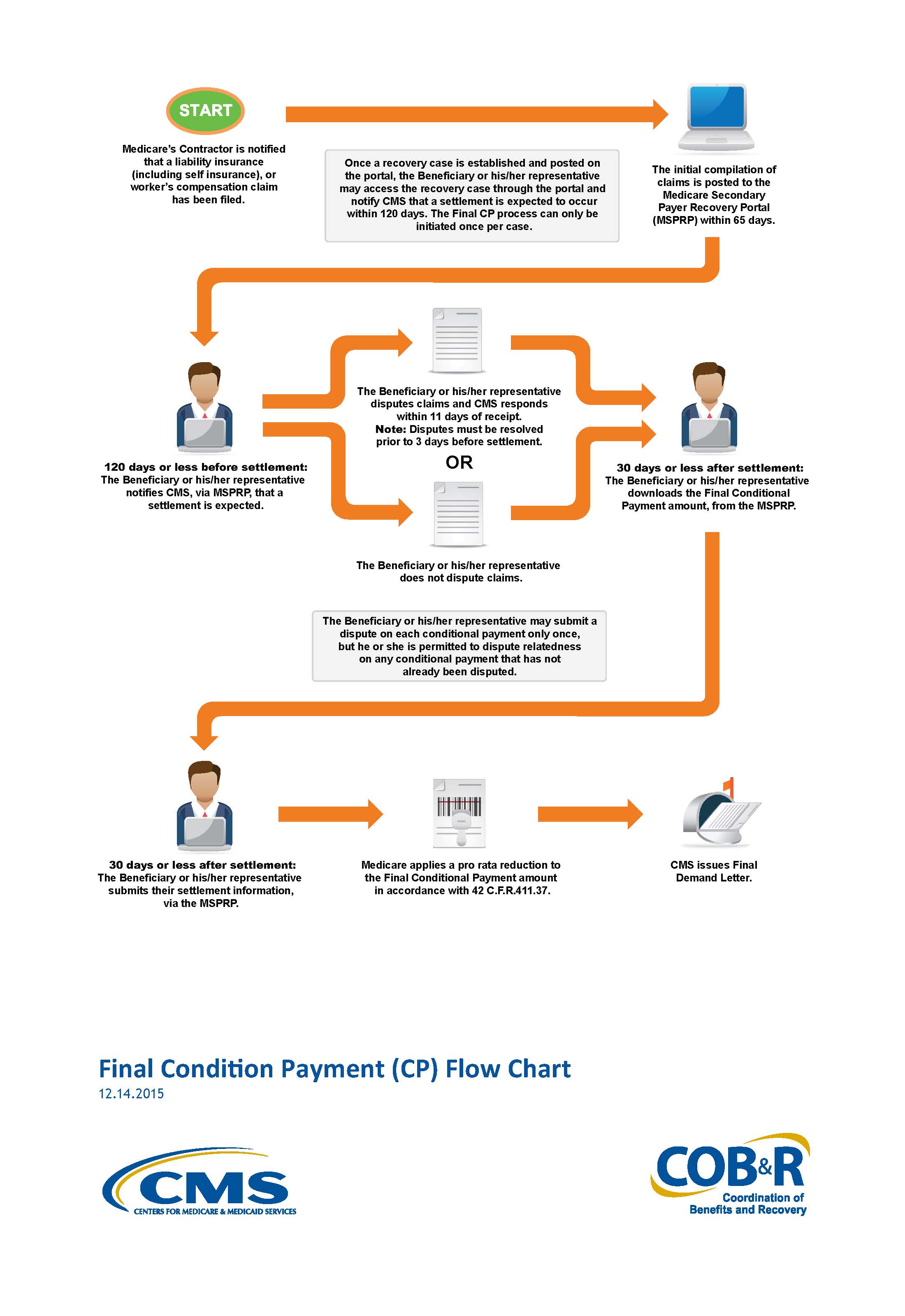
On November 9th 2015, The Centers for Medicare & Medicaid Services (CMS) announced the much anticipated, and long overdue, start date for the new Medicare Secondary Payer Recovery Portal (MSPRP).  The new MSPRP will begin functioning on January 1, 2016.  The current MSP Web portal permits authorized users to register through the Web portal in order to access MSP conditional payment amounts electronically and update certain case-specific information online.

CMS is adding functionality to the existing MSP Web portal that will permit users to notify them when the specified case is approaching settlement, download or otherwise obtain time and date stamped Final Conditional Payment Summary forms and amounts before reaching settlement.  Additionally, the new MSP Web portal will ensure that relatedness disputes and any other discrepancies are addressed within eleven business days of receipt of dispute documentation.

The process is rather straight forward and will address many of the issues that have plagued the plaintiff’s bar in attempting to settle a personal injury action without any certainty of the repayment amount due Medicare.  The process will begin when the beneficiary, their attorney or other representative (such as Synergy) provides the required notice of a pending liability insurance settlement to the appropriate Medicare contractor at least one hundred eighty five days before the anticipated date of settlement.

If the beneficiary, their attorney or other representative (Synergy), believes that claims included in the most up-to-date Conditional Payment Summary form are unrelated to the pending liability insurance “settlement”, they may address discrepancies through a dispute process available through the MSP Web portal.  This dispute may be made once and only once.  Following the dispute CMS has only eleven business days to resolve the dispute.

After disputes have been fully resolved, and a final claims refresh has been executed on the MSP Web portal, then a time and date stamped Final Conditional Payment Summary may be downloaded through the MSP Web portal. This form will constitute the Final Conditional Payment amount if settlement is reached within 3 days of the date on the Conditional Payment Summary.

The plaintiff attorney will complete the process by providing, within thirty days, the settlement information to CMS via the MSP Web portal. This information will include, but is not limited to: the date of “settlement”, the total “settlement” amount, the attorney fee amount or percentage, and additional costs borne by the beneficiary to obtain his or her “settlement”.  If this information is not provided within thirty days, the Final Conditional Payment amount obtained through the Web portal will expire.

Final-Conditional-Payment-Flow-Chart

Florida Supreme Court Cites Synergy CEO as an Authority in Important Collateral Sources Ruling

The Supreme Court issued its ruling in John Joerg, Jr., etc. et. al. v. State Farm Mutual Insurance Company on October 15, 2015. The opinion is exceedingly important as it reinforces application of the collateral sources rule to bar evidence of future Medicare benefits which may be potentially received by the plaintiff. (more…)

What Sets SSNPT Apart?

Clients who receive needs based benefits such as Medicaid and SSI require special planning to protect eligibility for those public benefits. More and more frequently, a pooled special needs trust is being utilized to preserve eligibility given the ease with which one can be set up and the relatively low cost. (more…)

Distributions from Special Needs Trusts: In Kind Distributions, Credit Cards, Gift Cards, or Debit Cards

You are the trustee of a special needs trust. Your beneficiary (Beth) lives in public housing, receives SSI (Supplemental Security Income) and MA (Medical Assistance), and has just asked you for a $200 gift card to Target so that she can buy headphones, clothes, toiletries, and some food. (more…)

Medicare Advantage Plans and Liability Medicare Set Asides

By B. Josh Pettingill, MBA, MS, MSCC

Traditional Medicare vs. Medicare Advantage Plans

There is often confusion between “Traditional Medicare”, Part A and Part B coverage and Medicare Advantage Plans. It is critical to identify exactly what benefits your client is actually receiving before the resolution of their case. The best time to confirm public benefit eligibility is during the intake of the case. In addition to a detailed client interview, a copy of all health insurance cards should be requested. That way, appropriate Medicare secondary payer (MSP) compliance or other planning can be undertaken ahead of resolution of the case.

Some clients elect out of Part A and B of Medicare coverage and instead opt for Part C, Medicare Advantage plan coverage. What happens when your client is on a Medicare Advantage Plan in terms of MSP compliance? Do Medicare’s future interests still need to be taken into account? Should a Medicare set aside (MSA) still be a consideration? Before we address these questions, let’s take a look at the difference between Traditional Medicare Plans versus Medicare Advantage Plans.

Traditional Medicare Eligibility – Part A and Part B

In order to be eligible for Medicare benefits, you must fall into one of the following categories:

  • You are age 65, a US citizen and have worked for at least 10 years, earning 40 credits.
  • You have a disability and have been receiving Social Security Disability Insurance (SSDI) for more than 24 months.
  • You have been diagnosed with End-Stage Renal Disease.
  • You have been diagnosed with Amyotrophic Lateral Sclerosis (ALS), commonly known as Lou Gehrig’s Disease.

If you are unsure if your client is eligible to receive Social Security benefits, then a Social Security Consent for Release of Information form can be submitted to your local Social Security office to verify eligibility. This form is also known as the Form SSA-3288. The form can be downloaded at http://www.ssa.gov/forms/ssa-3288.pdf.

Part A & Part B Coverage

Medicare Part A (hospital insurance) covers inpatient care at a hospital, skilled nursing facility (SNF), and hospice. Part A also covers services like lab tests, surgery, doctor visits, and home health care. Medicare Part B (medical insurance) covers doctor and other health care providers’ services, outpatient care, durable medical equipment, home health care, and some preventive services.

Practical Implications

If your client only has Part A and Part B as their primary source of health insurance, then Medicare may refuse payment for accident related care post-settlement that the client was compensated for in the underlying settlement. Through the Section 111 reporting requirement, Medicare has developed a comprehensive system to track all current Medicare beneficiaries. Beginning later this year, Medicare is implementing the new ICD coding system. ICD-10 has 141,000 codes—more than 8 times the 17,000 codes in ICD-9. The additional codes will enable responsible reporting entities to be more specific on claim forms in reporting the care provided to plaintiffs. What this means for plaintiffs is that when they go to treat for accident related care in the future, if treatment consists of a body part or ICD code previously reported to Medicare as part of the settlement, CMS may send a letter of denial. Consequently, the plaintiff may lose their Medicare benefits for accident related care indefinitely, until they have properly reimbursed Medicare for any past claims they have denied, as well as sufficient funds have been spent down to adequately protect their interests. In order to avoid this happening, a Medicare set aside can be established at the time of settlement.

Medicare Advantage Plan – Part C

Medicare Advantage Plans, also referred to as “Part C” Plans, were established under the Social Security Act as an alternative to traditional Medicare. Medicare Advantage Plans are a type of Medicare health plan offered by a private company that contracts with Medicare to provide all Part A and Part B benefits.

Part C Coverage

Medicare Advantage Plans include Health Maintenance Organizations, Preferred Provider Organizations, Private Fee-for-Service Plans, Special Needs Plans, and Medicare Medical Savings Account Plans. If your client is enrolled in a Medicare Advantage Plan, most Medicare services are covered through the plan and are not paid for under original Medicare. Most Medicare Advantage Plans offer prescription drug coverage as well. In order to be eligible for a Medicare Advantage Plan, you must be eligible for Medicare Part A and Part B. Source: www.Medicare.gov

Practical Implications

If the plaintiff has a Medicare Advantage Plan, they are not using traditional Medicare coverage. A Medicare Part C Plan is comparable to any other private health insurance plan. Medicare Part A and Part B claims payments are processed through CMS. In contrast, Medicare Advantage Plans are offered by private insurance companies, who receive compensation from the federal government to provide all Part A and B benefits to enrollees, but do not process claims through the CMS. CMS cannot deny a claim if the bill is never submitted to them. With a Medicare Advantage Plan, all the medical claims are processed by a private insurance company.

This private insurance company will serve as the primary payer for accident related treatment. Therefore, an argument could be made that as long as the Part C coverage is maintained, the plaintiff will never use Medicare Part A or Part B. Consequently, there is no shift in the burden to Medicare to pay for future accident related treatment.

Risks to Consider

The decision to implement an MSA is ultimately the plaintiff’s decision to make. The reality is if the plaintiff were to ever lose their Part C coverage, then a burden shift to Medicare will occur. Medicare Part A and Part B will become the primary payer of accident related treatment. We often have clients who still elect to establish a MSA account to ensure there is an insurance policy in the event they ever lost their Part C coverage.

Legal Basis for Protecting Medicare’s Future Interests

The legal basis for addressing Medicare’s future interests comes from Section 1862(b)(2)(A)(ii) of the Social Security, Act [42 USC 1395 y(b)(2)] which precludes Medicare payment for services to the extent that payment has been made or can reasonably be expected to be made promptly under liability insurance. The fundamental question every attorney must ask when resolving a claim has to be, “does the resolution of this claim shift the burden to Medicare to pay for future accident related care?” Medicare is always supposed to be secondary to all forms of insurance according to federal law. This means that when there is a primary payer for injury related care, they are supposed to pay first. With a Part C Plan, the burden of future medical expenses in a personal injury case will not be shifted to Medicare.

Should an MSA be a Consideration for a Plaintiff with a Medicare Advantage Plan?

Part C plans have begun asserting that they have the same rights as Medicare under the MSP and its implementing regulations. Case law is evolving on that issue but the leaning seems to be towards that interpretation of the MSP. That being said, MSAs were created by CMS as a means to protect Medicare’s future interests. MSAs come from Medicare’s interpretation of the MSP and not from any regulation, statute or case law. Accordingly, it would be a significant stretch to say that a Part C plan could insist upon a set aside when Medicare itself does not have legal basis to insist upon them in liability settlements.

Despite the foregoing, it is important to bear in mind that an injury victim while currently enrolled in Part C could switch back to Parts A/B (traditional Medicare). If the client believes they will maintain their Part C Plan for their lifetime, then they may opt not to do an MSA since there will never be a shift in burden to CMS for future medicals. However, if they were to go back to traditional Medicare, CMS may deny claims for accident related care indefinitely. CMS has made it clear that it the plaintiff counsel’s obligation to determine whether or not a Medicare set aside (MSA) should be implemented. Synergy has developed a multifaceted process to ensure plaintiff attorneys are addressing the protection of Medicare’s future interests as to comply with the Medicare Secondary Payer Act. This simple, straightforward process guides plaintiff attorneys as to adequately comply with plaintiff’s obligations under the Medicare Secondary Payer Act.

Step 1: Evaluation of Case

Synergy’s experienced staff will gather case specific information and necessary documentation.

Step 2: Findings

Relying on their expertise and experience, Synergy will recommend a Medicare Compliance solution.

  1. No MSA letter
  2. MSA Consultation: plaintiff executed wavier and acknowledgment for counsel
  3. MSA Estimate
  4. Allocation

Step 3: Deliverable

If it is determined that the MSA is not applicable, then Synergy provides a letter to counsel memorializing Medicare’s interests have adequately been taken into account (No MSA letter). If it is determined an MSA is appropriate, then Synergy can provide:

  1. Plaintiff executed wavier for counsel (Client does not want MSA despite recommendation)
  2. MSA Estimate (MSA analysis with future cost projection)
  3. Allocation (Full “Cadillac” MSA)

Conclusion

If you have a client who is a current Medicare beneficiary that is going to require accident related care in the future and there are funds earmarked towards future medical treatment, a Medicare set aside should be considered and fully explained to the client. If you have a client who is enrolled in a Medicare Advantage plan, then they must be properly advised on the potential risks of losing Part A&B coverage should they need to go back to them. There are numerous ways to deal with Medicare secondary payer compliance to ensure both your firm, as well as your clients are protected. The recommended course of action remains the same for plaintiffs on Part A, Part B or Part C coverage: Consult, Advise and Document (“CAD”). Consult competent experts such as those at Synergy. Advise the client regarding potential implications if they are a Medicare beneficiary and receive money for future medicals. Document your file regarding what you did to address Medicare’s future interests and go on to the next case.

Introducing Medicare 360° – A Complete Medicare Secondary Payer Compliance Solution

Synergy Settlement Services’ experts will resolve the most difficult and complex Medicare Secondary Payer compliance challenges facing your firm. Medicare 360° is the complete solution for Medicare conditional payment resolution and Medicare Set Aside (MSA) allocations. Medicare 360° combines the most powerful services from our lien resolution group and our MSP compliance group into one solution.

Medicare 360° Benefits:

• Complete Medicare Secondary Payer Compliance to close cases rapidly and compliantly for Medicare beneficiaries

• Very reasonable cost

• A comprehensive Medicare compliance solution that handles the entire process from reporting potential for third party liability to the Medicare contractor, resolving Medicare’s repayment demands (including the first two (2) levels of administrative appeals) and protection of the plaintiff’s future Medicare eligibility

• Plaintiff centric services (Synergy doesn’t do defense work)

• Complete outsourcing solution for the trial attorney and their firm

• Peace of mind knowing that it is being handled by a team of highly credentialed MSP experts

Medicare 360° Services:

Phase 1: Medicare Conditional Payment Services – Medicare Conditional Payment Audit and Verification
This service includes the audit and verification of conditional payments for cases that originate from a personal injury case. The process includes reporting to the Centers for Medicare and Medicaid Services (CMS), the audit and dispute of Conditional Payment Summaries, the request for Final Demand, and includes 1st and 2nd level administrative appeals.

Phase 2: MSP Compliance Service – Medicare Set Aside Allocation without CMS Submission
This service includes preparation of a Medicare Set Aside allocation report that complies with CMS requirements for submission. Normal turnaround time for set aside allocations is 10 days from the due date we receive all necessary documents. Pricing includes coverage for one revision to the report.

Medicare 360° Pricing*: $2,500

*A 50% deposit is required at time of intake. If report needs to be expedited, a $500 rush fee will apply.