
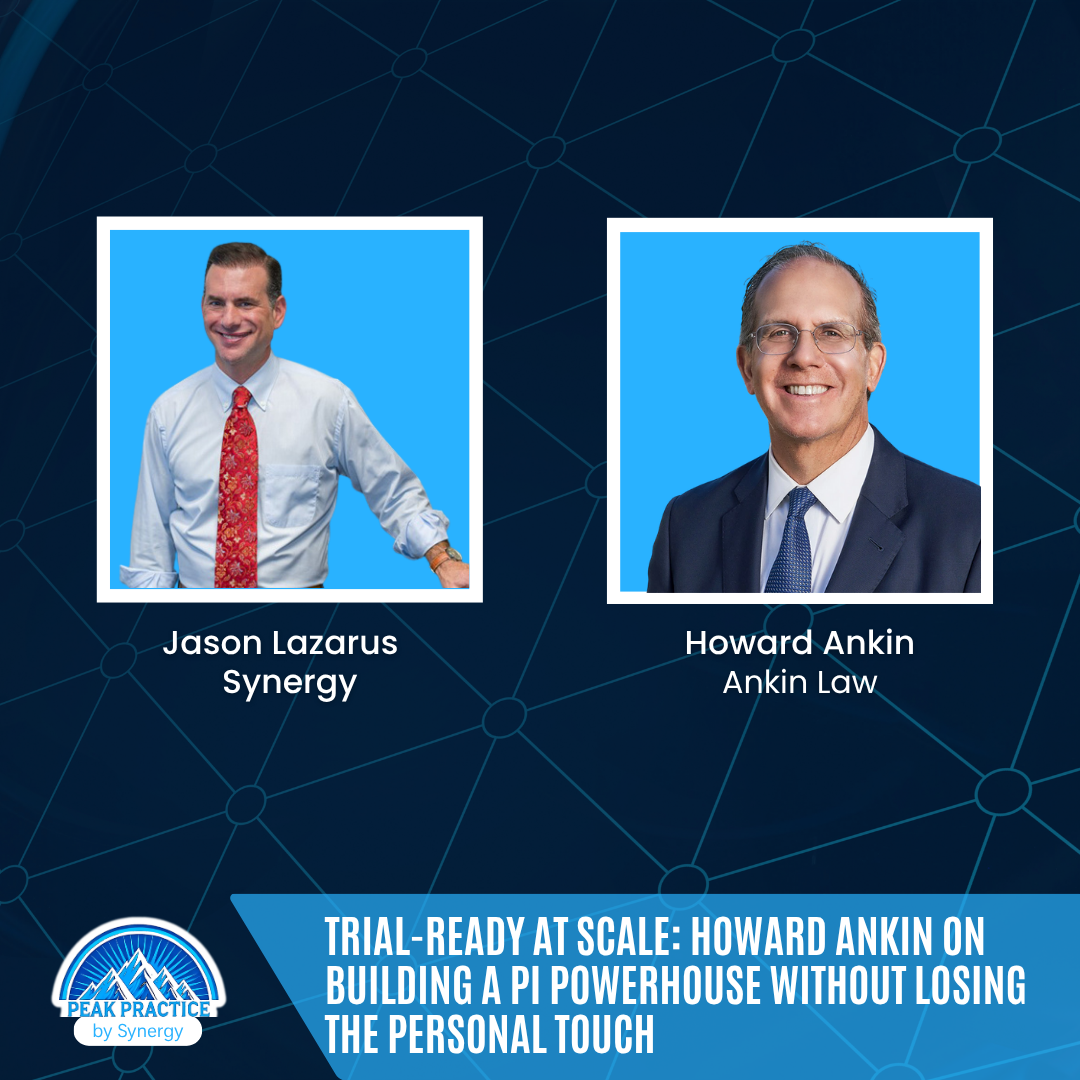
If you want a snapshot of where personal injury practice is headed, look at what it takes to win jury trials with Ankin Law. In Howard Ankin’s shop, that means a real budget for focus groups, purpose-built visuals for every phase, and specialists whose only job is to make the story land for jurors.
In our conversation on Trial Lawyer View by Synergy podcast, we dug into how he built a high-volume personal injury and workers’ compensation firm while keeping a culture that treats clients like family. For innovative trial lawyers who want to grow without giving up craftsmanship, this playbook matters.
🔎 Why scale now
Ankin didn’t scale because of a grand plan. He scaled because the market forced the issue. The 2008 downturn pushed him to build infrastructure that could survive shocks. The next wave came as private equity and national PI brands expanded into local markets. With alternative business structures taking root in places like Arizona and Utah, he sees a future where massive, well-capitalized firms compete in every channel. Capacity and systems are no longer optional. The firms you face tomorrow will have capital, media, and intake engines. Your edge becomes operational excellence paired with an authentic client experience.
🧱 Infrastructure is the hidden advantage
Infrastructure is the quiet driver of outcomes. Ankin describes a constant arms race to integrate the many tools it now takes to run a case from intake to verdict. Nothing arrives in a box that just works. Each tool adds monthly cost and complexity, so the only sane way to decide what to keep is to map the tech stack to the case lifecycle. If a system removes delays between intake, demand, filing, discovery, mediation, and trial, it stays. If it creates friction, it goes. The goal is a stack that helps lawyers do the high-value work while the technology handles the routine.
⚖️ Trial-readiness is a process
Trial-readiness has become a process, not a promise. In Ankin’s firm, every case is focus grouped before trial. Dedicated team members build exhibits so visual communication strengthens oral advocacy. Jurors live on screens and absorb information in snapshots, so demonstratives are not a luxury. Treat focus groups and visuals as baseline case costs. If you do not have an internal exhibit lab, build predictable partnerships so you can move quickly the moment a setting gets real.
🤝 Keep it personal on purpose
Through all the growth, Ankin keeps the work personal by design. His ethos was forged in a family practice where clients called his father’s house. Today, “injury law made personal” means more on-site staff than many competitors and no offshore answering services or paralegal teams. Most of the team works in-office because attention and accountability improve when people share space. If you want clients to feel cared for, define what personal actually looks like at scale. Then hire, train, and measure against those behaviors so the promise shows up in every call, text, and meeting.
🧠 Buy expertise before you need it
Quality control is about buying the right expertise at the right time. Maximizing recovery often turns on spotting the third-path claim and pairing it with a targeted expert. That takes a real budget for consultation fees and, in some cases, a standing relationship with a consultant who can source niche experts on short notice. Build your expert bench early, not after a lowball offer arrives. Treat expert discovery like any other critical path task with timelines, owners, and funding.
🚀 What to do this week
If you want practical next steps, start by auditing your tech stack against the case timeline and cut what does not shorten the distance from intake to resolution. Institutionalize focus groups with clear criteria and calendar them like depositions. Codify your client experience in a short list of observable behaviors and train them until they become muscle memory. Above all, commit to a definition of trial-ready at scale that your entire team understands, from intake specialists to first-chair trial lawyers.
🌄 Why This Matters to the Peak Practice Community
Howard Ankin’s model matters to Peak Practice because it proves you can build real capacity without sacrificing the human touch. His focus on trial-readiness, visual storytelling, and disciplined expert work shows how process and craftsmanship can live side by side. By defining “personal” at scale and funding the tools that move cases faster and smarter, he sets a path for firms that want growth with integrity. This aligns with Peak’s mission to help PI leaders build durable systems, while synergy. removes friction through lien resolution so your team can stay focused on advocacy, outcomes, and long-term client trust.
🎧 Listen to the full podcast conversation on Trial Lawyer View here: https://triallawyerview.com/podcast/howard-ankin/
🔗 Want more insights like this?
If you’re a personal injury lawyer ready to scale, streamline, and step into your role as CEO, let’s talk. Join the Peak Practice Community, and learn how synergy. can help you eliminate settlement bottlenecks, resolve complex liens, and maximize recoveries. Learn more here: https://partnerwithsynergy.com/peak-practice/
If you want to grow and scale your law firm more effectively, consider partnering with Synergy for lien resolution. Learn more at: https://partnerwithsynergy.com/liens/
