
PEAK PRACTICE
Peak Practice is a community that delivers expert industry insights on how to scale, streamline, and accelerate personal injury law practices. By providing knowledge and resources on law firm operations, marketing, and business growth, Peak helps personal injury attorneys gain a competitive edge. As the leader in lien resolution, Synergy partners with firms to eliminate settlement bottlenecks, optimize client outcomes, and drive greater profitability—so you can focus on securing justice. Join the community here and discover how partnering with Synergy helps you achieve Peak Practice.
Below are our Synergy InSights on all things related to Peak Practice.
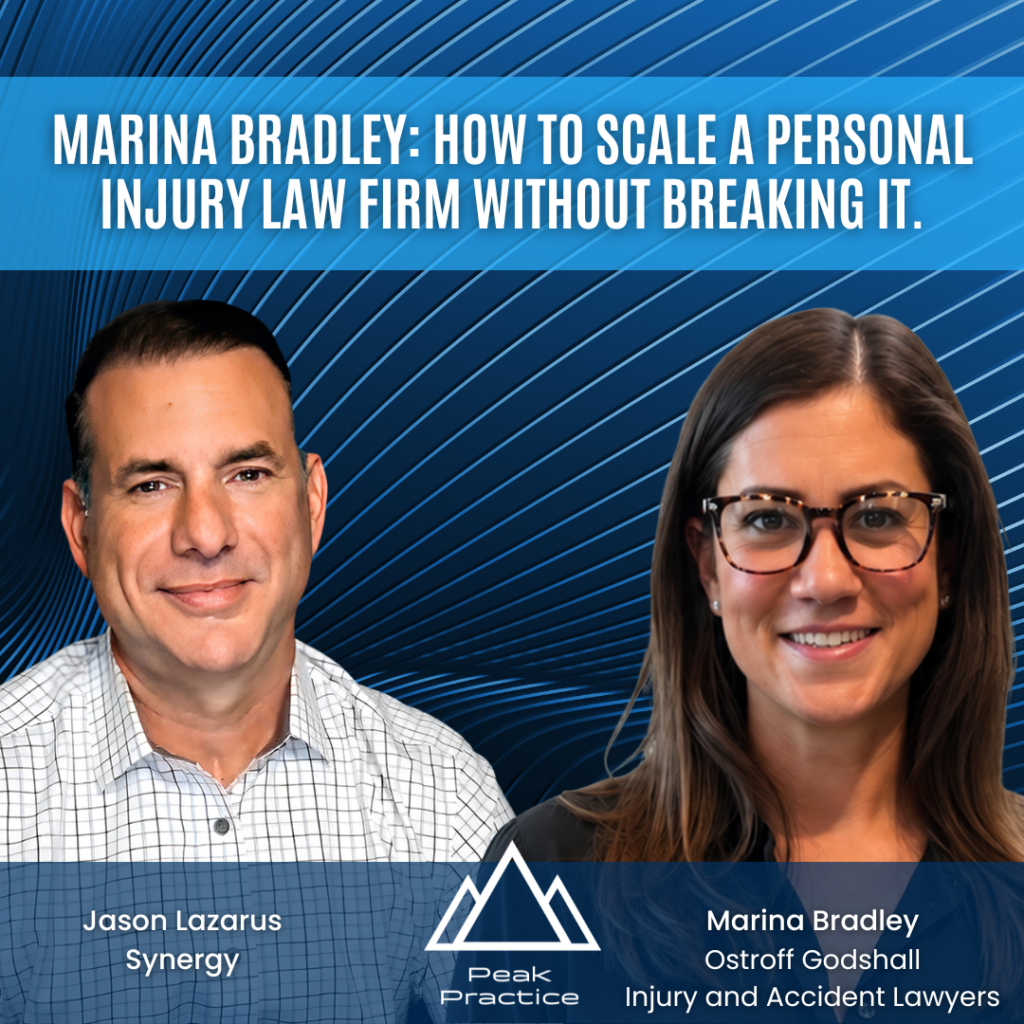
Plaintiff firms often hit a ceiling because of operations, not casework. Strong verdicts hide weak systems, until volume forces every weakness to the surface. Marina Bradley, Executive Director at Ostroff Godshall Injury and Accident Lawyers, sat down with me on a recent episode of the Trial Lawyer View by Synergy podcast to talk through what scaling looks like when you stop guessing and start measuring. Here are the highest-value ideas from the conversation for trial lawyers building a real firm behind their results.
The Executive Director role most PI firms are missing
The Executive Director seat at a personal injury firm is still being defined. Most plaintiff firms run on the traditional managing partner model, where the lawyer who loves trying cases ends up running HR, intake, and finance by default. Marina’s role exists because someone has to own the operational side so trial lawyers stay focused on the work they were hired to do.
“It’s even hard to admit you need help sometimes,” she said. The work starts with separating founder-level tasks from leadership tasks built around the business itself.
Hire ahead of the need
One of the biggest mistakes Marina sees in plaintiff firms is reactive hiring.
“You can’t wait until you need the paralegal to hire the paralegal. You have to have that paralegal training six months before.”
The fix is forward-looking workforce planning. Watch file counts. Watch phone volume. Train the next role before the gap becomes a fire.
The metrics worth tracking weekly
Marina sends a firmwide scorecard every week. No mysteries. No leadership-only data. Everyone sees the same numbers and rows in the same direction. The four she watches most closely:
- Signed cases, split between marketing-sourced and referred
- Complaints filed
- Demands sent out
- Resolution, both pre-lit and in litigation
Monthly, she tracks cost per case and average fee. About 30 percent of OG’s cases move into litigation, which explains a higher average fee and a deliberate choice to file cases.
Time on desk is where the money hides
If you want to find quiet revenue inside your firm, look at time on desk.
“If you cut a couple of months off the time on desk, you’re putting revenue in the previous year. You’re doing 14 months of revenue in 12 months.”
Lien resolution sits inside this problem. Cases stall while medical liens, Medicare obligations, and reductions get worked through. Clients wait. Five-star Google reviews die in the gap between settlement and check.
Intake is the most expensive operational leak
Ask Marina where plaintiff firms lose the most money, and she points straight at intake.
“One call could be a $5 million case.”
Her position: staff intake heavier than feels comfortable. Train constantly. Listen to the recordings. Coach the conversations. Intake feeds every other metric on the scorecard, because nothing moves without the signed case.
Culture as a hiring filter
Ostroff Godshall built core values and a social contract the partners stand behind. Those values drive interviews. Predictive Index assessments help match personality to role.
The lesson Marina learned the hard way: a high-performing hire who fails the culture test pulls the rest of the team down. Her rules are simple. Hire for traits. Train for skill.
The view from the operations seat
The competitive picture is shifting fast for plaintiff firms:
· MSOs backed by private equity entering more markets
· AI tools rewriting how cases get litigated
· Marketing spend climbing in every major metro
· Gen Z workforce expectations reshaping how teams operate
Marina’s response is to focus on what you control. For her firm, that looks like a client experience built on real human contact, with automations used to free up calls rather than replace them. Community presence matters too. Her firm gave away 1,000 backpacks last year and plans to give more this year.
“Grit” is one of OG’s core values, and Marina lives it
If she were building a personal injury firm tomorrow with a goal of 30 lawyers, her first three priorities would be:
· Document every process so the founder’s knowledge lives outside their head
· Lock down cybersecurity, secure phones, and secure email
· Write an AI policy before the team starts using tools without guardrails
The takeaway for plaintiff firm leaders
Operations is the difference between a firm with great verdicts and a firm with a great business. Build the foundation, measure the numbers, protect the intake, and keep the human side of the work alive.
🎧 Listen to the full podcast conversation on Trial Lawyer View here: https://triallawyerview.com/podcast/marina-bradley/
🔗 Want more insights like this?
If you’re a personal injury lawyer ready to scale, streamline, and step into your role as CEO, let’s talk. Join the Peak Practice Community, and learn how Synergy can help you eliminate settlement bottlenecks, resolve complex liens, and maximize recoveries. Learn more here: https://partnerwithsynergy.com/peak-practice/
If you want to grow and scale your law firm more effectively, consider partnering with Synergy for lien resolution. Learn more at: https://partnerwithsynergy.com/liens/

Section 111 of the Medicare, Medicaid, and SCHIP Extension Act of 2007 requires liability insurers, no-fault insurers, workers’ compensation carriers, and self-insured entities to report settlements, judgments, and awards involving Medicare beneficiaries to CMS. The reporting captures the beneficiary’s identity, the settlement details, and the ICD codes that define the injury, giving CMS the data it needs to enforce the Medicare Secondary Payer Act and recover conditional payments. The original 2007 statute imposed a mandatory civil money penalty of $1,000 per day per claim for noncompliance, with no discretion given to CMS. The SMART Act of 2013 changed that mandatory penalty to a discretionary one, capped the daily amount at $1,000, and directed CMS to publish regulations setting out when and how penalties would be imposed. Those regulations became applicable on October 11, 2024, and the first audits and informal notices arrived in 2026, which is why the penalty regime that has sat dormant for nearly two decades is finally live.
The first informal notices of intent to impose civil money penalties under Section 111 of the Medicare, Medicaid, and SCHIP Extension Act began mailing in March. CMS closed its second quarterly audit cycle on April 1. The trade press has framed all of this as an insurer compliance issue. That framing is wrong. Acting on it will cost plaintiff firms money, time, and client outcomes over the next twelve months.
I have spent almost two decades working with trial lawyers on Medicare Secondary Payer compliance. I have watched every false start CMS made on enforcement going back to 2007. This one is different. The audit process is running. The penalty exposure is significant. And the pressure falls hardest on plaintiff lawyers, even though plaintiff lawyers are not the ones being audited.
Here is what is actually happening, and what to do about it.
Where Things Stand This Week
Here is the timeline without the regulatory clutter. October 11, 2024, was the date CMS implemented the final rule for Civil Money Penalties for Section 111 reporting. Since there is a 12-month window in which to report a Total Payment Obligation to Claimant (TPOC) or Ongoing Responsibility for Medicals (ORM), a civil money penalty could not be assessed until October 11, 2025. Reports that should have been filed by then but were not, are now exposed.
CMS opened the first random audit in early 2026. The agency pulls 250 records per quarter, 1,000 per year, across both group health and non-group health plan reporting. Selection is random. The 250 records are drawn from the entire universe of accepted records, not from each Responsible Reporting Entity.
The first informal notices of intent to impose a penalty went out in March. RREs have 30 days to respond with mitigating evidence. If the response is rejected or absent, CMS issues a Notice of Proposed Determination and the formal process begins.
The tiered penalty itself runs from $250 per day per record up to $1,512 per day after the January 2026 inflation adjustment. The single-instance cap at this time is $551,880.
Workers’ compensation TPOC enforcement, including the new WCMSA reporting fields that went live April 2025, are in full scope starting in July.
That is where things stand. Now the part that has been missed.
Why This Is a Plaintiff Problem
The carrier is the entity at risk of a penalty. The plaintiff is the entity that absorbs every operational change the carrier makes to avoid the penalty. There are five specific ways this hits your practice right now.
First, settlement checks are going to sit longer. Carriers will not release funds until they are confident the reporting record is locked and clean and Medicare liens resolved. If you have built your firm’s cash flow assumptions around a 30-day disbursement window, plan for longer. The check is a downstream event of a process you do not control.
Second, ICD diagnosis code overreporting will get worse. A carrier facing $1,512 per day in penalty exposure will report a broader set of codes. That broader code set is what Medicare uses later to deny your client’s future injury-related care. The carrier’s compliance protection may become your client’s coverage problem after the case closes.
Third, release language is already getting more punitive. Hold harmless clauses, indemnity provisions, and reporting cooperation requirements are showing up in releases that did not have them six months ago. Much of this is unnecessary as a matter of law. All of it shifts risk to the plaintiff. The technical reality is that nothing in the MSP requires most of what defense counsel asks plaintiffs to sign. The practical reality is that defense counsel asks anyway, and many plaintiffs sign without pushing back.
Fourth, information demands are now formal and documented. The CMS safe harbor allows the RRE to document a refusal by the beneficiary or counsel to provide a Medicare Beneficiary Identifier or Social Security Number. That documentation is retained for at least five years. If a coverage dispute arises later, the refusal becomes evidence.
Fifth, workers’ compensation closures get harder in July. The new WCMSA reporting fields are about to be tracked for penalty purposes. Lump sum settlements that relied on informal MSA assumptions or below-threshold treatment will draw scrutiny they did not draw last year.
What to Change This Month
Most of the fixes are process work, not legal theory. They are also things every trial lawyer handling cases with Medicare beneficiaries should already be doing. The penalty era just raises the cost of not doing them.
Build Medicare beneficiary screening into intake. Pull the Medicare card, the SSDI award letter, and the MBI at the start of the case, not at the end. Do not let the carrier control the timing or the data flow. Update the Medicare beneficiary screening during the life of the case.
Negotiate ICD codes that will be reported before you sign the release. Get a closed list in writing. Push back on any code that is not directly injury related. The carrier will resist. Make them resist on the record.
Strip boilerplate Medicare compliance language from releases. Most of it cites statutes and regulations that do not say what defense counsel claims they say. A core set of provisions can address the real Medicare issues in one paragraph without onerous obligations on the plaintiff.
Open the Benefits Coordination and Recovery Center conditional payment file before settlement, not after. Final demand timing is now a settlement gating item. The conditional payment letter is preliminary and does not bind Medicare. Only the final demand binds. If you disburse on a CPL, you will pay the difference yourself.
Document everything. If your client declines an MSA, why. If the carrier asks for information, you decide not to provide, document the reason and the law you relied upon. The file should tell the story without you in the room.
The Strategic Point
The penalty era pulls every party in a Medicare case toward earlier and more careful work. The trial lawyers who treat Section 111 as an insurer compliance problem will give up leverage they did not know they had, and they will hand control of the record to the people on the other side of the table.
The trial lawyers who get ahead of it will close cases faster, protect their clients’ future Medicare access, and avoid the malpractice exposure that comes with watching someone else drive the process.
At Synergy, we have spent years helping firms rebuild their MSP intake and settlement workflows for this environment. The cost of getting the process right is small compared to the cost of getting it wrong on a single catastrophic case. The harder problem is that most firms do not yet realize the environment has changed.
The next call you should make on this is internal. Find out who in your firm owns Medicare compliance. If the answer is no one, that is the first thing to fix.
Why Synergy is the Answer to Help You Scale
Synergy exists to help firms confront the operational realities being driven by Medicare compliance pressure. By removing administrative burdens related to Medicare compliance, lien identification, verification and resolution, from your staff, we help you strengthen your practice’s capacity for high-value legal work and sustainable growth. Learn more at https://partnerwithsynergy.com/medicare-compliance/
🔗 Want more insights like this?
If you’re a personal injury lawyer ready to scale, streamline, and step into your role as CEO, let’s talk. Join the Peak Practice Community, and learn how Synergy can help you eliminate settlement bottlenecks, resolve complex liens, and maximize recoveries. Learn more here: https://partnerwithsynergy.com/peak-practice/
If you want to grow and scale your law firm more effectively, consider partnering with Synergy for lien resolution. Learn more at: https://partnerwithsynergy.com/liens/
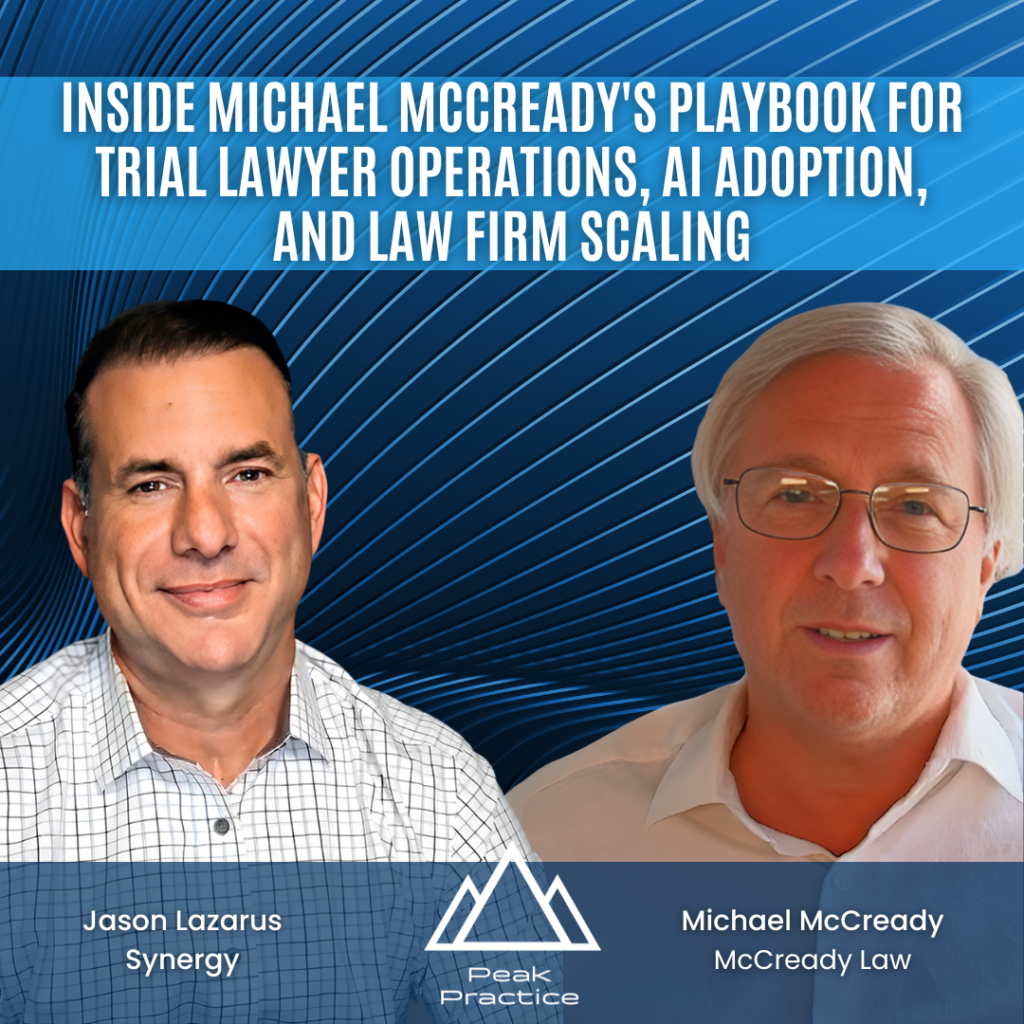
Most personal injury firm leaders confuse two questions. Are we winning cases? Are we running a healthy business? They are not the same question. And the firms pulling ahead are the ones who stopped pretending otherwise.
In a recent episode of the Trial Lawyer View by Synergy podcast, Michael McCready founder of McCready Law laid out the truth most firm owners avoid. Verdicts do not equal firm health. Talent in the courtroom does not equal sound operations. The PI firms scaling fastest are the ones treating the business of law like a business.
McCready started McCready Law in 1999. He now runs a 160-person multi-state practice from Puerto Rico. His perspective is useful for any firm leader sitting at a growth ceiling and wondering what changed.
The Founder Is Often the Bottleneck
McCready had an honest moment years ago. He went to his team and asked if he was the problem, they said yes. This is the inflection point most founders refuse to face. You touch every case. You believe no one will deliver to your standard. And the firm stops growing because you are the constraint.
His answer: Trust your team. If you do not trust them, hire different people. Then focus your time on what moves the needle most for the firm. For McCready, the highest-leverage work shifted from trying cases to building leaders.
Process Produces Profit and Better Outcomes Together
Every PI case has repeatable elements. Plaintiff depositions. Discovery responses. Settlement check follow-ups. If your team handles these ten different ways, you have ten different outcomes.
McCready’s view is sharp. On a contingency model, every hour saved drops to the bottom line. If a workflow takes ten hours and you reduce it to eight, you have improved profitability without changing a single case strategy.
The bonus is consistency for clients. They receive the same high level of client experience regardless of which paralegal or attorney in the firm is handling their file. Process is not bureaucracy. Process is what produces an optimal client experience at scale.
Intake Is the Single Best Place to Start
For firms under 50 people, McCready’s recommendation is specific. Put one person in charge of intake. Even a paralegal whose only job is owning the intake process will deliver more value than another 80 hours of trial prep. Most firms still treat intake as a receptionist task. The firms scaling fastest treat intake as the most important seat in the building.
The Competitive Shift Is Already Here
Private equity, ABS structures in Arizona, and MSO models are entering the PI space. Many trial lawyers see this as a threat to professional independence. McCready sees the opposite. These models bring business discipline to firms long resistant to it. An MSO lets a 15-lawyer firm access HR, technology, and operations support previously available only to firms the size of large firms. The result is better representation for clients, not worse, as long as lawyers hold the line on their ethical duty. Ignore the shift, and you will be competing against firms with the cost structure and tech stack of a 200-lawyer practice while still operating like a solo shop.
AI Is the Next Operational Lever
McCready Law is what he calls an AI-first firm. Every position uses AI. They review user statistics each week. If a team member is not using the tools, the firm finds out why and addresses it. If they refuse to adopt, they are coached out.
A few specifics from the conversation. The firm built a custom internal LLM trained on McCready’s writing, speaking, and firm values. Team members get answers in his voice with the firm’s bias toward diversity, accessibility, and creativity built in. The HR handbook lives inside an LLM, so anyone types a question and receives the answer.
McCready’s line on AI is the one to keep. AI will not replace lawyers. Lawyers who use AI will replace lawyers who do not. Entry-level associate work is the most exposed. Senior judgment is the most protected.
The 90-Day Move for Firm Leaders
If you lead a firm and you know operations are holding you back, McCready’s advice is simple. Stop reinventing the wheel. The best practices exist. Bring in a consultant. Join a mastermind. Start tracking the metrics you have been guessing at. The cost of starting late is not zero. The firms three years into a serious tech and operations build are pulling ahead at a pace most others will struggle to close.
What This Means for Your Firm
The pattern across every section of this conversation is the same one. Trial talent gets you to the courtroom door. Operational rigor decides whether your firm survives the next decade.
If you are weighing your next operational move, the full Michael McCready episode of Trial Lawyer View is worth the listen. He covers his progression from solo founder to managing partner of a 160-person practice, his read on private equity and MSOs, the specifics of his AI implementation, and his framework for protecting human judgment while systematizing the routine work around it.
🎧 Listen to the full podcast conversation on Trial Lawyer View here: https://triallawyerview.com/podcast/michael-p-mccready/
🔗 Want more insights like this?
If you’re a personal injury lawyer ready to scale, streamline, and step into your role as CEO, let’s talk. Join the Peak Practice Community, and learn how Synergy can help you eliminate settlement bottlenecks, resolve complex liens, and maximize recoveries. Learn more here: https://partnerwithsynergy.com/peak-practice/
If you want to grow and scale your law firm more effectively, consider partnering with Synergy for lien resolution. Learn more at: https://partnerwithsynergy.com/liens/
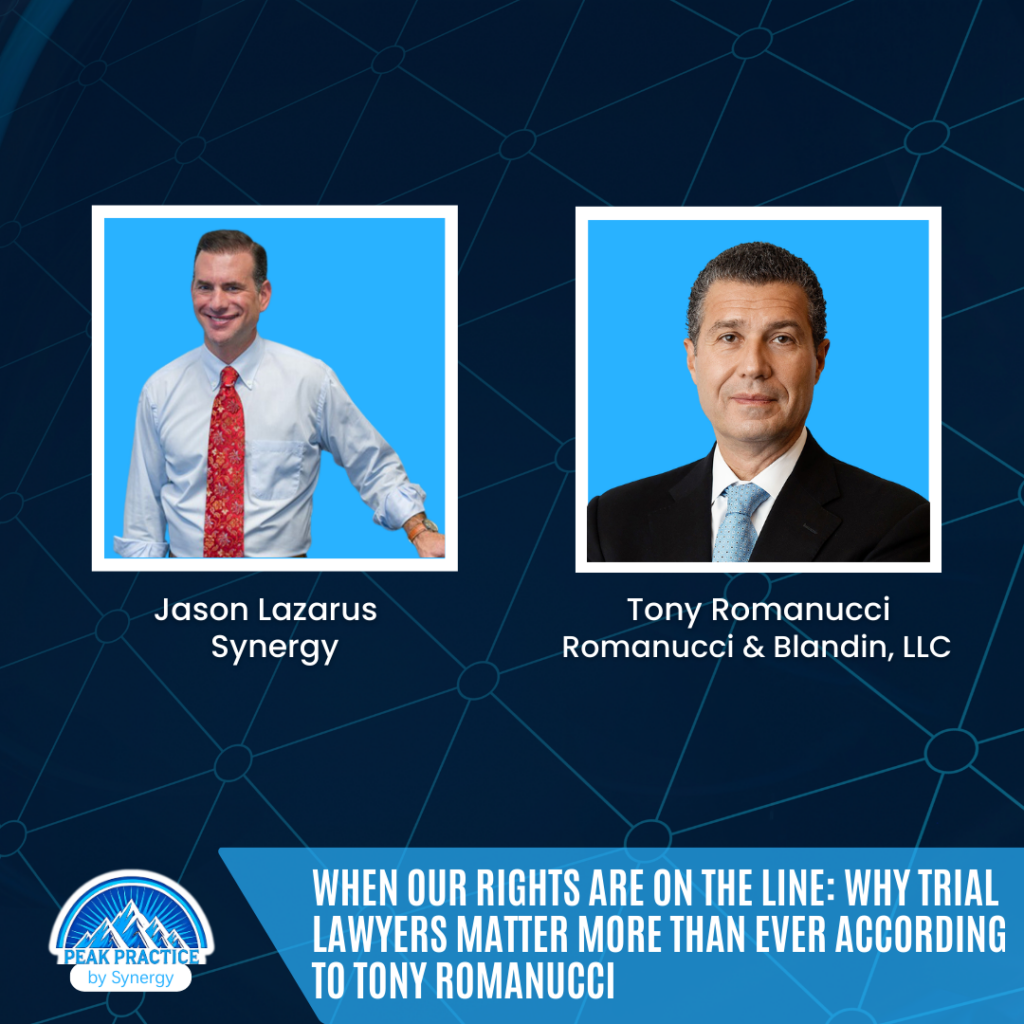
On a recent episode of the Trial Lawyer View by Synergy podcast, I sat down with Antonio Romanucci of Romanucci & Blandin, LLC, one of the country’s most respected civil rights trial lawyers, to talk about something that should have every trial lawyer paying attention. Not just because it affects clients, but because it affects the very role lawyers play in a functioning democracy.
Tony did not mince words. He described the current wave of executive orders targeting diversity initiatives, policing practices, and the legal profession itself as “diabolical.” Strong language, yes. But after listening closely, it is hard to dismiss the concern.
Three Pressure Points Trial Lawyers Cannot Ignore
Tony framed the current environment around three interconnected threats.
First, the elimination of diversity. Not as a buzzword, not as a talking point, but as a rollback of hard-fought progress that allowed different lived experiences to shape education, workplaces, and institutions. When diversity is stripped away, so is perspective. And perspective is what keeps systems honest.
Second, the aggressive expansion of policing power. Tony explained how marginalized communities bear the brunt of unconstitutional policing, and how recent rhetoric and recruitment efforts have emboldened behavior that years of reform work tried to correct. His warning was clear. Aggressive policing almost always leads to civil rights violations.
Third, and this one should hit close to home, the direct attack on lawyers. When the ability of attorneys to choose clients, challenge power, or pursue accountability is weakened, the entire justice system tilts. Tony reminded us of an old truth. If you want to eliminate accountability, you start by silencing the lawyers.
Lawyers as Guardians, Not Spectators
One of the most powerful moments in the conversation came when Tony described lawyers as guardians of democracy. Not in a poetic sense, but in a very real, functional way.
People can speak out. But without lawyers willing to file lawsuits, challenge unconstitutional acts, and absorb the personal and professional pressure that comes with doing so, none of it matters.
This is where trial lawyers, especially those on the private side, play a critical role. Civil rights litigation. Police misconduct cases. Institutional accountability. These are not side projects. They are important work. Just like personal injury!
And as Tony pointed out, we are seeing a familiar pattern. After George Floyd’s murder, reforms moved forward. Consent decrees were put in place. Policing standards tightened. Then, slowly, much of that progress began to unravel.
“One step forward, two steps back,” he said.
Why This Conversation Belongs in a Growth-Oriented Community
You might be wondering why a discussion like this belongs in a community focused on scaling practices, improving operations, and building better firms.
Here is why. The most successful trial lawyers do not separate growth from responsibility. They understand that leadership extends beyond the balance sheet. Firms that scale with intention do so because they know who they are, what they stand for, and why their work matters.
Innovation is not just about systems and processes. It is about courage. It is about deciding when to lean in, even when the work is hard, unpopular, or risky.
The Bigger Takeaway
This episode was not about politics. It was about power, accountability, and the role trial lawyers play when institutions are under strain.
Peak Practice commentators talk a lot about building firms that last. That requires more than operational excellence. It requires clarity of purpose.
If you believe the law is a tool for justice, not convenience, then conversations like this are not optional. They are essential.
🎧 Listen to the full podcast conversation on Trial Lawyer View here: https://triallawyerview.com/podcast/antonio-m-romanucci-2nd-appearance/
🔗 Want more insights like this?
If you’re a personal injury lawyer ready to scale, streamline, and step into your role as CEO, let’s talk. Join the Peak Practice Community, and learn how synergy. can help you eliminate settlement bottlenecks, resolve complex liens, and maximize recoveries. Learn more here: https://partnerwithsynergy.com/peak-practice/
If you want to grow and scale your law firm more effectively, consider partnering with Synergy for lien resolution. Learn more at: https://partnerwithsynergy.com/liens/
Can you be a courtroom warrior and run a high-performing business? For most personal injury trial lawyers, the answer is: not without help.
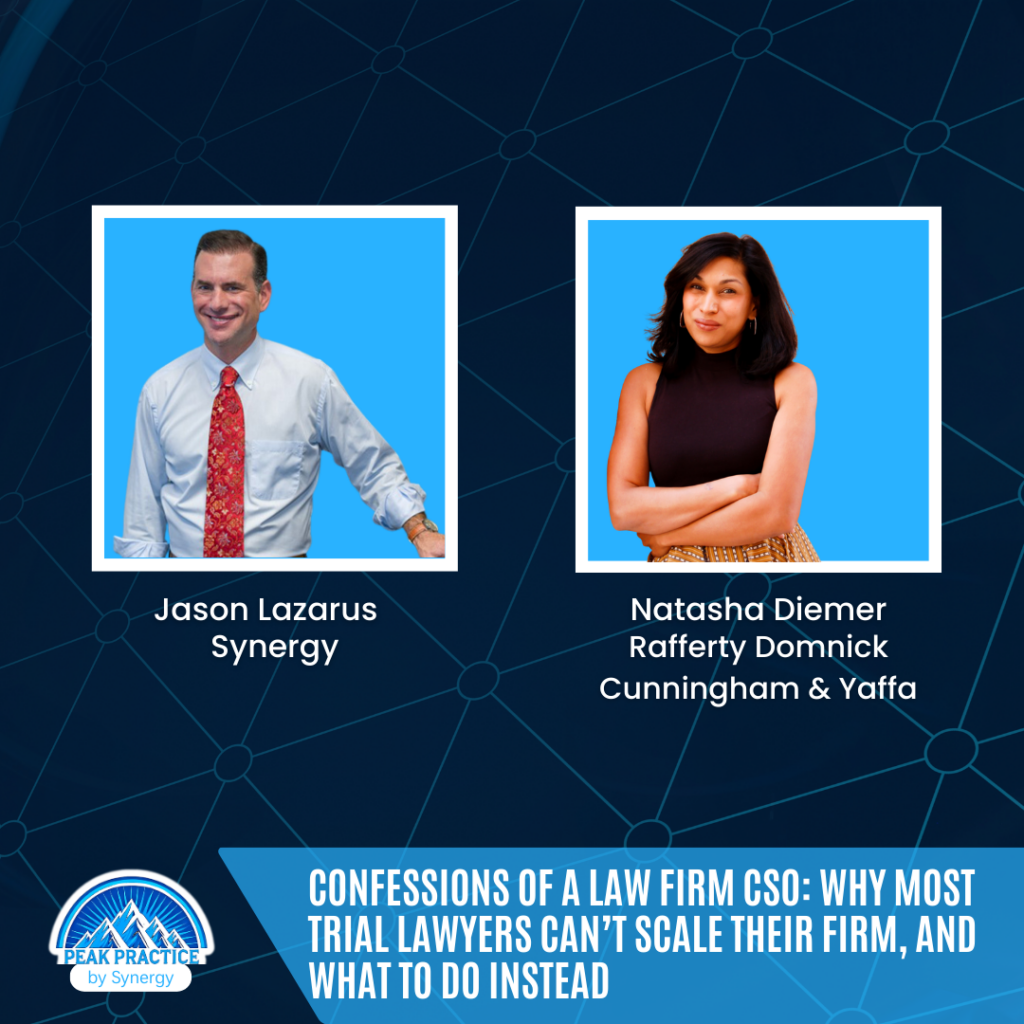
In a recent episode of the Trial Lawyer View by Synergy podcast, I sat down with Natasha Diemer, Chief Strategy Officer at Rafferty Domnick Cunningham & Yaffa (RDCY), a nationally recognized PI firm building serious momentum. Our conversation pulled back the curtain on how law firms can grow strategically without burning out their top lawyers or compromising client results. Here’s what every trial lawyer should take away from our discussion.
🎯 The Role Most Firms Still Don’t Have But Desperately Need
Natasha made it clear: great lawyers don’t automatically make great CEOs. Yet many trial firms still expect their top litigators to double as business leaders. It’s a recipe for stalled growth and operational chaos. The game-changer at RDCY? A dedicated leadership role focused solely on strategy.
“You’ve got to know what you don’t know. Not everybody has a John Morgan running their business,” Natasha shared. “You need someone focused on growth, team structure, and operational change”.
Having a CSO or COO, even a fractional one, can help manage the business side, freeing up trial lawyers to focus where they’re strongest: in the courtroom.
🔧 Operational Gaps That Kill Momentum
If you’re hiring more staff but not seeing better results, Natasha would tell you to look at your onboarding and training systems.
“We bring in help but don’t invest in setting them up for success,” she said. “Most roadblocks happen when someone isn’t trained to meet the real needs of the trial team”.
It’s not just about filling roles, it’s about building capability. And that includes:
- Cross-training staff
- Customizing workflows for each legal team
- Creating feedback loops to address inefficiencies early
The firms that scale are the ones that invest in human capital, not just headcount.
🧠 Tech Overwhelm is Real. Here’s How to Cut Through the Noise
With every legal conference showcasing dozens of new tools, Natasha offered a candid reality check:
“There used to be four case management software options, now there are 400. Everyone’s promising a magic solution”.
RDCY formed an internal AI and tech committee to carefully vet tools based on their actual needs, not marketing hype. Her advice?
✅ Survey your staff on repetitive tasks
✅ Focus on solving real problems, not chasing trends
✅ Be selective. One good tool is better than five unused ones
🧭 Strategy Starts with Knowing Your Priorities
The hard part for most firms isn’t choosing the right software or partner. It’s choosing what matters now.
“You can be a four-person firm or a national boutique, either way, you have to ask: What’s the one thing we’ll do better this year?”
It’s not about doing everything. It’s about doing the right things in the right order, guided by clear goals and intentional leadership.
💡 Branding That Actually Reflects Your Values
Natasha also touched on how RDCY approaches branding, not with canned marketing tactics, but with purpose.
They partnered with a marketing team that adapted to their vision, instead of pushing a cookie-cutter campaign.
“It has to feel like your firm. You can’t fake authenticity. You need a partner that’s delivering your story, not fitting you into a template”.
This kind of brand clarity isn’t just for visibility, it drives trust, differentiation, and team alignment.
🌄 Why This Matters to the Peak Practice Community
Natasha’s insights matter to Peak Practice because they spotlight a critical truth: personal injury law firms can’t scale on trial talent alone. Her leadership at RDCY shows what’s possible when firms invest in operational strategy, build strong internal systems, and align technology decisions with real needs, not trends. She reminds us that law firm growth starts with clarity, not complexity.
🎧 Listen to the full podcast conversation on Trial Lawyer View here: https://triallawyerview.com/podcast/natasha-diemer/
🔗 Want more insights like this?
If you’re a personal injury lawyer ready to scale, streamline, and step into your role as CEO, let’s talk. Join the Peak Practice Community, and learn how Synergy can help you eliminate settlement bottlenecks, resolve complex liens, and maximize recoveries. Learn more here: https://partnerwithsynergy.com/peak-practice/
If you want to grow and scale your law firm more effectively, consider partnering with Synergy for lien resolution. Learn more at: https://partnerwithsynergy.com/liens/
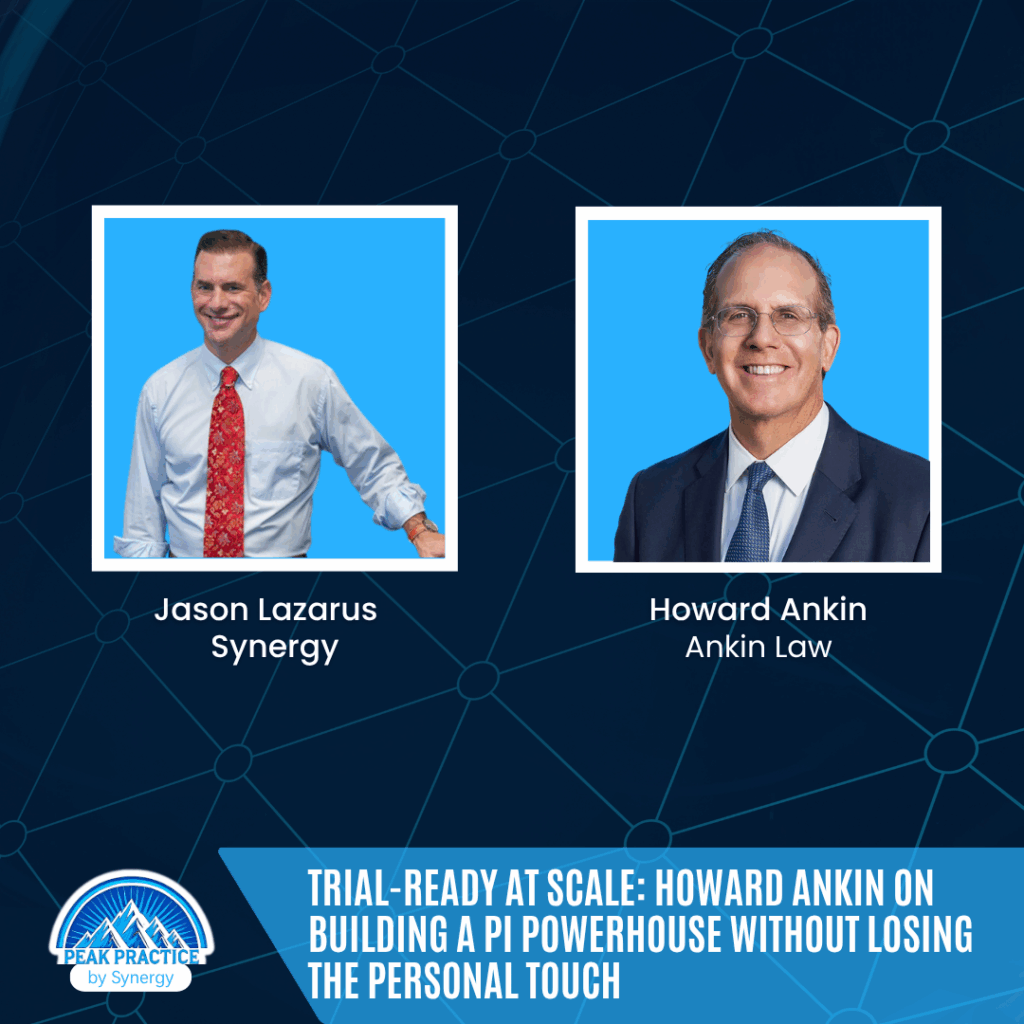
If you want a snapshot of where personal injury practice is headed, look at what it takes to win jury trials with Ankin Law. In Howard Ankin’s shop, that means a real budget for focus groups, purpose-built visuals for every phase, and specialists whose only job is to make the story land for jurors.
In our conversation on Trial Lawyer View by Synergy podcast, we dug into how he built a high-volume personal injury and workers’ compensation firm while keeping a culture that treats clients like family. For innovative trial lawyers who want to grow without giving up craftsmanship, this playbook matters.
🔎 Why scale now
Ankin didn’t scale because of a grand plan. He scaled because the market forced the issue. The 2008 downturn pushed him to build infrastructure that could survive shocks. The next wave came as private equity and national PI brands expanded into local markets. With alternative business structures taking root in places like Arizona and Utah, he sees a future where massive, well-capitalized firms compete in every channel. Capacity and systems are no longer optional. The firms you face tomorrow will have capital, media, and intake engines. Your edge becomes operational excellence paired with an authentic client experience.
🧱 Infrastructure is the hidden advantage
Infrastructure is the quiet driver of outcomes. Ankin describes a constant arms race to integrate the many tools it now takes to run a case from intake to verdict. Nothing arrives in a box that just works. Each tool adds monthly cost and complexity, so the only sane way to decide what to keep is to map the tech stack to the case lifecycle. If a system removes delays between intake, demand, filing, discovery, mediation, and trial, it stays. If it creates friction, it goes. The goal is a stack that helps lawyers do the high-value work while the technology handles the routine.
⚖️ Trial-readiness is a process
Trial-readiness has become a process, not a promise. In Ankin’s firm, every case is focus grouped before trial. Dedicated team members build exhibits so visual communication strengthens oral advocacy. Jurors live on screens and absorb information in snapshots, so demonstratives are not a luxury. Treat focus groups and visuals as baseline case costs. If you do not have an internal exhibit lab, build predictable partnerships so you can move quickly the moment a setting gets real.
🤝 Keep it personal on purpose
Through all the growth, Ankin keeps the work personal by design. His ethos was forged in a family practice where clients called his father’s house. Today, “injury law made personal” means more on-site staff than many competitors and no offshore answering services or paralegal teams. Most of the team works in-office because attention and accountability improve when people share space. If you want clients to feel cared for, define what personal actually looks like at scale. Then hire, train, and measure against those behaviors so the promise shows up in every call, text, and meeting.
🧠 Buy expertise before you need it
Quality control is about buying the right expertise at the right time. Maximizing recovery often turns on spotting the third-path claim and pairing it with a targeted expert. That takes a real budget for consultation fees and, in some cases, a standing relationship with a consultant who can source niche experts on short notice. Build your expert bench early, not after a lowball offer arrives. Treat expert discovery like any other critical path task with timelines, owners, and funding.
🚀 What to do this week
If you want practical next steps, start by auditing your tech stack against the case timeline and cut what does not shorten the distance from intake to resolution. Institutionalize focus groups with clear criteria and calendar them like depositions. Codify your client experience in a short list of observable behaviors and train them until they become muscle memory. Above all, commit to a definition of trial-ready at scale that your entire team understands, from intake specialists to first-chair trial lawyers.
🌄 Why This Matters to the Peak Practice Community
Howard Ankin’s model matters to Peak Practice because it proves you can build real capacity without sacrificing the human touch. His focus on trial-readiness, visual storytelling, and disciplined expert work shows how process and craftsmanship can live side by side. By defining “personal” at scale and funding the tools that move cases faster and smarter, he sets a path for firms that want growth with integrity. This aligns with Peak’s mission to help PI leaders build durable systems, while synergy. removes friction through lien resolution so your team can stay focused on advocacy, outcomes, and long-term client trust.
🎧 Listen to the full podcast conversation on Trial Lawyer View here: https://triallawyerview.com/podcast/howard-ankin/
🔗 Want more insights like this?
If you’re a personal injury lawyer ready to scale, streamline, and step into your role as CEO, let’s talk. Join the Peak Practice Community, and learn how synergy. can help you eliminate settlement bottlenecks, resolve complex liens, and maximize recoveries. Learn more here: https://partnerwithsynergy.com/peak-practice/
If you want to grow and scale your law firm more effectively, consider partnering with Synergy for lien resolution. Learn more at: https://partnerwithsynergy.com/liens/
BLOGS
READY TO SCHEDULE A CONSULTATION?
The Synergy team will work diligently to ensure your case gets the attention it deserves. Contact one of our legal experts and get a professional review of your case today.
